
The eight soccer games kids ask for again are Sharks and Minnows, Piggy in the Middle, Musical Balls, Cops and Robbers, Trick or Treat, Four Goals, Simon Says and Tic-Tac-Toe. Each one runs with cones, a few balls and no long explanation.
They work at team practice and in the backyard, from kindergarten up to about 12. Age changes the setup more than the game: a five-year-old and a ten-year-old can both play Sharks and Minnows, just with a different ball and a different-sized space. Below each game we give the space we'd mark out, then a table to pick by headcount and age.
1. Sharks and Minnows
Sharks and Minnows is a crossing game. The minnows each have a ball and start at one end; one shark stands in the middle without a ball. On "go," the minnows try to dribble to the far end while the shark tries to kick their balls out of the area. Anyone whose ball goes out turns into a shark. Last minnow left wins.

For a backyard we mark out roughly 45 by 30 feet. Our full Sharks and Minnows guide has versions for small groups and older kids.
2. Piggy in the Middle
Piggy in the Middle, also called Monkey in the Middle, is keep-away played with feet. Kids stand in a circle about 15 feet across and pass the ball around while one or two "piggies" in the middle try to win it. Whoever gave the ball away swaps in.
Three kids make it 2v1, and a parent joining makes it 3v1. If you want to see how coaches run the team version, our rondo guide builds it out.
3. Musical Balls
Musical Balls is musical chairs with a ball. Everyone dribbles inside a square about 25 by 25 feet. When you shout "change," each player leaves their ball where it is and dribbles away with a different one.
After the first round, take one ball out. Now somebody is left without a ball on every "change." In the knockout version that player sits out; we prefer having them do five toe taps on a cone and come straight back, so a three-kid backyard game doesn't end in an argument. Our toe tap guide shows the move.
4. Cops and Robbers
In Cops and Robbers, the robbers take balls and stash them in a bank. Mark a small square of cones in the middle of a space around 40 by 40 feet. Cops dribble a ball each around the outside. The robbers, about one for every two cops, start in the bank with nothing.
Robbers try to win a ball and dribble it into the bank, where it has to stop dead. A ball still rolling doesn't count. A cop whose ball ends up in the bank becomes a robber. The last cop with a ball wins. We wear shin guards for this one, because it has the most tackling of the eight.
5. Trick or Treat
Trick or Treat is a cone-collecting race. Mark a square about 15 yards across and stack a pile of spare cones (the treats) on the far line. Kids start on the near line with a ball. When you shout "trick or treat," they dribble across, pick up one cone, dribble back with it, drop it, and go again. Most cones when the pile is empty wins.
A four-year-old can carry the ball in their hands the first time. With one child, time the run and try to beat it.
6. Four Goals
Four Goals is a scoring relay. Set four small goals in a cross, each about 40 feet from the one opposite, with a pile of balls in the center. Split into four teams, one per goal. On the whistle, one player from each team runs in, takes a ball, dribbles back and shoots at their own goal, then tags the next teammate.
Most goals when the balls run out wins. A missed shot means a long walk to fetch it, which is where a goal that sends misses back saves the most time (more on that below).
7. Simon Says
Simon Says needs a ball at every child's feet and an adult calling. "Simon says sole roll." "Simon says dribble to a cone." "Stop!" Anyone who stops on a command without "Simon says" sits out until the next round.
It's the easiest game here to explain to a four-year-old, and kids at that age love catching the adult out. Swap "Simon" for "Coach" if it helps.
8. Tic-Tac-Toe
Soccer Tic-Tac-Toe is a relay onto a 3 x 3 grid of cones. Two teams each get three pinnies in their color. One player at a time runs (or dribbles, for older kids) to the grid, drops a pinny on a square and runs back to tag the next. Once all three pinnies are down, the next player moves one of them. Three in a row wins.

Our soccer tic-tac-toe guide has the full rules and spacing.
Which game should you pick for the kids you have today?
Count heads first. The space and age columns are our suggestions for a backyard, not rules.
| Kids playing | Games from this list | Ages we'd start at | Space we'd use |
|---|---|---|---|
| 1 | Trick or Treat (timed), Simon Says with a parent | 4 and up | About 30 x 30 ft |
| 2 to 3 | Piggy in the Middle, Musical Balls | 4 and up | A 15 ft circle or 25 x 25 ft |
| 4 to 8 | Sharks and Minnows, Cops and Robbers, Tic-Tac-Toe | 5 and up | About 40 x 40 ft |
| 8 or more | Four Goals | 6 and up | About 40 x 40 ft |
A child on their own still has options. In wall ball, kick the ball against a wall, garage door or rebounder and count passes in a row. In soccer golf, lay out five hula hoops or towels around the yard and count kicks to stop the ball inside each one. With two or three kids aged 8 and up, soccer tennis over a knee-high rope or garden bench works well; one bounce and up to three touches a side, play to 11.
Which games suit which age group?
Start with your child's format, because it sets the ball. Formats come from U.S. Soccer's game-format guidance; ball sizes and the U6 numbers from the US Youth Soccer Policy on Players and Playing Rules (December 5, 2025), Rule 303.
| Age group | Game format | Ball | Games we'd start with |
|---|---|---|---|
| U6 | No more than 4 a side, 3 strongly recommended | Size 3 | Simon Says, Trick or Treat, Musical Balls |
| U7 to U8 | 4v4 maximum | Size 3 | Sharks and Minnows, Cops and Robbers |
| U9 to U10 | 7v7 maximum | Size 4 | Four Goals, Piggy in the Middle, Tic-Tac-Toe |
| U11 to U12 | 9v9 maximum | Size 4 | Piggy in the Middle with two-touch limit, soccer tennis |
One change for this season: from 2026-27, US Youth Soccer, US Club Soccer and AYSO form age groups on an August 1 to July 31 cycle (US Youth Soccer, June 10, 2025), so check your child's group before buying a ball. For practice plans built on these formats, see our U6 soccer drills and soccer drills for 8 year olds, and our ball size by age guide covers sizing.
What do you need to play soccer games in the backyard?
A ball sized for the youngest player, a handful of cones, something to shoot at, and a way to keep the ball in the yard. Most of these games assume grass. If you're starting from bare lawn, our guide to building a backyard soccer field covers layout.
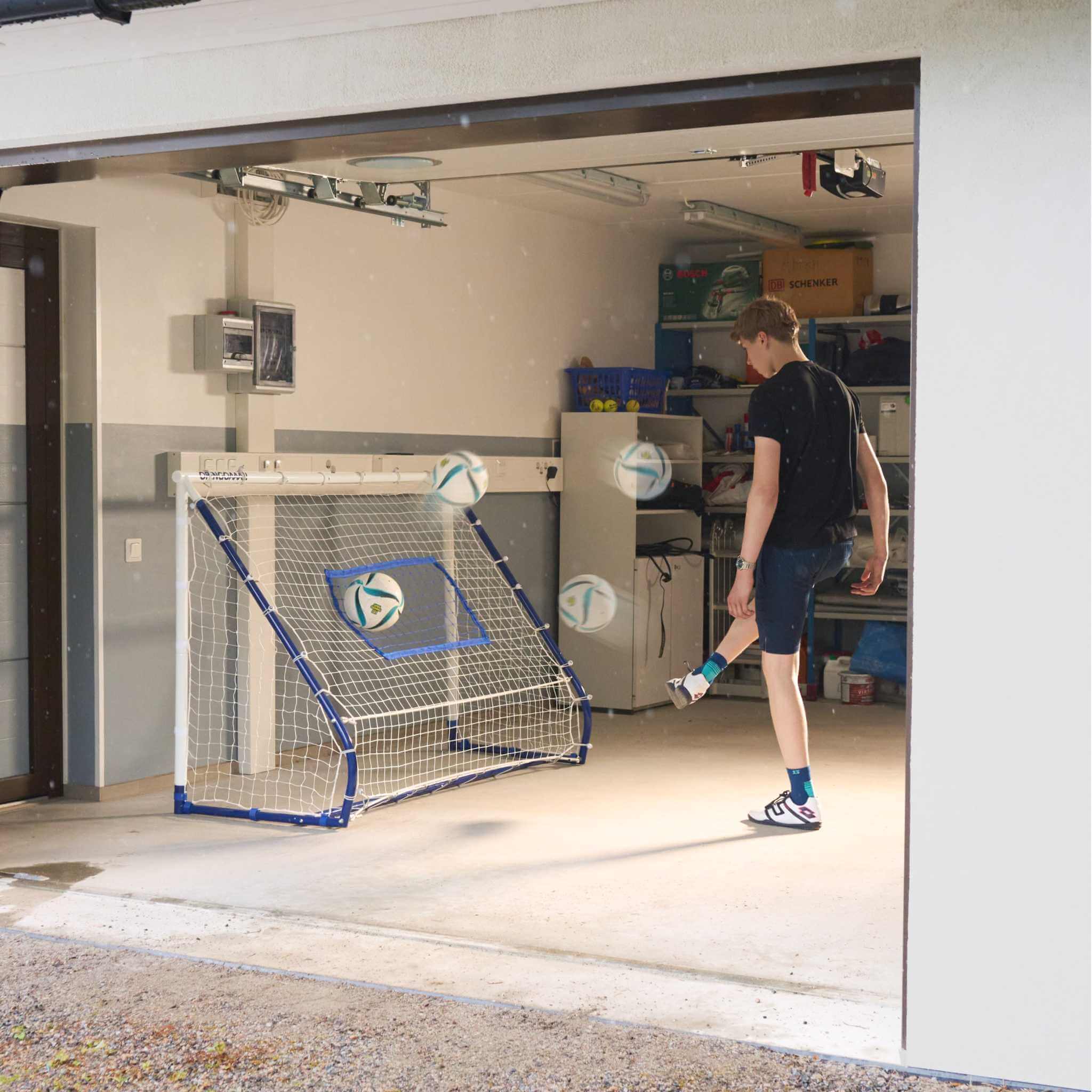
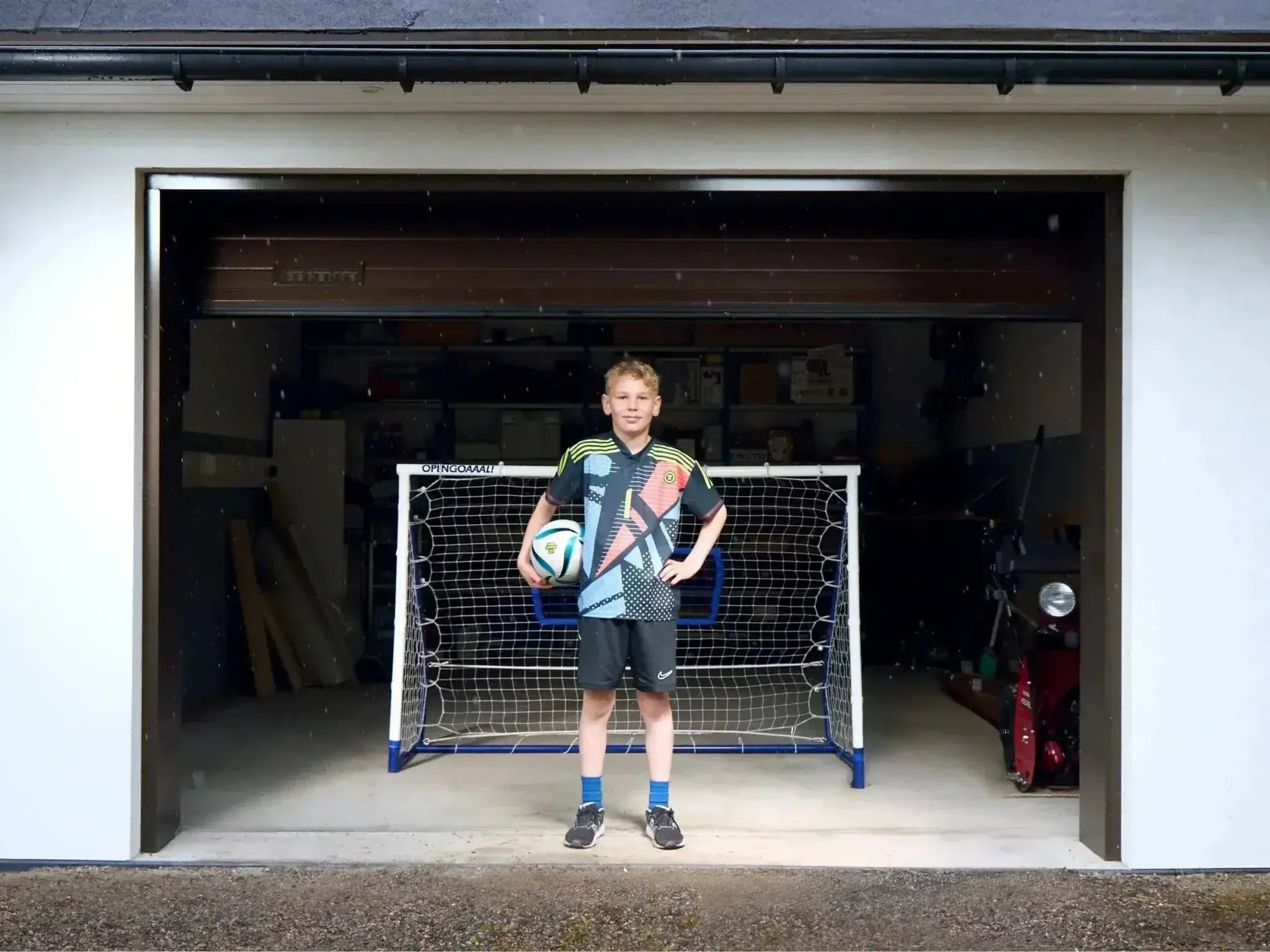
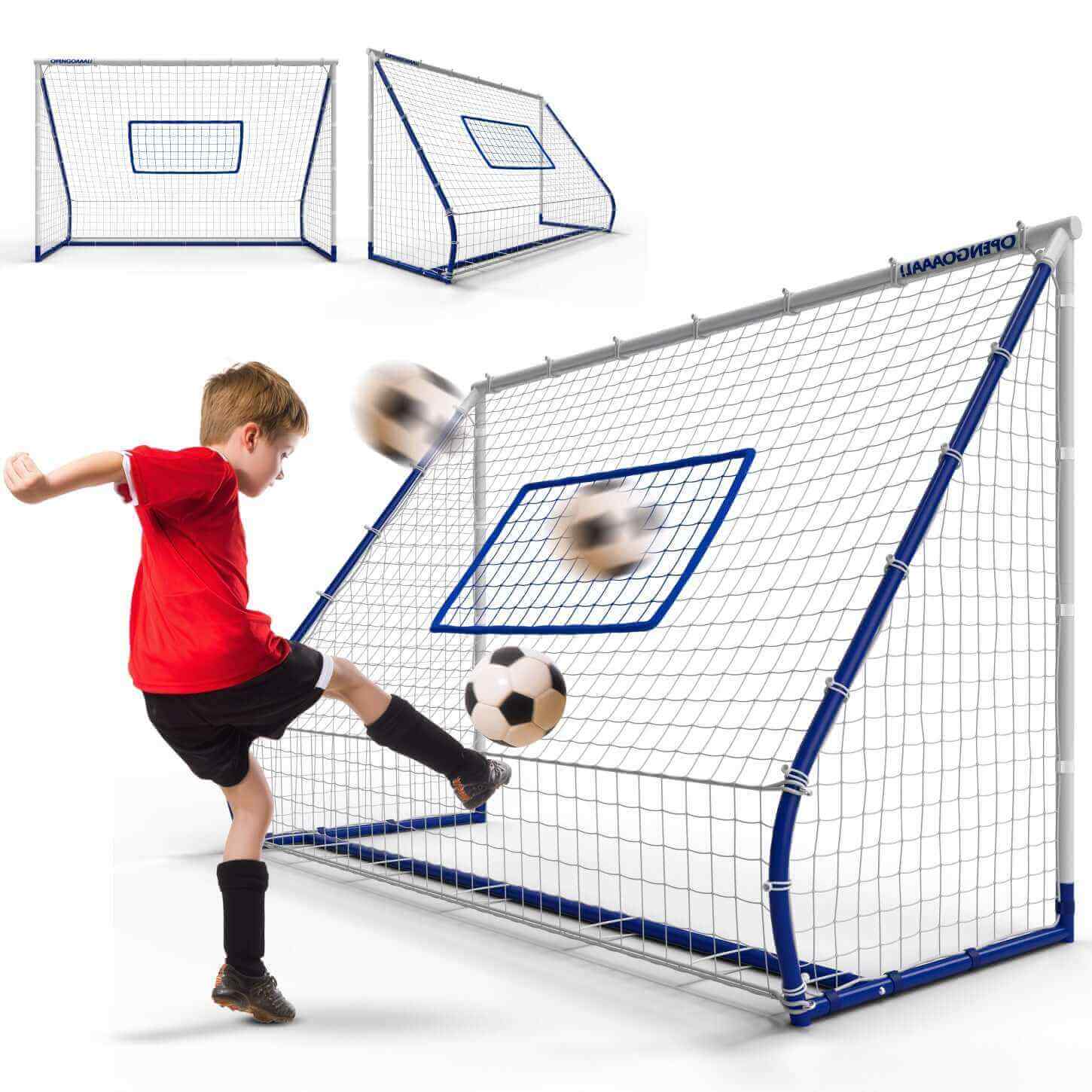
Owners tell us they bought the Open Goaaal® 3-in-1 Soccer Goal Trainer to stop balls going over the fence. It combines a goal, a rebounder and a backstop, so most missed shots come back. The Standard size has a 9 x 5 foot inner goal under a backstop 10 feet tall and up to 21 feet wide, and the width can be set narrower for a tighter yard. It goes up on natural grass with no digging: pole spikes push into the lawn and guy ropes hold it. Plan on about an hour and a half with two people for the first build, using the build video. For smaller yards there's the Junior size, and a corner target turns Four Goals into a points game.
Shin guards are compulsory in a match under Law 4 of IFAB's Laws of the Game, covered by the socks. In the backyard it's your call; we'd wear them for Cops and Robbers.
Questions parents ask about soccer games for kids
What is a good soccer game for a 5-year-old?
We'd start with Simon Says or Trick or Treat. Every child has a ball, nobody is out for long, and you can explain either in one sentence.
Can kids play these games in a small backyard?
Piggy in the Middle and Musical Balls fit in about 25 x 25 feet. We'd take Sharks and Minnows and Four Goals to the park unless your yard is big.
Should kids head the ball in backyard games?
We keep every game on the ground for kids 10 and under. The US Youth Soccer policy (Rule 305) bars players 10 and under from heading in matches and organized team practice.
What is backyard soccer?
It's soccer played at home on your own rules: no set field, no set team size, whoever is around plays. Siblings, cousins and a parent in work shoes all count.
This article is general information, not medical advice, diagnosis or treatment. For a persistent or worsening symptom, or any concern about your health, speak to a qualified healthcare professional.
Final thoughts
The game you pick matters less than having one ready before the kids get bored of deciding, so keep the headcount table handy. When you want something more structured, our week plan for 8-year-olds turns the same yard into a training spot, and our tips on keeping soccer balls in your backyard help with the neighbors.