
The best U12 soccer drills are small-sided games with a clear theme: possession, 1v1 duels, attacking in threes, finishing, playing in lanes, pressing in pairs and moving after the pass. Below are eight of them, each with a setup in yards and the coaching focus, plus a 90-minute practice plan that puts them together for a 9v9 team.
At this age, players can handle a bit more structure and a few rules at once. Drills can ask them to make a decision, not just repeat a technique, and to correct a mistake on the next try. Every drill here starts with a game rule rather than a line of players.
What does U12 soccer look like in the US?
It's 9v9 on a mid-size field. U.S. Soccer's game formats set 9v9 as the maximum for U11 and U12, with 11v11 starting at U13. US Youth Soccer's Policy on Players and Playing Rules (Dec. 5, 2025) uses a size 4 ball (25 to 26 inches around) and two 30-minute halves for 12-and-under games.
Goals are smaller than full size. Eastern Pennsylvania Youth Soccer, a US Youth Soccer state association, lists 7 x 21 feet as the maximum goal for U11 and U12 9v9 (EPYSA field and goal standards), against 8 x 24 feet from 11v11. Check your own league, because local rules can differ.
Heading also changes at this age. The same US Youth Soccer policy (Rule 305) allows players aged 11 and 12 to head the ball in games and practice, but asks coaches to keep any one player to no more than 25 headers a week in practice. Players 10 and under don't head the ball at all in its events. None of the drills below need heading.
8 soccer drills for U12
1. 6v6 target goals
Setup. A 40 by 30 yard area. Two small target goals (or cone gates 2 yards wide) on each end line, and a circle of cones about 10 yards across in the middle. Two teams of six, one ball.

How it runs. A team can score in either of the two goals it attacks, but only after completing a pass that goes into or through the center circle. If the defending team wins the ball, they need their own pass through the circle before attacking.
Objective. Patience in possession. The rule forces players to move the ball across and back to open a gap rather than going long every time. Coach the team without the ball to press together: the nearest player goes to the ball, the next two cut off the easy passes.
2. 1v1 + 1 with neutrals
Setup. A 15 by 15 yard square inside a 30 by 30 yard square. One attacker and one defender inside the small square. Four neutral players, one on each side of the big square.

How it runs. A neutral passes in to the attacker, who tries to receive and pass out to a different neutral. The defender tries to win the ball. The neutral who receives dribbles around the nearest corner cone and plays the next ball in. Change the pair in the middle every 45 seconds.
Objective. Receiving under pressure in a tight space. The attacker needs to check away from the defender before the pass, turn quickly and find the open neutral. Our 1v1 soccer drills go deeper into the duel itself.
3. Front three attack
Setup. Half of a 9v9 field with a full-size 9v9 goal and a goalkeeper. Three defenders. Six attackers: two wingers, a center forward and three midfielders, starting at the halfway line.

How it runs. The coach plays a ball into the midfield. Attackers have 20 seconds to score. The pattern to look for: ball to a winger, winger gets to the end line or the edge of the box, cross or cut-back to a runner. Defenders who win the ball try to dribble it over the halfway line.
Objective. Width and timing. Wingers stay wide to stretch three defenders across the field, and the center forward times the run so they arrive with the cross. A second coach on the defensive side helps. For more patterns, see our soccer attacking drills.
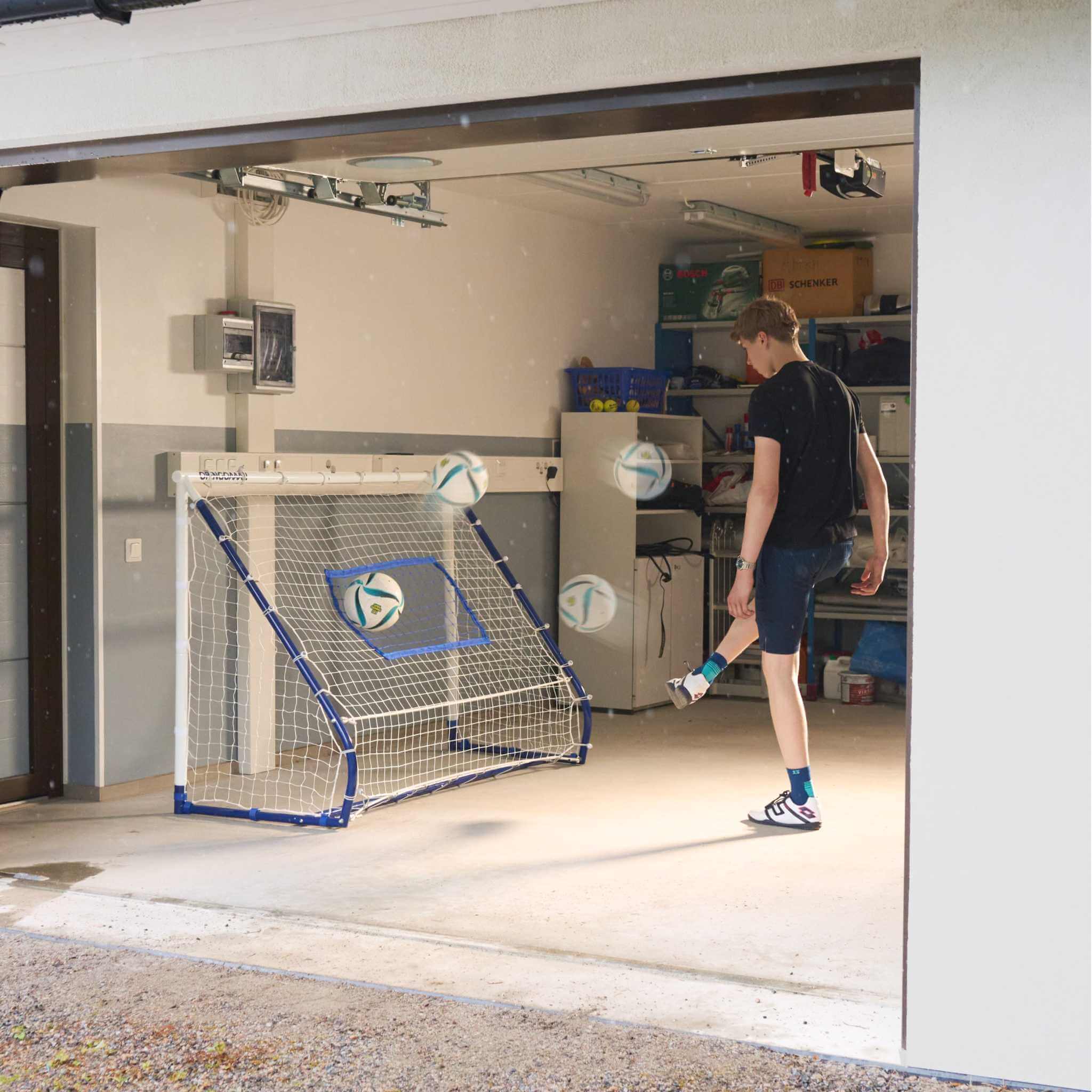
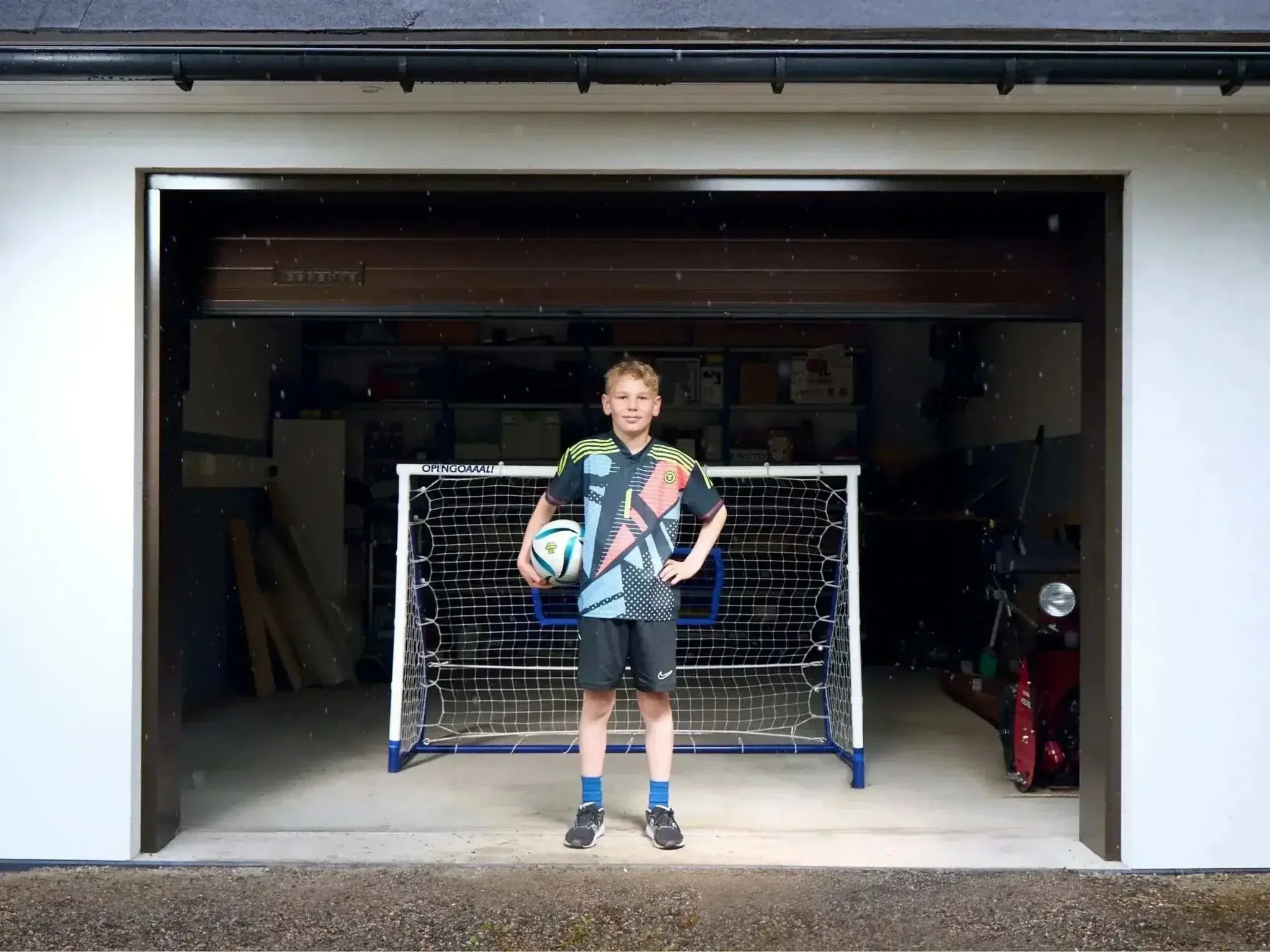
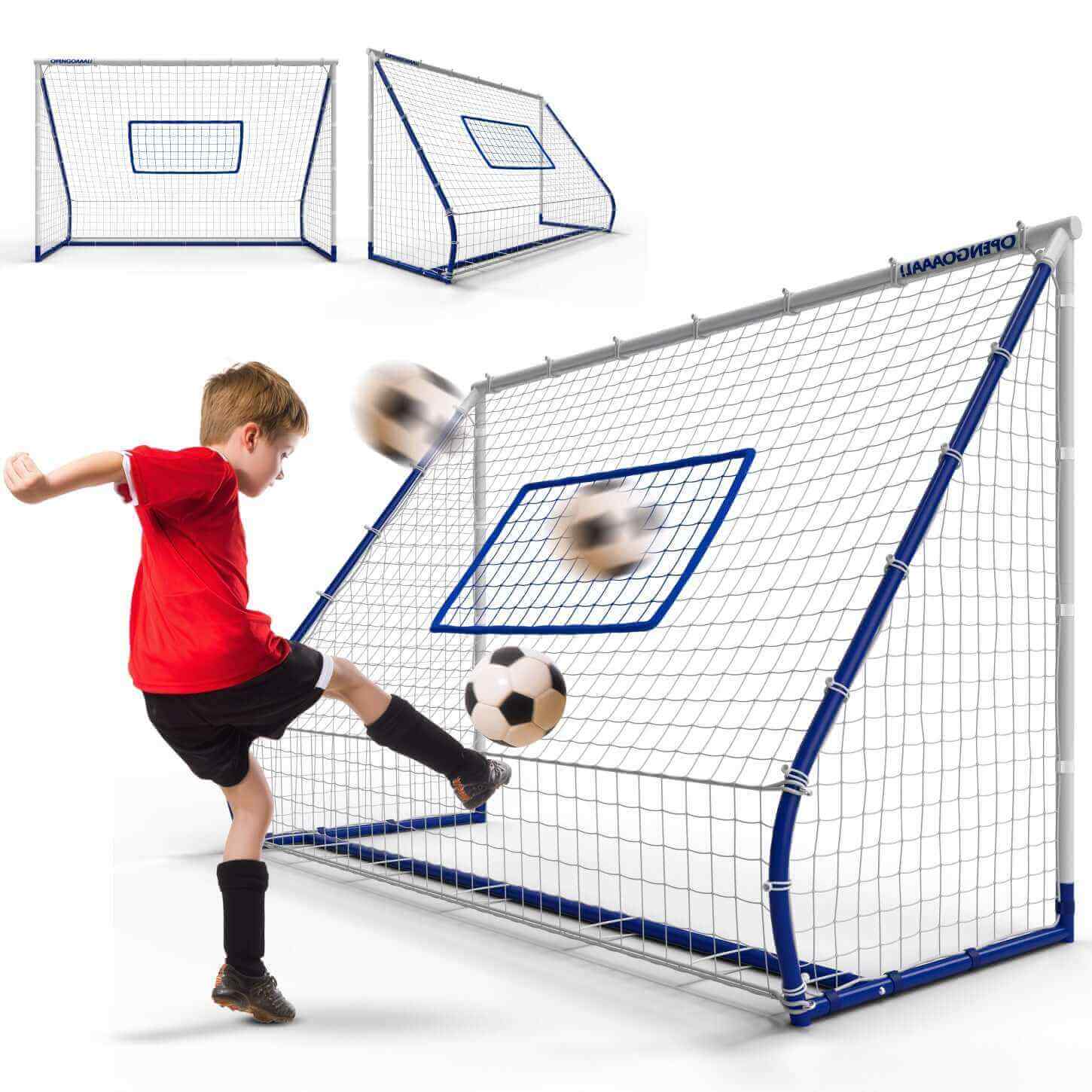
Players who want extra finishing reps at home can practice into a goal of similar height. The Open Goaaal® Large has a 16 x 7 ft inner goal, the same height as a 9v9 goal, inside a backstop 10 ft tall and up to 29 ft wide, with a rebounder that sends most missed shots back.
4. Predator in the penalty area
Setup. A 25 by 25 yard outer square with a 15 by 15 yard inner square. A small goal on two opposite sides of the inner square. Two attackers and two defenders inside. Four to six teammates of the attackers stationed around the outer square.

How it runs. The outside players pass the ball around the outer square until every one of them has touched it, while one defender can step out to try to intercept. Then the last outside player passes into the inner square, and it's 2v2 to goal. Three attacks, then the teams swap.
Objective. Quick passing on the outside, then a fast decision inside. The first attacker to receive in the box should shoot or set up a teammate within two touches.
5. Three lane tactics
Setup. A 50 by 40 yard field split lengthwise into three lanes with cones. Two teams of six or seven, a goal at each end.

How it runs. Each player is assigned to a lane and stays in it. A team must get the ball into all three lanes before it can score. If the other team wins it, play goes on, no stoppage.
Objective. Shape and width. When players hold their lanes, the team covers the whole field, and the ball can be switched from one side to the other. Use it to introduce positional roles. Our youth soccer positions guide explains them for parents.
6. 2v2 battles
Setup. A penalty area with a goal and goalkeeper. Two defenders inside the box, two attackers on the edge of it.

How it runs. The goalkeeper rolls or passes the ball to one of the defenders. The attackers press right away and try to win it and score. The defenders try to play out of the box, by dribble or pass, over the edge of the area.
Objective. When to press and when to cover. The first attacker goes to the ball; the second takes away the pass to the other defender. On the other side, it teaches defenders to play out calmly. Rotate roles every three reps.
7. 2v2 targets
Setup. A 30 by 20 yard area. A target player standing on each end line. Two attackers and two defenders in the middle.

How it runs. The attackers try to work the ball from one end and complete a pass to the target player at the far end. If the defenders win it, they attack the opposite target. A completed pass to the target earns a point, and the target joins in to make it 3v2 for the next ball.
Objective. Patience and support angles. In a 2v2, the player without the ball has to keep moving to give a passing option, and the pair should wait for a gap to open rather than forcing the pass. For bigger keep-away games, try our soccer possession drills or rondo soccer.
8. Pass and move
Setup. A 30 by 30 yard area. Four groups of three in different-colored pinnies. Three or four balls.

How it runs. Players can only pass to a teammate wearing a different color. After passing, the passer runs out of the square, touches the boundary line and comes back in, ready to receive again.
Objective. Scanning and communication. Players coming back in have to look around and call for the ball by color or name. It also works well as a warm-up. Our soccer passing drills have simpler versions for younger groups.
What does a 90-minute U12 practice plan look like?
Start with a game, teach in the middle, finish with a game. That's the shape U.S. Soccer recommends in its Play-Practice-Play model (Feb. 2018), where the coach guides with minimal talking during the play phases. Here's how we'd put the drills above into one session for a squad of 12 to 14. The timings are ours.
| Minutes | Phase | Activity | Theme |
|---|---|---|---|
| 0 to 10 | Arrival and warm-up | Pass and move (drill 8) | Scanning, moving after the pass |
| 10 to 25 | Play | 6v6 target goals (drill 1) | Possession |
| 25 to 40 | Practice | 1v1 + 1 with neutrals (drill 2) | Receiving under pressure |
| 40 to 55 | Practice | Front three attack (drill 3) or Predator (drill 4) | Finishing |
| 55 to 60 | Water break | ||
| 60 to 85 | Play again | Three lane tactics (drill 5), then free 7v7 or 9v9 | Shape and width |
| 85 to 90 | Cool-down | Light jogging, quick team talk | One thing from today |
Swap the themes week to week. A defending week might run 2v2 battles and 2v2 targets instead of the attacking drills. For quick switches between attack and defense, add one of our soccer transition drills.
FAQ
What formation should U12 teams play?
With 9v9, common shapes are a 3-2-3 or a 2-3-2-1 (plus goalkeeper). The format matters less than keeping width and giving players time in different positions. For the full-size game they move to at U13, see our soccer formations for 11v11.
How long should a U12 practice be?
We'd plan 75 to 90 minutes for a travel or club session and about an hour for rec. Past that, the quality of the last drill usually drops off.
What ball size do U12 players use?
Size 4, per US Youth Soccer's rules for 12U and under. They move to size 5 at 13U.
Can U12 players head the ball?
Under US Youth Soccer rules, yes, with practice limited to 25 headers per player per week. Check your league's own rule.
Final thoughts
U12 is the last season before full 11v11, so it's a good time for players to learn what their position asks of them, to talk on the field and to keep the ball when a quick shot isn't on. Build each practice around one theme, keep the games small and let players work out the answers before you give them.
This article is general information, not medical advice, diagnosis or treatment. For a persistent or worsening symptom, or any concern about your health, speak to a qualified healthcare professional.
For extra reps between team practices, the 3-in-1 Soccer Goal Trainer keeps backyard finishing sessions going, because the ball comes back after a miss.