
A good 1v1 soccer drill puts one attacker against one defender in a small space, gives both of them a clear way to win, and rotates fast enough that nobody stands in line for long. The ten drills below run from U6 to high school, and you scale each one by changing the grid size and the number of goals.
Watch any youth game and you'll count dozens of 1v1 moments: a winger running at a fullback, a striker trying to turn a center back, a defender stepping up to a dribbler. These drills recreate those moments with cones, balls and a few small goals. Several also work in a backyard with a parent playing defender, and we've noted how.
How should you set up 1v1 drills for each age group?
Size the grid to the game your players play on the weekend. U.S. Soccer's game formats cap U7 and U8 at 4v4, U9 and U10 at 7v7, and U11 and U12 at 9v9, with 11v11 from U13. A 1v1 grid should feel like a slice of that field, small enough that the defender can get there and big enough that the attacker has a real choice.
Check rosters before you plan by age this fall. US Youth Soccer, AYSO and US Club Soccer are moving to an August 1 to July 31 age-group cycle starting with the 2026-27 season, to line players up with their school grade (US Youth Soccer, June 10, 2025), so a team that was U10 in the spring may have reshuffled.
| Age group | Weekend format (max) | Suggested 1v1 grid | Drills to start with |
|---|---|---|---|
| U6 to U8 | 4v4 | 10 x 15 yards | 1v1 4 Goal, Mini Game |
| U9 and U10 | 7v7 | 15 x 20 yards | The Numbers Game, It's a Knockout |
| U11 and U12 | 9v9 | 20 x 25 yards | Goals from Chaos, In the Zone |
| U13 and up | 11v11 | 20 x 30 yards | Attack and Defend, Ultimate Transition |
The formats come from U.S. Soccer. The grid sizes are our own starting points, not a rule, so shrink the grid if defenders never win the ball and stretch it if attackers never get past.
1. The Numbers Game
This is a race followed by a duel. Two teams line up along opposite sides of a 20 x 25 yard grid, with a small goal at each end. Number the players on each team from one up, so every number has a match on the other side. You call a number and roll a ball into the middle, and the two players with that number sprint in and play until someone scores or the ball leaves the grid.

Nobody arrives set, which is the point. Game 1v1s rarely start with both players balanced. Once it gets easy, call two numbers for a 2v2.
2. 1v1 4 Goal
Put four small goals around a square, one per side, with a defender in each and an attacker in the middle. The attacker picks a goal and goes. After scoring, they return to the middle and attack a different goal; if a defender wins the ball, the two trade places. Keep a running count of each player's goals.

Four targets mean the attacker always has somewhere else to go, so it suits U6 and U8 players who are just learning to look up. Our U6 soccer drills have more games at this level.
3. Mini Game
Set out as many small fields as you have pairs, each roughly 10 x 15 yards with a cone goal at both ends. The attacker starts with the ball and tries to dribble through the far goal. The moment the defender wins it, they become the attacker and go the other way.

Tell attackers to keep the ball within a step and to use a move to make the defender commit before they speed past. Our guide to soccer moves has a list to choose from. At home, this is the simplest version to run: a parent defends a cone gate, the kid attacks it, and you switch after five tries.
4. Goals from Chaos
Mark a 25 x 25 yard square and build two small cone goals on each side, eight in all. Split the group into four lines, one per side. The first player in line 1 passes to the first player in line 2, and those two play 1v1, each attacking the pair of goals in front of them. Lines 3 and 4 start at the same moment going the other way.

With two games crossing through the middle, players have to keep their heads up or run into someone. That traffic is what makes it a good drill for U11 and U12.
5. 1v1 Madness
Use a 35 x 25 yard grid with three small goals at each end and pair everyone up with one ball per pair. On the whistle, every pair plays at the same time for two minutes, each player defending one end. A ball that goes out restarts with the other player dribbling in. Switch partners every round so the same two kids aren't matched all night.

Two minutes is a long time for a 1v1. Expect tired legs by the third round, and give a short break between them.
6. It's a Knockout
Build a 20 x 20 yard grid with a small goal in each corner and a team lined up behind each goal. You roll a ball in, and the first player from every line runs in to play 1v1v1v1, scoring in any goal except their own. When a player's goal is scored on, they're out and go to the back of their line. Roll in a fresh ball for the three still standing, and keep going until one is left.

Kids love the elimination, and it teaches a defender to protect their own goal while still looking for a chance to attack someone else's.
7. In the Zone
Place two small goals about 10 yards apart, facing the same direction, and mark an end zone 5 yards in front of them. Defenders line up between the goals. Attackers line up 20 yards out, each with a ball. On your whistle, the attacker dribbles forward and the defender steps out to meet them. The attacker must reach the end zone before shooting at either goal, and the defender wins by keeping them out of it.

Because the defender starts close to goal, they learn to approach under control instead of charging. For a parent at home, the end zone can be the last few yards in front of the backyard goal.
8. Attack and Defend
Run this one inside the 18-yard box with a goalkeeper. Player 1 passes to player 2, then steps out to defend them 1v1. When the attack ends with a goal, a save or a turnover, a server feeds the next ball and everyone rotates one spot. Teams alternate between attacking and defending each round.

Your keeper gets a steady stream of real shots from close range, which makes this a useful drill to pair with goalkeeper work.
9. 1v1 Practice
Two teams, two goals, and a target of ten goals. Players attack one at a time against a defender from the other team; as soon as an attack ends, the attacker turns and defends the next player coming at them. Add goalkeepers if you have them, and mark off a smaller box when attackers start winning too easily.

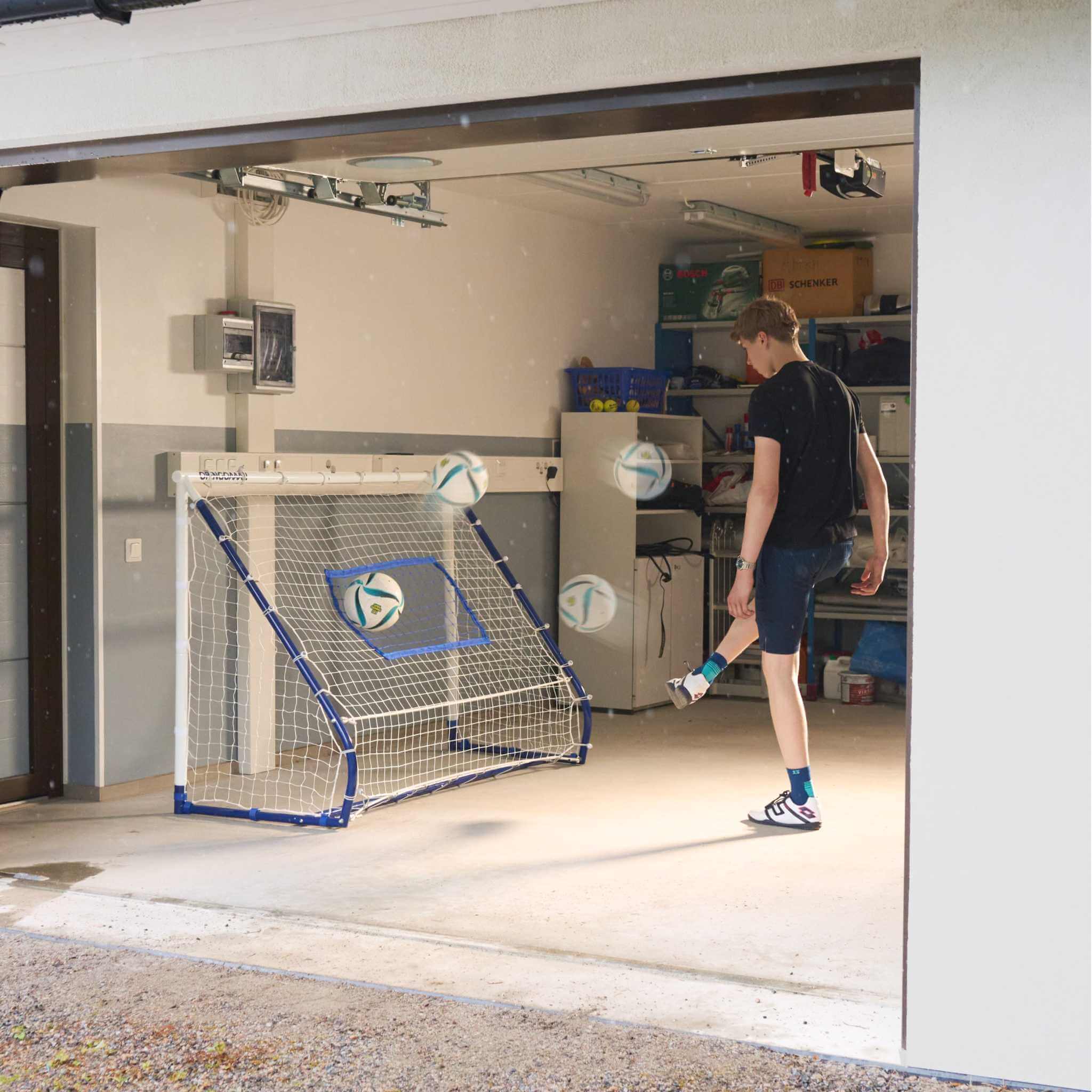
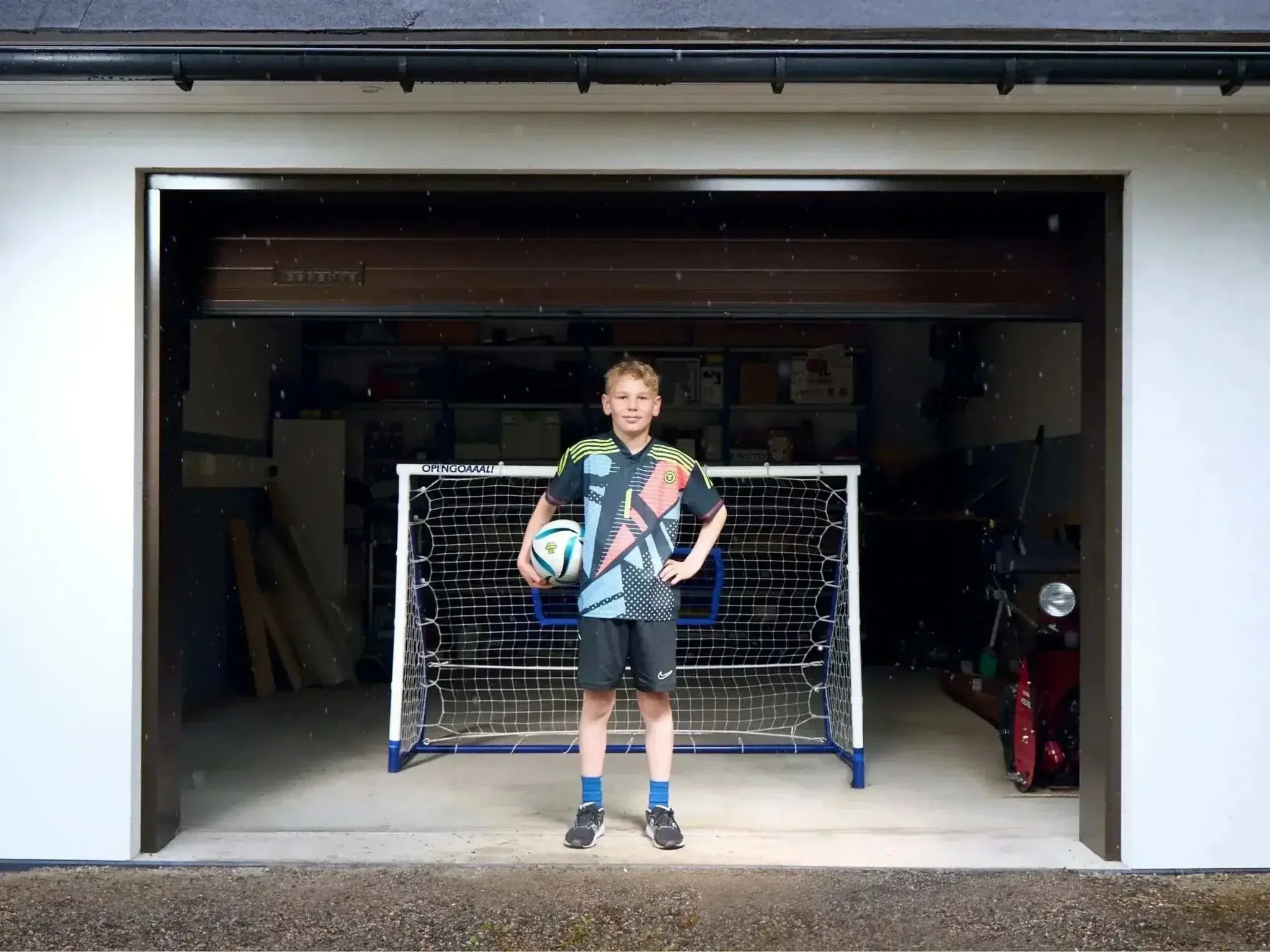
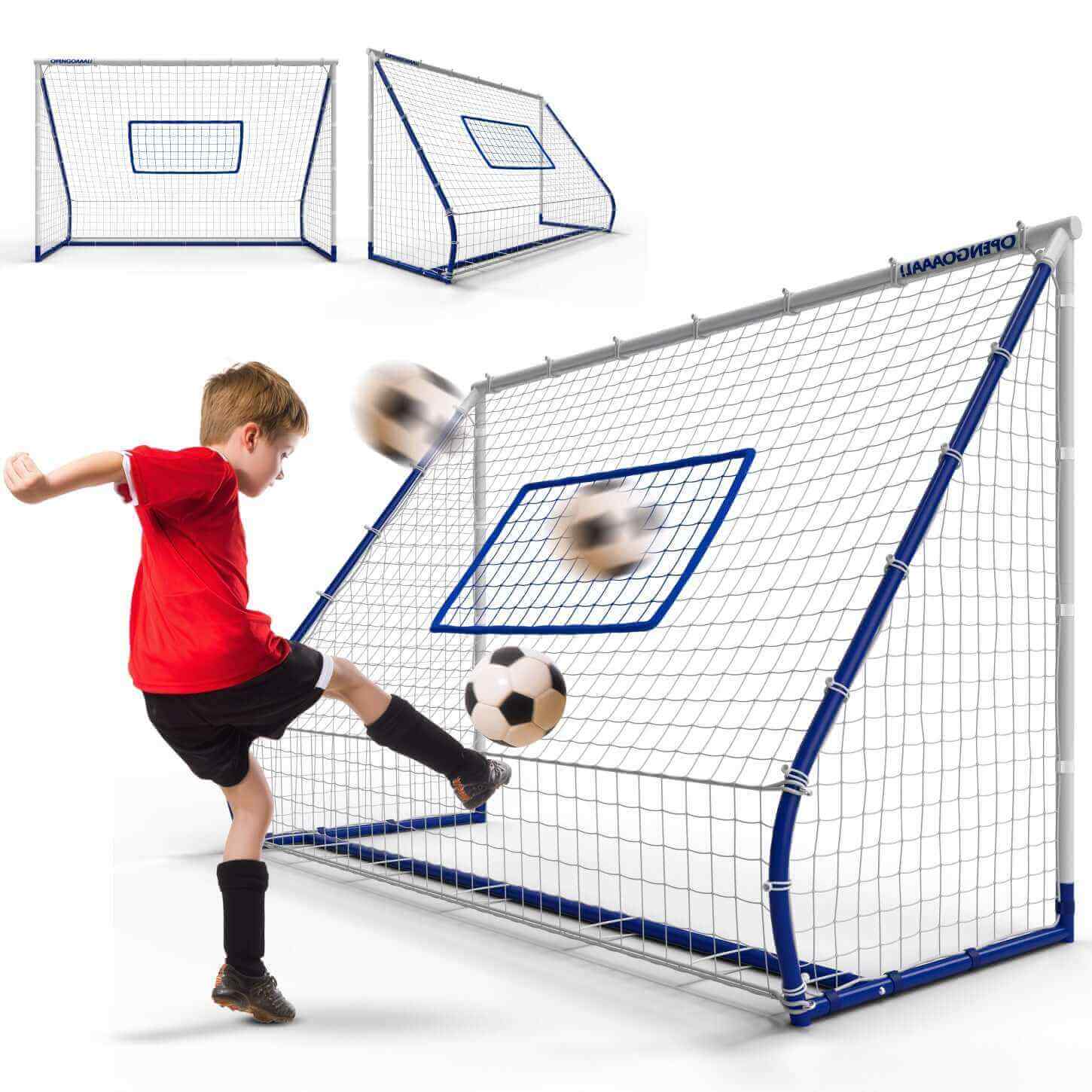
This is the drill that translates most directly to the backyard. A parent defends, the player attacks the goal, and you swap roles every five reps. The Open Goaaal® 3-in-1 Soccer Goal Trainer is a goal, rebounder and backstop in one, so most missed shots come back and the next rep starts sooner. The Standard size has a 9 x 5 foot inner goal and a backstop 10 feet tall and up to 21 feet wide, which can be set narrower if your yard is tight. It goes on natural grass, and the first setup takes two people about 1.5 hours with the build video.
10. Ultimate Transition
Set up four cone gates, two red and two blue, and put the teams in pinnies that match. A blue player dribbles in and tries to get through a blue gate while a red player closes them down. If red wins the ball, red attacks a red gate and blue has to recover and defend. A ball that leaves the area is dead, and the next pair goes.

For attackers, the cues are to keep the ball close, disguise which gate they're going for, and change pace when they go. Defenders should close down fast, slow their last few steps, get side-on and push the attacker wide. Our soccer transition drills build on the same switch from attack to defense.
How do you win a 1v1 as a defender, and when should an attacker shield?
Defenders win most 1v1s by arriving under control. Sprint to close the space, slow down over the last couple of yards, bend the knees, stand side-on and show the attacker toward the sideline, then wait for a heavy touch. Our page on soccer defense positions covers the body shape.
Attackers who can't get past have another option, which is to shield. Under IFAB Law 12, a player may shield the ball by taking a position between an opponent and the ball, as long as the ball is within playing distance and the opponent isn't held off with the arms or body. Add a shielding round to any drill above: the attacker scores a point for keeping the ball for five seconds. Our soccer shielding guide goes further, and if your attackers are getting cheeky, the nutmeg is one more way through.
1v1 soccer drill FAQs
What does 1v1 mean in soccer?
One attacker against one defender, either in a drill or in a game moment where a player has to beat the opponent in front of them without help.
How long should a 1v1 rep last?
Short. Most reps end in under 30 seconds, and rest between reps should be at least as long as the rep itself so the next one is played at full speed.
How big should a 1v1 grid be?
About 10 x 15 yards for U6 to U8 and up to around 20 x 30 yards for teenagers. Those are our starting points; adjust until both players win sometimes.
Can you practice 1v1 at home?
Yes, with a second person. Mini Game, In the Zone and 1v1 Practice all work with a parent or sibling as the defender and a single goal.
Final thoughts
Pick one drill per practice, size the grid to the age group, and keep the lines short so every player gets plenty of turns as both attacker and defender. If you're coaching a younger group, our drills for 8-year-olds and U12 drills pair well with these, and if practice is moving to the backyard, our soccer goals give the attacker something real to finish on.