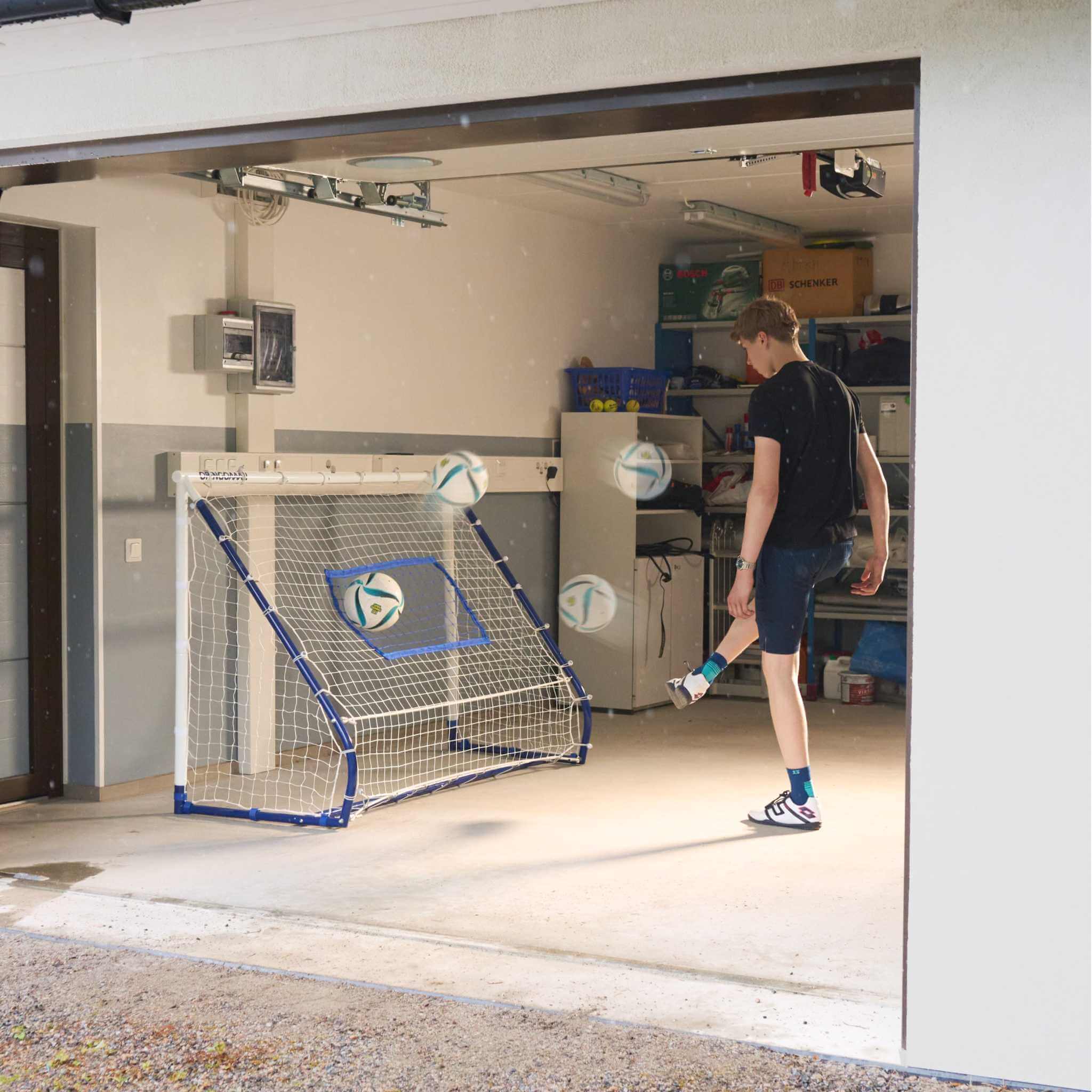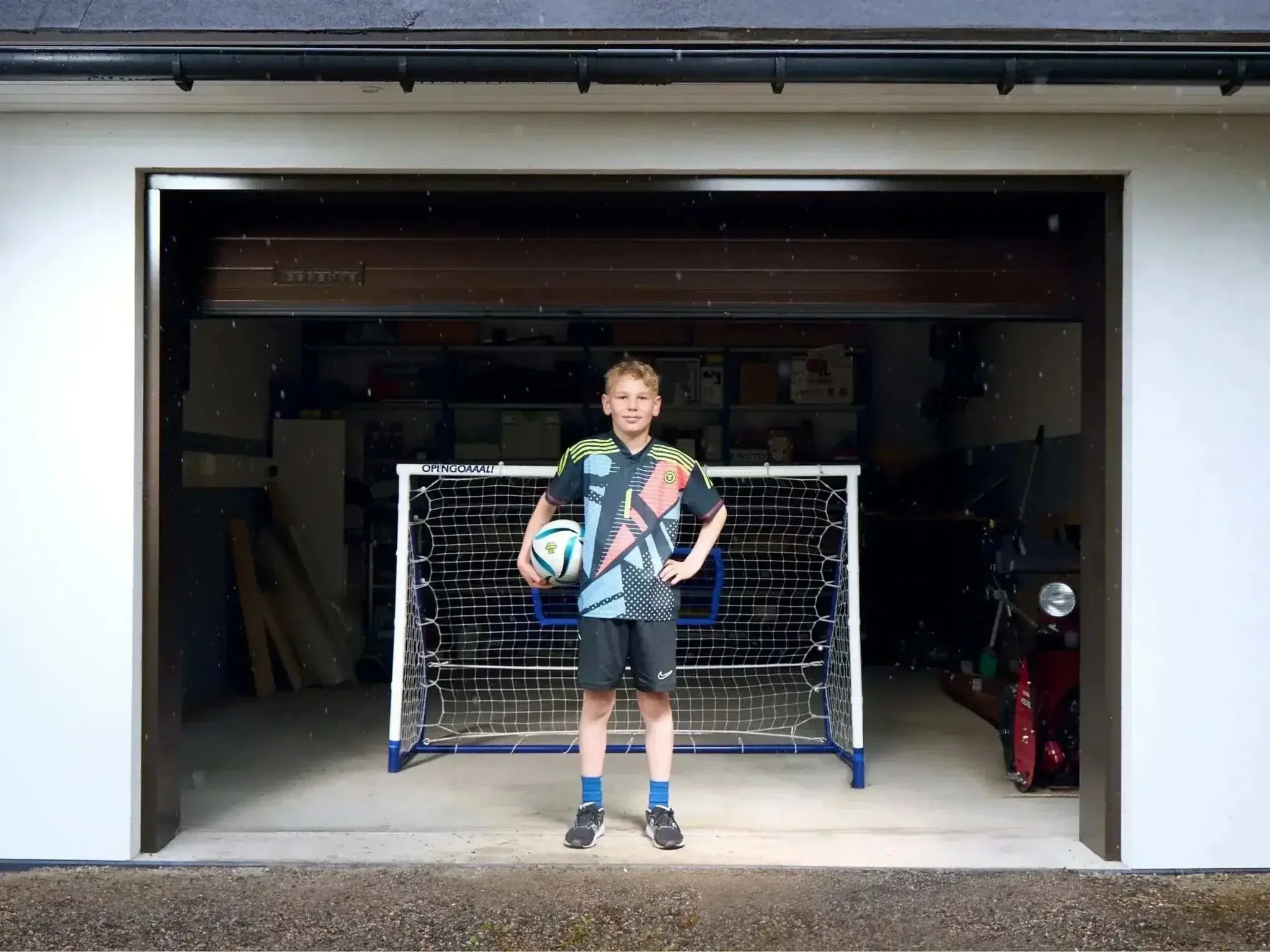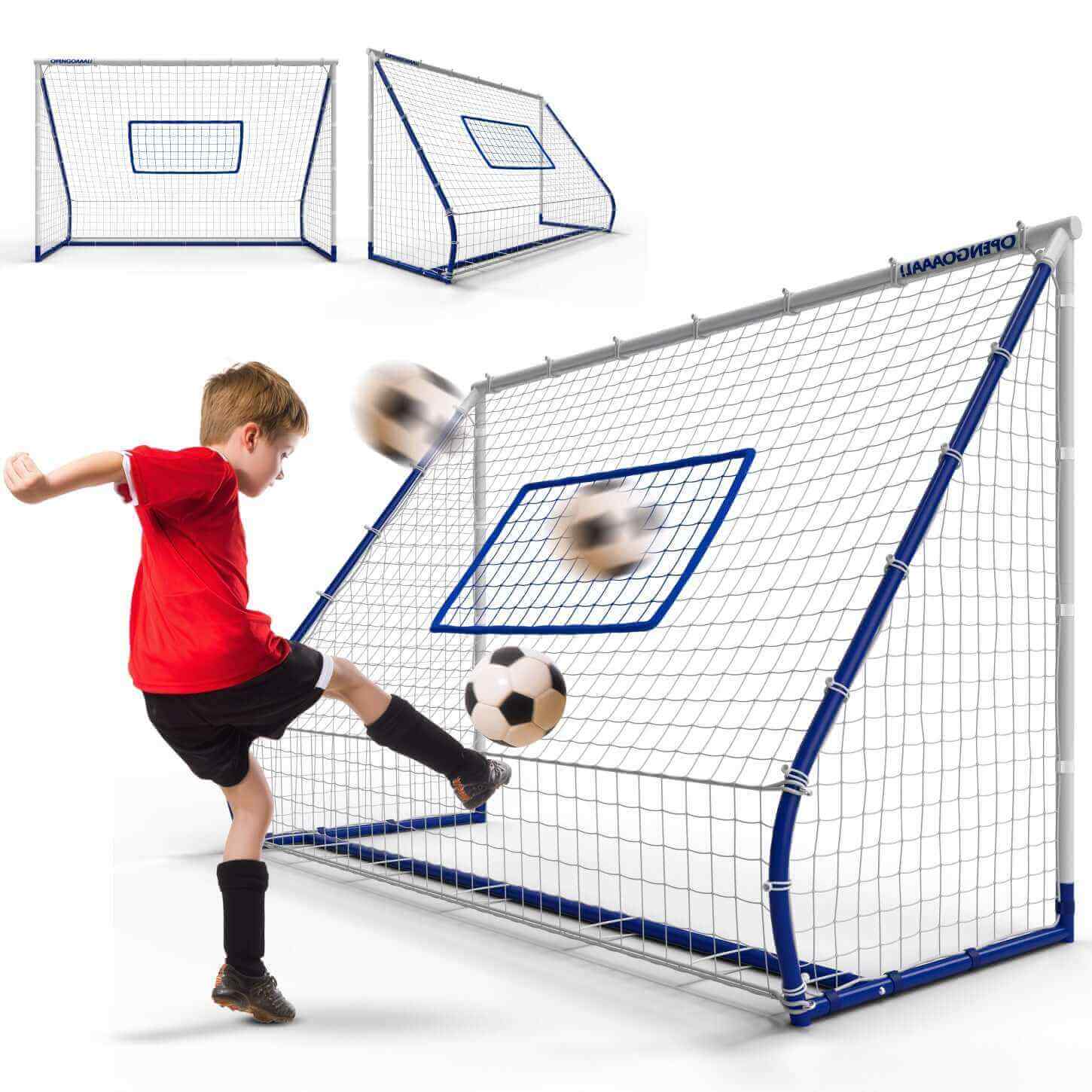

A soccer rebounder is a tensioned net or a solid board that sends the ball back after you pass or shoot into it. It stands in for a passing partner, so a player can get passing, receiving and shooting reps alone, and it saves the walk to fetch every ball.
What is a soccer rebounder, exactly?
Any surface built to return a soccer ball in a predictable way. A garage door or a brick wall will send a ball back too, but the bounce depends on where it hits and what it hits, and some of those surfaces don't take kindly to a size 5 ball at full power. A rebounder is made for the job.
You'll see four broad kinds:
- Net rebounders on a frame. A net stretched tight across a metal or plastic frame. Many tilt, so you can set the return along the ground or up in the air.
- Rebound boards and walls. A solid board of wood, plastic or composite, usually low to the ground. Good for ground passes and first touch, less so for shots in the air.
- Multi-sport rebounders. Smaller nets sold for several ball sports. Fine for a young child's passing, but check the frame before anyone strikes a ball hard at it.
- Rebounders built into a goal. A goal with a rebound net around it, sometimes with a backstop as well. You get a target to shoot at and the ball back when you miss.
How does a soccer rebounder work?
The net stretches when the ball hits it, then springs back and pushes the ball out again. A board does the same job by being hard. What you get back depends on how the rebounder is set up and on the pass you play into it.

Tension matters most on a net. Tight, and the ball comes back quick and flat, which is what you want for passing and receiving. Slacker nets return it slower, and that's easier for a six-year-old to stop.
Then there's the angle. Upright, a ground pass comes back along the ground; tilt the frame back and the ball pops up, so a player can control it on the thigh or chest, or volley it. And the pass itself counts: firm to the middle comes back firm, soft comes back soft, and a ball off the edge of the frame goes anywhere (aim for the middle).
One rule to know before you tilt the frame back for a young child: US Youth Soccer's Policy on Players and Playing Rules (December 2025), Rule 305, says players 10 and under don't head the ball in games or practice it in an organized team setting. For that age group, use the air setting for chest and thigh control, not headers.
What is a soccer rebounder good for?
Repetitions without a partner. Every pass that comes back is another touch, and less of the session goes on fetching the ball.
Most of the time it's passing and receiving: pass, take a touch, pass again, with both feet and both sides of each foot. U.S. Soccer's U7-U8 guide introduces short passing and receiving at that age, and that's the exact rep a rebounder hands back. Our first-touch drills for youth players have plenty to run against it. Once that's comfortable, try one-touch: no stopping the ball, play it straight back, and step further away to make it harder.
Tilt the frame and it becomes control in the air, chest or thigh the ball down and pass it back. Shooting only makes sense on a rebounder built to take it, or one with a goal in front. Goalkeepers can use it too, catching returns from a few yards out. That won't replace a shooter, but it adds catches on a night when nobody else is around.
For drills to run on one, see our five ways to use a soccer rebounder.
Why does a rebounder suit backyard practice?
Because the yard is where the ball-chasing problem is worst. On a field, a missed pass rolls into open grass. At home, it ends up under a hedge, in a flower bed or over the fence. A rebounder sends good passes back, so most of the session stays in one spot.
It also fits a small space. A passing rebounder needs a strip of flat ground in front of it, and a player can stand anywhere from a couple of yards away for quick touches to 10 or more for longer passes. U.S. Soccer's U9-U10 guide puts passing and shooting at mid-range distances of 20 yards at most for that age, so most yards cover the range a young player needs.
The weakness of a plain rebounder at home is the miss. A pass that's off target goes past it, and a shot that misses a small net goes wherever it was going. That's the gap a backstop closes.
How do you choose a soccer rebounder?
Start with what the player will do most, then check the build. We'd go through it in this order:
| Question | What to look for |
|---|---|
| Mostly passing and first touch? | A tight net or a board, low to the ground. Wider is more forgiving for younger players. |
| Shooting too? | A larger net that can take a hard strike, ideally with a goal and backstop so misses are caught. |
| Air balls wanted? | An adjustable angle. Check how the angle locks. |
| Frame | Metal if there will be hard shots. A light frame can shift when it's hit hard, so check how it's weighted or staked. |
| Staying outdoors? | Weather-resistant netting and frame finish, plus a way to secure it to the ground. |
| Space | Measure the flat strip in front of it as well as the footprint. |
If you're comparing specific models, our guide to soccer rebounders goes through the options, and the lacrosse goal vs rebounder piece helps if you're choosing between sports.
What about the Open Goaaal 3-in-1 as a rebounder?
The Open Goaaal® 3-in-1 Soccer Goal Trainer is a goal, a rebounder and a backstop in one patented frame. The rebound net returns passes and most missed shots, and the backstop catches the wide and high ones. So the ball comes back, and practice keeps going without anyone walking to the fence.

It comes in four sizes, each with an inner goal and a backstop around it:
| Size | Inner goal (W x H) | Backstop |
|---|---|---|
| Junior | 8 x 4.5 ft | 8 ft tall, up to 16 ft wide |
| Standard | 9 x 5 ft | 10 ft tall, up to 21 ft wide |
| Large | 16 x 7 ft | 10 ft tall, up to 29 ft wide |
| Regulation | 24 x 8 ft | 13 ft 3 in tall x 37 ft wide |
The Regulation inner goal matches the full-size 8 yards by 8 feet in IFAB Law 1. The Standard and Large can be set narrower if your yard is tight, and the Junior is the smallest footprint of the four. All four are made for natural grass. Junior, Standard and Large need no digging (pole spikes push into the grass and guy ropes hold it), while the Regulation uses spiral anchors. The first setup takes about 1.5 hours with two people, and the poles are steel with a 1-year warranty. Build videos are on the Standard and Large build page and the Junior build page.
It's a bigger piece of equipment than a passing board, and it needs grass. If you only want first-touch reps on a patio, a board is the simpler buy. If shooting is part of the plan and the ball keeps ending up next door, the 3-in-1 covers both. All sizes are in the soccer goals collection.
Soccer rebounder FAQs
Is a rebounder better than kicking against a wall?
For most families, yes. The return is more predictable, and you're not hitting the house. A wall costs nothing, though, so it's a fine place to start.
What size rebounder does a kid need?
For passing, wider is more forgiving at younger ages. For shooting, match the goal to the yard first, then to the player. Our goal sizes by age guide lists the official youth sizes.
Can a rebounder be used for heading practice?
Not for players 10 and under under US Youth Soccer's Rule 305. For older players, U.S. Soccer's U11-U12 guide has no heading at U11 and limits at U12.
Can a rebounder stay outside all year?
Depends on the model. Look for weather-resistant netting and a frame that can be secured to the ground, and check the maker's instructions.
Is a soccer rebounder worth it for a young player?
If your player practices at home, it's the simplest way to turn 20 minutes in the yard into 20 minutes of touches instead of ten minutes of fetching. Decide first whether you need passing only or shooting too, because that settles the type. Then start with a few drills from our backyard soccer training guide.