
A regulation soccer goal is 8 feet high and 24 feet wide, measured inside the frame. That's the size in the IFAB Laws of the Game, Law 1, and US college and high school soccer use the same opening. Youth, beach and indoor games are where the numbers change.

So "regulation" depends on who's playing. A 7-year-old's league goal is a fraction of the full-size one, and the goal grows three times on the way to 11v11. Below we go level by level, from the pros to U8, and then look at what actually fits in a backyard.
What is the official goal size under the Laws of the Game?
8 yards (24 feet) between the inside of the posts and 8 feet from the ground to the lower edge of the crossbar. Law 1 gives it as 7.32 m by 2.44 m. The posts and crossbar must be white, the same width and depth as each other, and no more than 5 inches (12 cm) across. They can be square, rectangular, round, elliptical or a mix of those shapes.
Two more lines in Law 1 matter off the pro field. Goals, portable ones included, must be firmly secured to the ground, and nets are optional; where they're used they have to be properly supported and stay out of the keeper's way. When a product listing says "regulation" or "full size", 8 x 24 is what it should mean.
What size goal does NCAA college soccer use?
The same 8 x 24. The 2026 and 2027 NCAA Men's and Women's Soccer Rules (Rule 1.9) put the posts 8 yards apart, inside measurement, with the crossbar's lower edge 8 feet up.
College is stricter than the Laws in a few places. Posts and crossbar must be between 4 and 5 inches wide, the back edge of each post lines up with the outer edge of the goal line, and only a single manufacturer's logo is allowed on the frame. Nets are required, not optional, and the top of the net should run back level with the crossbar for about 2 feet. The rule also says the goals shall be anchored, secured or counterweighted.
What size goal does high school soccer use?
High school plays on the same full-size opening. The NFHS 2024-25 soccer guide, which lines up NCAA, high school and IFAB rules topic by topic, lists no difference in goal size; its goal rows cover nets, padding and post placement.
Three details differ. Nets are mandatory in high school, as in college. The rear of each post sits on the outer edge of the goal line. And high school is the one code of the three that lets a white, commercially made pad go on the uprights, at least 72 inches tall and no more than an inch thick. The guide also notes that state associations can modify rules for their own state, so check yours if a field looks different. Our guide to soccer nets covers the net side.
How big is a beach soccer goal?
About 18 feet wide and 7 feet 2 inches high. FIFA's Beach Soccer Laws of the Game (2022-23 edition) set it at 5.5 m between the posts and 2.2 m to the crossbar, inside measurement. That's 6 feet narrower than a full-size goal and about 9 inches lower, on a surface where a keeper pushes off sand.
How big is a futsal goal?
About 9 feet 10 inches wide and 6 feet 7 inches high. The FIFA Futsal Laws of the Game 2025-26 give 3 m between the posts and 2 m from the crossbar to the floor, with posts 8 cm wide. Futsal is played on a hard indoor court, so those goals are a different product from anything you'd stake into a lawn.
What size goal does each US youth age group use?
Four sizes, matched to the four game formats. U.S. Soccer's game formats page sets the maximum format by age: 4v4 for U7 and U8, 7v7 for U9 and U10, 9v9 for U11 and U12, and 11v11 from U13. The goal and field sizes come from the field and goal standards published by Eastern Pennsylvania Youth Soccer, a US Youth Soccer state association, which attributes them to U.S. Soccer and US Youth Soccer. The last column is our own arithmetic, comparing each goal mouth's area with a full-size goal.
| Age group | Format | Largest goal (H x W) | Recommended goal | Field (yards) | Goal mouth vs 8 x 24 |
|---|---|---|---|---|---|
| U8 and younger | 4v4, no keepers | 4 x 6 ft | Up to 4 x 6 ft | 25 to 35 long, 15 to 25 wide | 12.5% |
| U9 and U10 | 7v7 | 6.5 x 18.5 ft | 6.5 x 12 ft | 55 to 65 long, 35 to 45 wide | 41% recommended, 63% largest |
| U11 and U12 | 9v9 | 7 x 21 ft | 6.5 x 18.5 ft | 70 to 80 long, 45 to 55 wide | 63% recommended, 77% largest |
| U13 and up | 11v11 | 8 x 24 ft | 8 x 24 ft | 100 to 130 long (IFAB range) | 100% |
A U8 goal is one eighth of the area a 13-year-old shoots at. Even the biggest 9v9 goal is under four fifths of it, so the move to 11v11 is a real change for keepers.
Leagues choose inside these limits. One town's U10 games might use the recommended 6.5 x 12 goal and the next town the 6.5 x 18.5 maximum, so look at your club's field before you match it at home. The same age bands decide the ball, and our soccer ball size by age chart lines up with this table.
Should kids practice on a smaller goal than they play on?
It's a coaching choice with no rule behind it either way. The standards above set limits for games only. At home, the useful question is what you want the goal to do: a smaller target makes a shooting session about placement, and a goal close to the game-day size makes it feel like Saturday.
Is a "regulation" goal the same as a "full size" goal?
In everyday use, yes. Both mean 8 x 24. It gets fuzzy in product listings, where "regulation" is sometimes attached to a youth goal that matches one of the maximums, like 6.5 x 18.5 or 7 x 21. If a listing says regulation, find out which age group it means.
Watch the order of the numbers as well. Some listings give height first and some give width first, so 24 x 8 and 8 x 24 describe the same goal.
What size goal fits in a backyard?
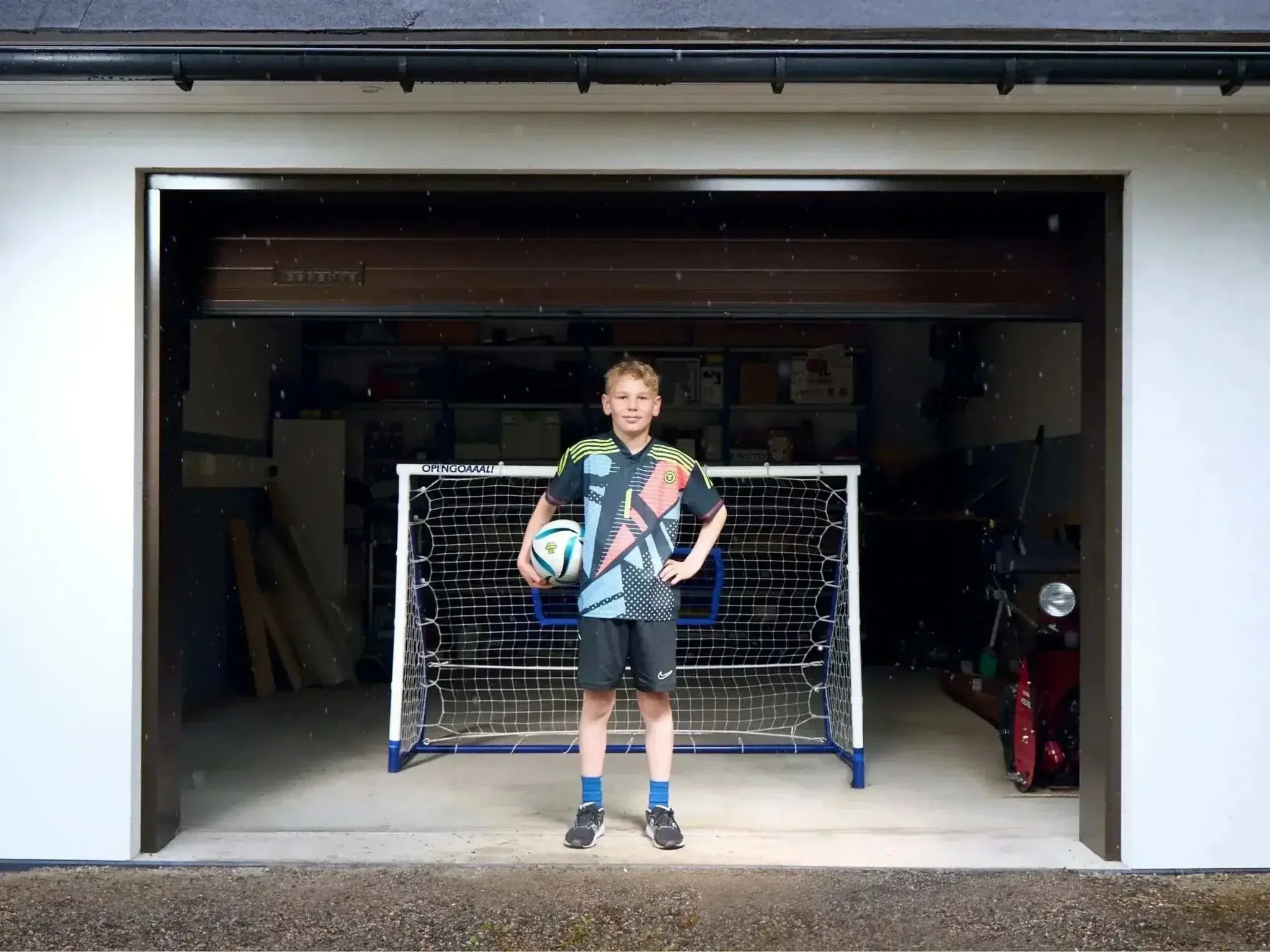
Whatever your grass allows, sized close to what your player sees on game day. A full 8 x 24 setup takes a lot of lawn (our Regulation trainer needs a grass strip just over 50 feet wide), and a U10 player won't face that goal for three more seasons.
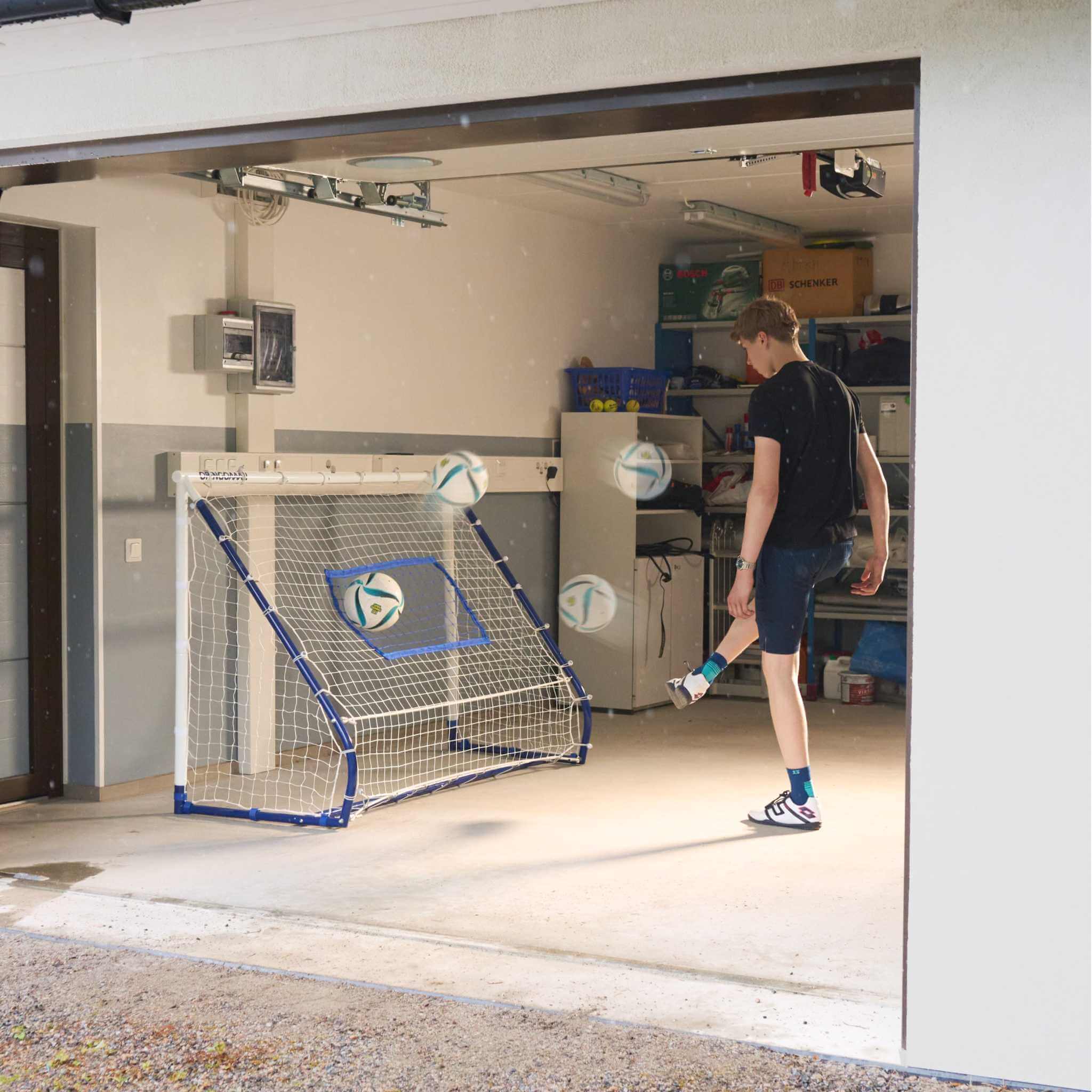
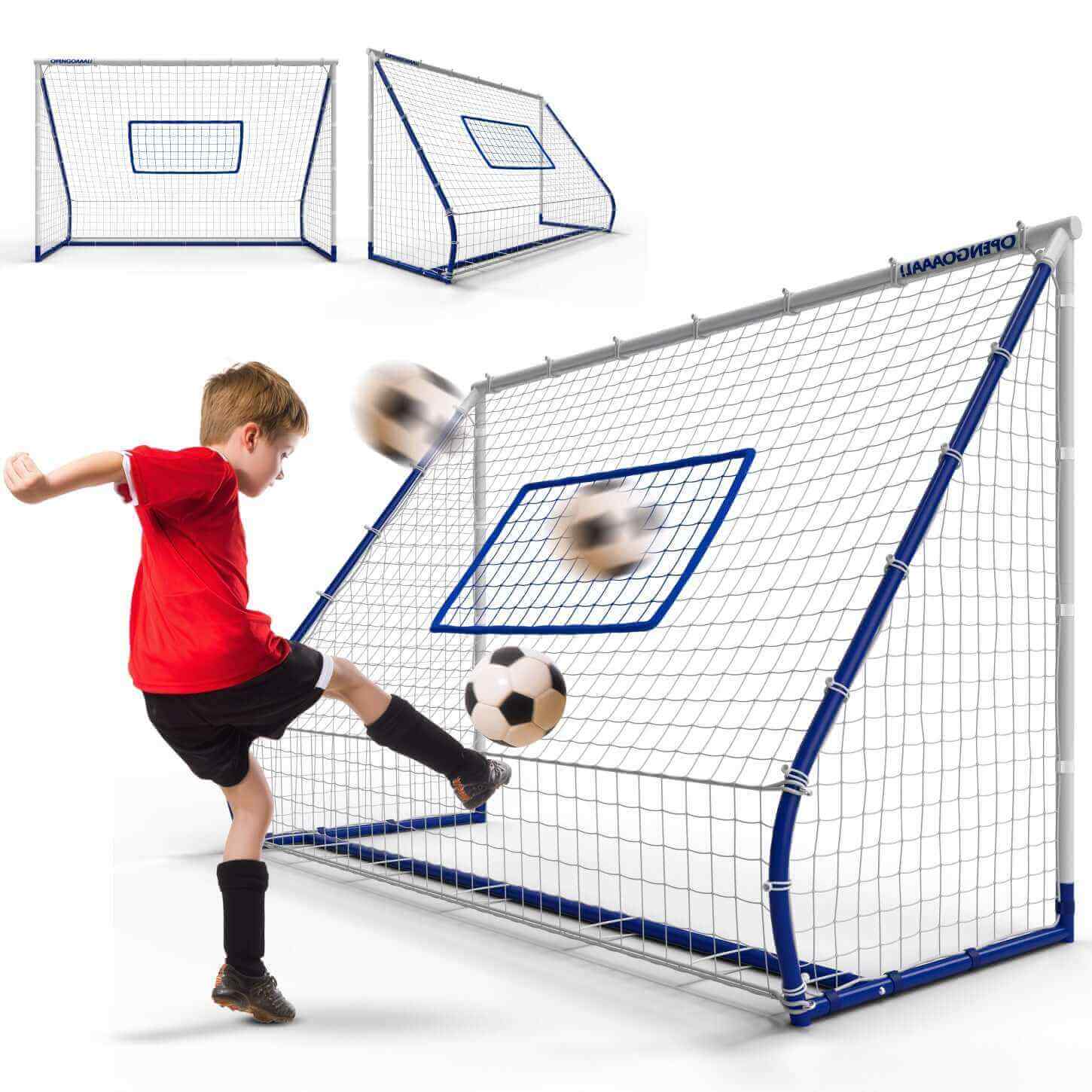
The Open Goaaal® 3-in-1 Soccer Goal Trainer is a goal, a rebounder and a backstop in one frame, so the backstop catches wide shots and most misses come back to the player. It comes in four sizes. The inner goal is the target your player shoots at; the backstop is the full structure you need room for.
| 3-in-1 size | Inner goal (W x H) | Goal mouth vs 8 x 24 | Backstop | Anchoring |
|---|---|---|---|---|
| Junior | 8 x 4.5 ft | 19% | 8 ft tall, up to 16 ft wide | Pole spikes and guy ropes, no digging |
| Standard | 9 x 5 ft | 23% | 10 ft tall, up to 21 ft wide (can be set narrower) | Pole spikes and guy ropes, no digging |
| Large | 16 x 7 ft | 58% | 10 ft tall, up to 29 ft wide (can be set narrower) | Pole spikes and guy ropes, no digging |
| Regulation | 24 x 8 ft | 100% | 13 ft 3 in tall, 37 ft wide; needs grass 50 ft 2 in wide and 8 ft 2 in deep | Spiral anchors |
The Large's inner goal is 7 feet high, the same height as the biggest 9v9 goal, while the Regulation opening matches the full 8 x 24. Every size sits on natural grass only, uses steel poles and carries a 1-year warranty. Plan on about an hour and a half with two people for the first setup; the build videos for the Standard and Large and the Junior are on our site. For tighter yards, start with the Junior.
Measure before you buy, then leave room to the sides and behind. Our guide to building a backyard soccer field covers layouts and goal placement, and our backyard goal buying guide compares goal types.
Frequently asked questions
What size is a U10 soccer goal?
No bigger than 6.5 x 18.5 feet in 7v7, with 6.5 x 12 feet recommended for the age and ability of most U9 and U10 players.
What size goal is used for 9v9?
U11 and U12 play 9v9 on goals up to 7 x 21 feet, and 6.5 x 18.5 feet is the recommended size.
How wide is a soccer goal in yards?
A full-size goal is 8 yards (24 feet) between the inside edges of the posts, under IFAB Law 1 and NCAA Rule 1.9.
Is a high school soccer goal smaller?
No. High school plays on the full 8 x 24 opening. The NFHS differences from college and IFAB are about nets, post padding and where the posts sit on the goal line.
What size goal do 6 year olds use?
Players in U8 and younger play 4v4 with no goalkeepers, on goals no larger than 4 feet high and 6 feet wide.
Picking the right size
Full size is 8 x 24 feet for the pros, college and high school. Kids work up to it in steps: 4 x 6 through U8, around 6.5 x 12 at U9 and U10, up to 7 x 21 at U11 and U12, then the full goal from U13. For a yard, choose for the age group your player is in now and leave room around the frame. Every size is in our soccer goals collection, and our explainers on the penalty box and the full soccer field layout cover the lines in front of the goal.