
The best backyard soccer goal is the type that matches your yard, your player's age and how far a missed shot can travel before it's a problem. For most families that comes down to five types: a 3-in-1 goal with rebounder and backstop, a folding portable goal, a full-size steel goal, a standalone rebounder, or a pop-up goal.
We make one of the five, the 3-in-1, so read our section on it with that in mind. We don't rate other brands' goals here. Each type below gets what it's good for, what it isn't, and who it suits.
What are the 5 best types of backyard soccer goals?
1. 3-in-1 goal: goal, rebounder and backstop
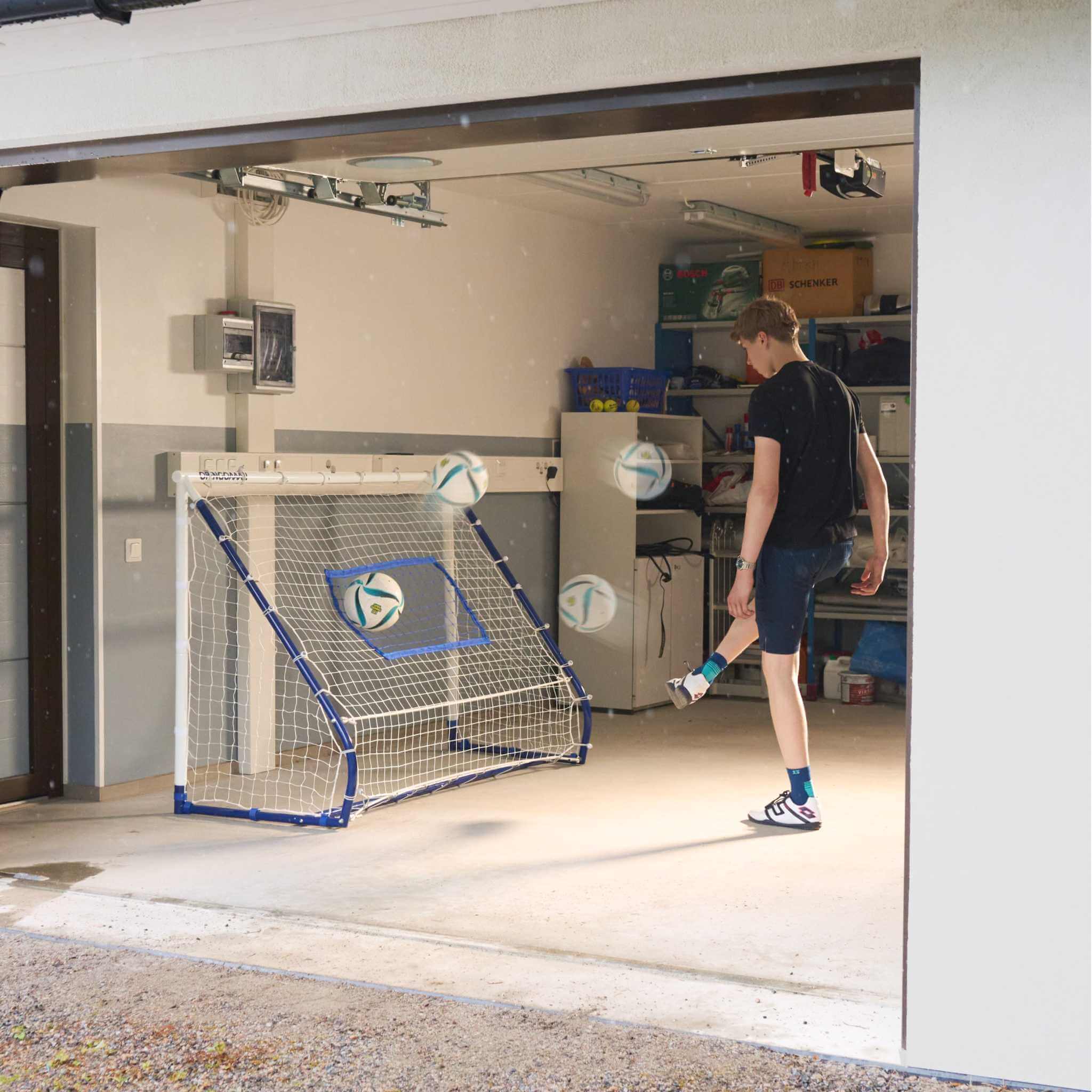
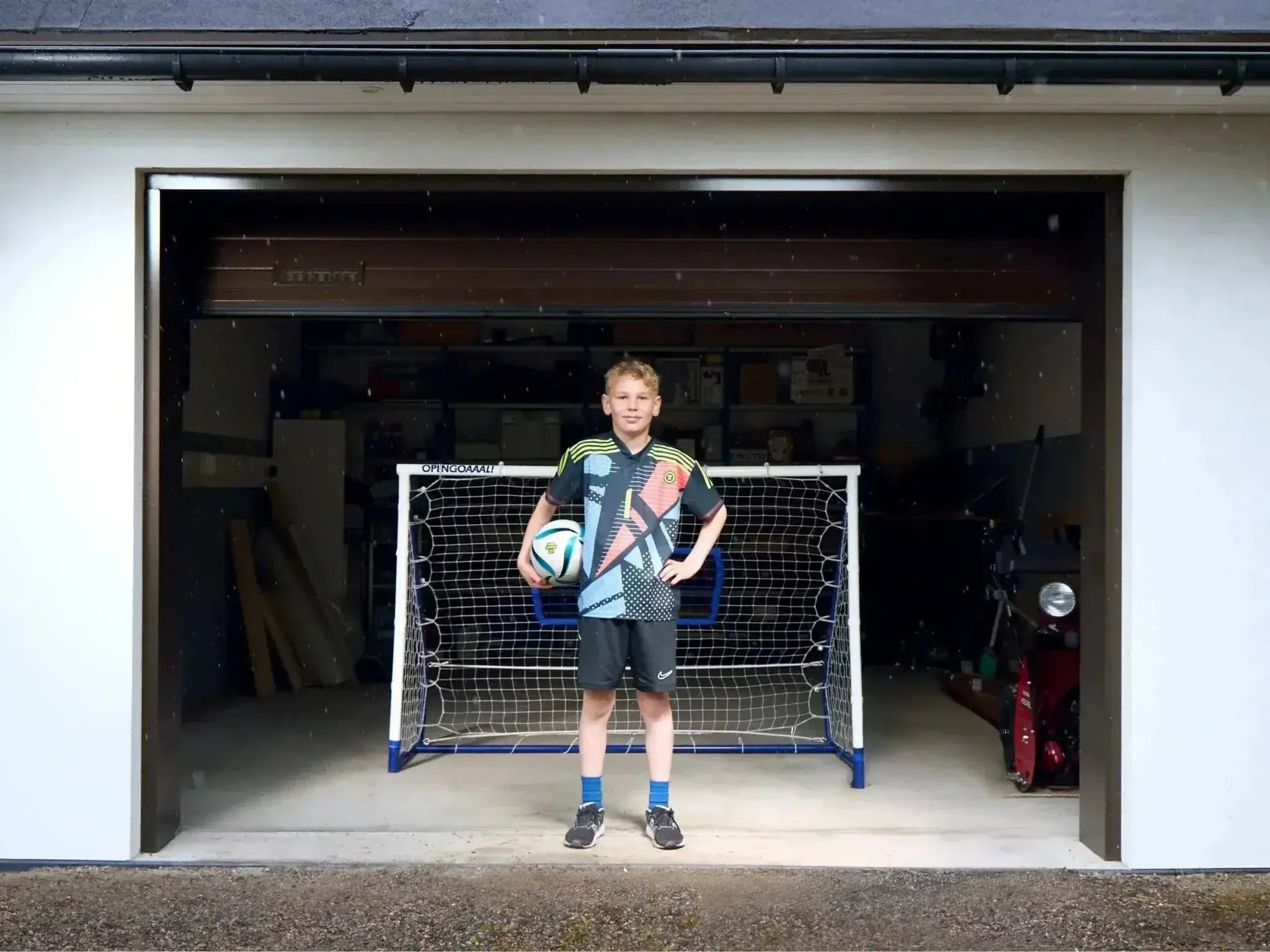
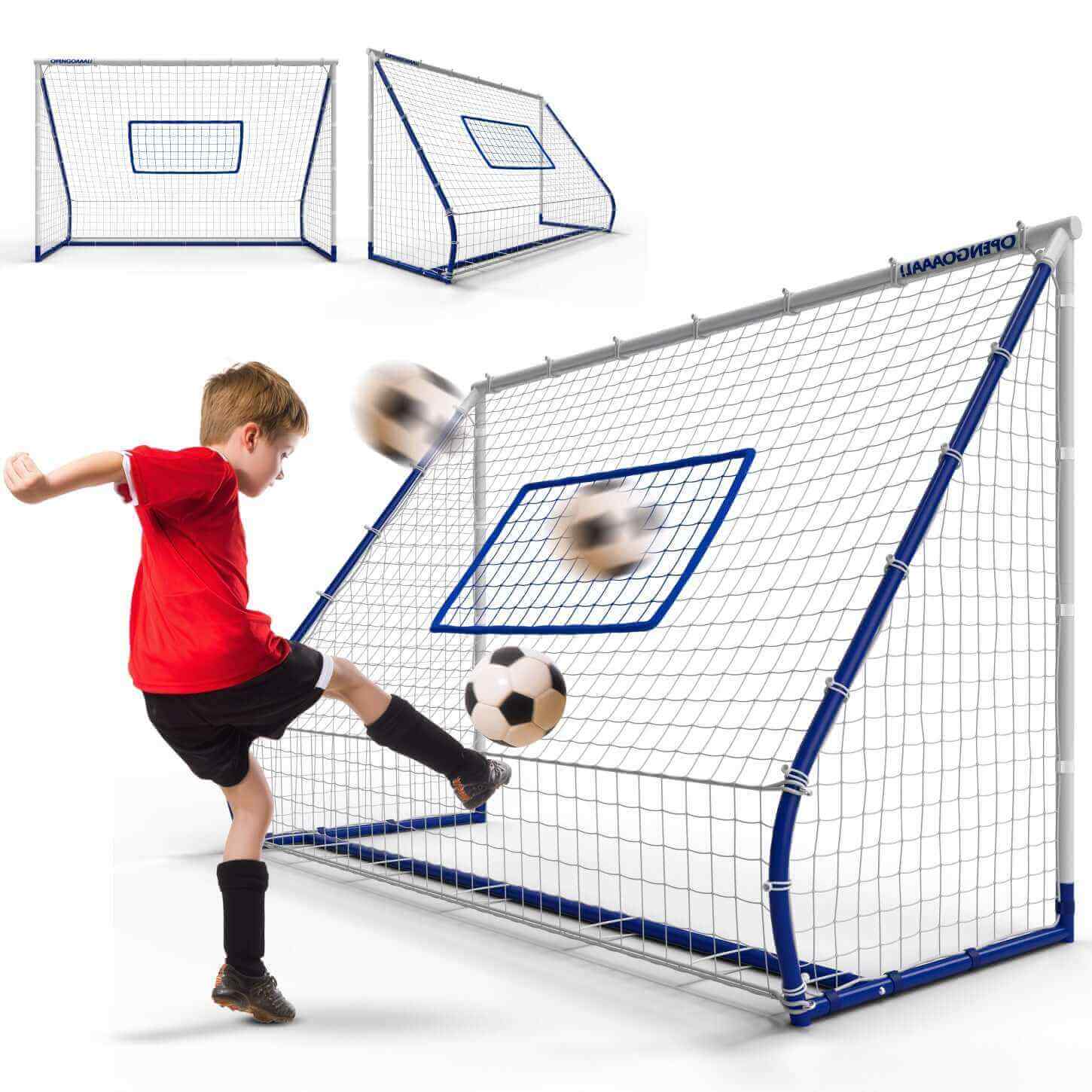
Best for a yard where the ball leaving is the real problem. A 3-in-1 puts a goal in the middle, a rebound net around it that sends most missed shots back, and a tall backstop behind that catches the wide and high ones. When families tell us why they bought one, the reason is usually the fence, the road or the neighbor's yard rather than training. The goal and rebounder make the case after that.
The Open Goaaal® 3-in-1 Soccer Goal Trainer comes in four sizes:
| Size | Inner goal (W x H) | Backstop |
|---|---|---|
| Junior | 8 x 4.5 ft | 8 ft tall, up to 16 ft wide |
| Standard | 9 x 5 ft | 10 ft tall, up to 21 ft wide |
| Large | 16 x 7 ft | 10 ft tall, up to 29 ft wide |
| Regulation | 24 x 8 ft | 13 ft 3 in tall x 37 ft wide |
Where it falls short: it needs natural grass, it isn't something you carry to the park, and the first build takes about 1.5 hours with two people (customers who enjoyed the build still say you need the second pair of hands). Junior, Standard and Large go up without digging, with pole spikes pushed into the grass and guy ropes holding the frame; the Regulation uses spiral anchors and needs a grass area 50 ft 2 in wide by 8 ft 2 in deep. The Standard and Large can be set narrower for a tight yard. Poles are steel, and there's a 1-year warranty. Build videos for the Standard and Large are on the build page.
It makes most sense for a family that wants the ball kept in the yard and a player who practices alone a lot.
2. Folding portable goal
A small steel or aluminum frame that folds or telescopes for the trunk of a car, with stakes to hold it down. It sits between a pop-up and a fixed goal: sturdier than the first, far easier to move than the second.
The catch is size. Most are youth-sized, and a frame light enough to fold is light enough to shift if it isn't staked properly. There's no rebound or backstop, so every miss is a walk.
Pick one for a younger player, for practice split between the yard and a park, or if you need the lawn back after every session.
3. Full-size steel goal
A heavy frame built to the full-size 8 yards wide and 8 feet high set by IFAB Law 1, or one of the large youth sizes. It feels like the goal on a game field because it is the same size.
It's also the type that needs the most care. The U.S. Consumer Product Safety Commission's guidelines for movable soccer goals say every movable goal should be anchored at all times, used only on level ground, never climbed on, and checked for damaged or missing parts before each use. A full-size frame in a backyard also needs a lot of space behind it, because a full-size goal with no backstop sends misses a long way.
This is the older teen's goal, and only for a big, flat yard with plenty of room behind it.
4. Standalone rebounder
A tensioned net or board that sends passes back to the player, with no goal attached. For first touch and passing on your own it's hard to beat, because a decent pass comes straight back.
What it doesn't give is something to shoot at, and a pass that misses the net still goes past it. Our explainer on what a soccer rebounder is covers the types in detail, and the soccer rebounder guide goes through the options.
Good for passing and receiving in a small space, or as an add-on to a goal you already own.
5. Pop-up goal
A flexible frame that springs open out of its bag and folds flat again, usually sold in pairs. They weigh next to nothing and go out and back in the bag in a minute, which makes them good for small-sided games with friends.

Pop-ups are small, most aren't made for a hard shot from close range, and in wind they need their stakes. For U6-U8 players and 2v2 or 3v3 games in the yard (or a bag for the beach) they're right. For an older player who wants to train, they're too small.
How do you choose the best soccer goal for your backyard?
Answer three questions in order: how much flat grass you have, what age your player is, and where a missed shot ends up. The first two set the size. The third decides whether you need a backstop.
For size, youth leagues use smaller goals than the full-size one. These are the maximum goal sizes listed by Eastern Pennsylvania Youth Soccer, a US Youth Soccer state association, against U.S. Soccer's game formats by age:
| Age group | Largest format | Max goal (W x H) |
|---|---|---|
| U6-U8 | 4v4 | 6 x 4 ft |
| U9-U10 | 7v7 | 18 ft 6 in x 6 ft 6 in |
| U11-U12 | 9v9 | 21 x 7 ft |
| U13 and up | 11v11 | 24 x 8 ft |
A backyard goal doesn't have to match the league goal exactly, and a goal smaller than the game goal makes a fine target. Remember the age groups shift: from the 2026-27 season, US Youth Soccer, AYSO and US Club Soccer use an August 1 to July 31 cycle. Our goal sizes by age guide has more detail.
What features matter most in a backyard soccer goal?
Four things, and the first two decide more than the others.
- How it stays put. Stakes, spikes, anchors or weights that suit your ground. The CPSC guidelines say net pegs aren't meant to anchor the frame.
- What happens to a miss. Nothing (plain goal), sent back (rebounder), or caught (backstop).
- Frame and net. Steel or aluminum if it will take hard shots and live outdoors (a light frame is easier to move, and easier to knock over). Weather-resistant netting if it stays out.
- Parts you can replace. A goal that lives outside meets lawnmowers and winters. Being able to buy one pole, rope or peg instead of a new goal is worth checking before you buy. Our spare parts are sold individually for that reason, and owners do come back for single parts years later.
If the yard needs work before any goal goes in, start with our guide to building a backyard soccer field.
Backyard soccer goal FAQs
What size soccer goal should I get for my backyard?
Measure the flat grass first, including the space behind the goal, then match the goal to your player's age group from the table above. For a younger player in a smaller yard, the Open Goaaal Junior has an 8 by 4.5 ft goal inside a backstop 8 ft tall and up to 16 ft wide.
Do backyard soccer goals need to be anchored?
Yes. The CPSC says movable soccer goals should always be anchored, and only used on level ground.
How do I stop soccer balls going into the neighbor's yard?
Put a backstop behind the goal, or turn the goal so the fence or house isn't behind it. More ideas in our post on keeping soccer balls in your backyard.
Can a backyard goal stay up all year?
Many can, if they're anchored and made for outdoor use. Check the maker's instructions for your goal and climate.
This article is general information, not medical advice, diagnosis or treatment. For a persistent or worsening symptom, or any concern about your health, speak to a qualified healthcare professional.
Final thoughts
Start with the yard. When missed shots are the problem you need a backstop, and that points to a 3-in-1; a family moving between home and the park is better off with a folding goal, and a big flat yard with an older teen can take a full-size frame, anchored. Rebounders and pop-ups fill the gaps for passing practice and little kids' games. Once the goal is in, our backyard soccer training guide has sessions to run on it.