
The best soccer attacking drills put players in small, numbers-up or even-numbers games where they have to get past someone and finish. The nine below run from 1v1 and 2v2 battles to a 5v2 rondo, each set up with cones, a few balls and small goals.
They're written for youth teams playing 7v7 and 9v9, which U.S. Soccer's game formats page sets as the maximum for U9 to U10 and U11 to U12. Grid sizes are our suggestions, so shrink them for younger players and stretch them for older ones. A table after the list shows which drill fits which age, and there's a backyard finishing add-on at the end.
1. 2v2 with target players to small goals
You need a ball per pair, disc cones and two mini goals. Mark a grid about 20 yards wide and 30 long with a mini goal on each end line, and put six players in two teams of three. One player from each team stands on the end line their team attacks, as a target who can slide left and right along it. The other four play 2v2 in the middle.

A team has to play the ball into its target and get it back before it's allowed to shoot. Targets play one or two touches. Swap targets every two or three minutes so everyone gets time in the middle.
It trains the pass into a forward and the movement to receive it back, which is most of what combination play is. Watch where the players without the ball go. If both stand still after the pass into the target, the return pass has nowhere to land.
2. 1v1 battle: attacking and reaction drill
Mark a grid that's wider than it is long, roughly 30 yards across and 20 deep, with a mini goal centered on each of the two short sides. Defenders line up on one long side, attackers on the other, each with a ball for the defenders' line.

The first defender passes across to the first attacker and sprints out to close them down. The attacker can go to either goal. A goal, a ball out of the grid or a defender's win ends the rep, and the next pair goes.
Having two goals to pick from is what makes it work. The attacker has to read which way the defender is leaning and go the other way, which means faking, changing direction and deciding fast. Defenders get the mirror image: close quickly, then slow down and stay on their feet. For more of these, see our 1v1 soccer drills.
3. 4v4 passing game
Play 4v4 in a grid about 30 by 25 yards with a full goal and a keeper at each end. The only rule beyond normal play: at least two players on the attacking team have to touch the ball before a shot counts.

Start with free touches. Once the group handles that, cap each player at three touches, then two. The touch limit forces the ball to move and makes the players without it talk and get open.
4v4 is the game format at U7 and U8 too, so it doubles as one game a mixed-age group can all play. Our passing drills work well as a warm-up for it.
4. Control and turn drill
Set three cones of different colors in a triangle with sides of about 5 yards. The player starts in the middle, facing the coach, who stands 8 to 10 yards away with a ball.
The coach passes in and calls a color as the ball travels. The player controls, turns and dribbles around the called cone, then comes back to the middle for the next ball. Add a time limit when the turns get clean.
Call the color late, while the ball is on its way. The player has to check over a shoulder and choose the first touch before the ball arrives, the same habit a forward needs with a defender close behind. Our first touch drills build the control underneath it.
5. Dribbling past a defender drill
Lay six cones in a straight line about 2 yards apart. About 6 yards past the last one, set two more cones as a gate a couple of yards wide.

Players dribble the line in a zigzag, using both feet, then accelerate through the gate. Time them with a target of somewhere between 30 and 45 seconds for the whole thing, depending on age, and race the clock rather than each other at first.
The cones stand in for a defender's legs and the gate for the gap behind. Players new to this should start with our dribbling drills.
6. 2v2 battle for attacking and defending
Mark a grid about 30 by 25 yards with two mini goals on one end line. Split the group into attackers and defenders, lined up on opposite sidelines.
Two defenders step in with the ball, pass to one of two attackers, then press. The attackers combine to beat them and can score in either mini goal. After a goal or a lost ball, the next four go. Switch the lines halfway through so everybody attacks and defends.
Pairs are where a wall pass, an overlap or a simple switch of the ball actually shows up. The coaching point for the attacking pair is spacing: two attackers standing close together are easy to defend with one player.
7. Balanced attack training drill
Set up a game with a goal and a keeper at each end, ideally with ten or more players, and size the field to the group. Limit each player to two or three touches.

The first team to have three different players score wins, whatever the total. Once one player has scored, they can still assist, but their goals stop counting toward the target.
Teams can't just feed their best striker, so midfielders and defenders start arriving in the box (and the top scorer turns provider for a while).
8. 2v2 to targets
Instead of goals, put two target players on each end line of a grid about 25 by 20 yards. Keep a pile of balls at the side so the game restarts quickly.
Two pairs play 2v2. A team scores by moving the ball from one end and passing it into either of the targets at the other, under pressure. Every couple of minutes, targets swap in for the field players.
Targets give the attacking pair four options instead of one goal, and a one-two (give and go) is often the fastest way to reach them. Our give-and-go drills go into that pass in detail.
9. 5v2 plus one rondo
Split a grid of roughly 30 by 20 yards into two halves. Five attackers and two defenders start in one half. Two of the five work along the sidelines, one stays on the halfway line, and a sixth attacker waits as a target on the far end line.
The attacking group needs four passes in a row before it can play the ball to the target. When it does, the attackers move into the far half to support, and the defenders follow. If the defenders win the ball, they hand it back and take a short run before rejoining. Change defenders every few minutes.
Players learn to keep the ball and then play forward the moment the pass is on. For more circle and grid versions, see our rondo guide.
Which attacking drill fits which age?
Start with the drills whose numbers match the games your players play. U.S. Soccer's U9-U10 game model asks attackers to create height, width and depth, to play forward by dribbling or passing, and to use 1v1s or passes to a free player in the attacking half. The U11-U12 model names combination play and adds crosses along the ground. The table sorts the nine drills against that.
| Drill | Players | What it works on | Best fit |
|---|---|---|---|
| 2. 1v1 battle | 2 at a time | Beating a player, choosing a goal | U7 and up |
| 4. Control and turn | 1 plus a passer | Scanning, first touch, turning | U7 and up |
| 5. Dribbling past a defender | 1 at a time | Close control at speed | U7 and up |
| 3. 4v4 passing game | 8 plus 2 keepers | Moving the ball, getting open | U7 and up |
| 1. 2v2 with targets to small goals | 6 | Passing into a forward, support runs | U9 and up (7v7) |
| 6. 2v2 battle | 4 at a time | Combination play in pairs | U9 and up (7v7) |
| 8. 2v2 to targets | 8 | One-twos, finding the free player | U9 and up (7v7) |
| 7. Balanced attack | 10 or more | Spreading the attack, late runs | U11 and up (9v9) |
| 9. 5v2 plus one rondo | 8 | Possession, then playing forward | U11 and up (9v9) |
The "best fit" column is our call, not a league rule; a strong U8 group can handle the 2v2 games.
How can players practice attacking at home?
Finishing is the part of attacking a kid can rep alone. Take any of the solo drills above (the control and turn, or the cone slalom) and end every rep with a shot. That's where a backyard setup either helps or wastes half the session on fetching balls.
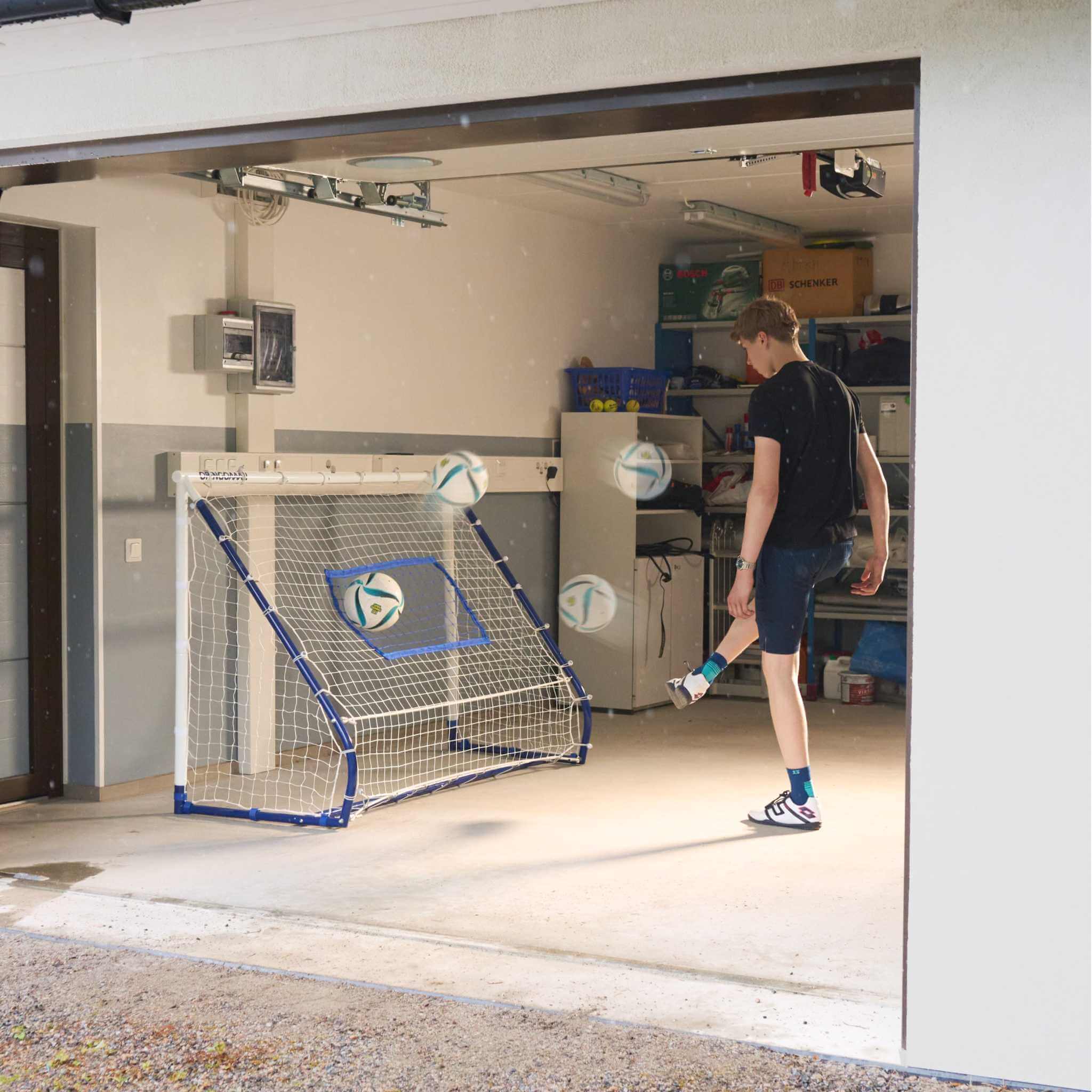
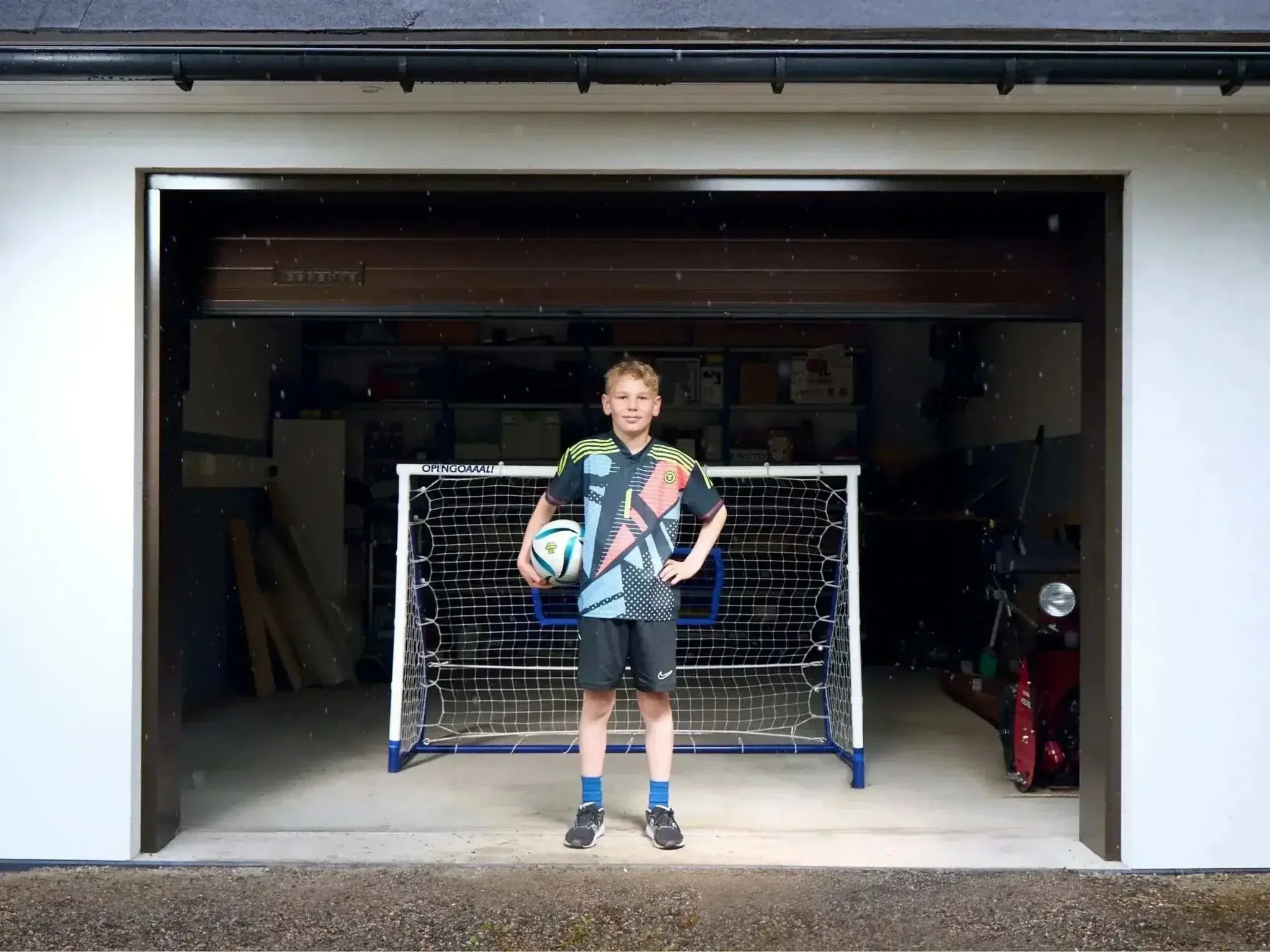
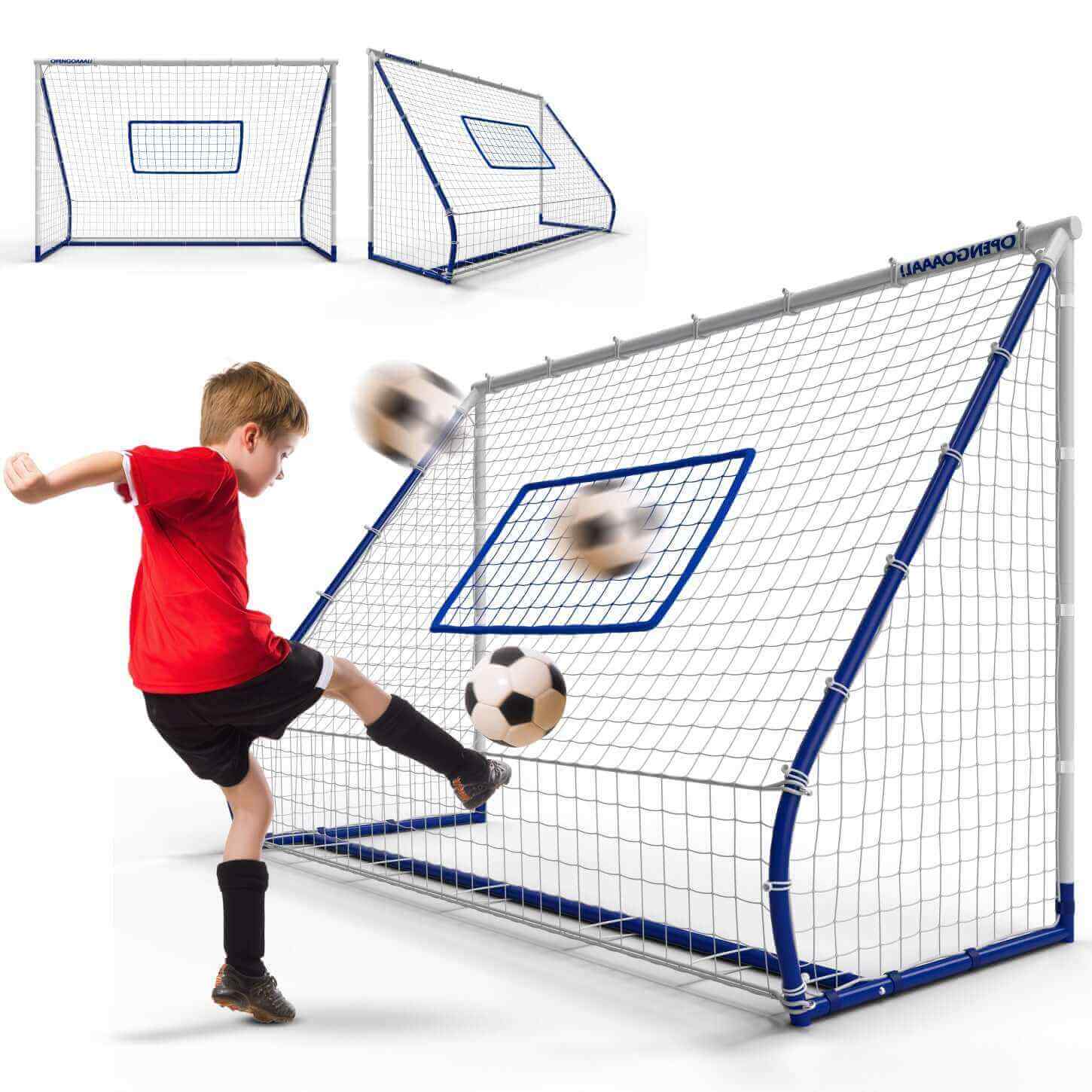
The Open Goaaal® 3-in-1 Soccer Goal Trainer is a goal, rebounder and backstop in one frame, so most missed shots come back and the ball stays in the yard. The Standard has a 9 x 5 ft inner goal with a backstop 10 ft tall and up to 21 ft wide; the Large has a 16 x 7 ft inner goal. Plan on two people and about 1.5 hours for the first build, with videos for the Standard and Large. Clip on precision shooting targets to give each shot a corner to aim at.
Soccer attacking drills FAQs
What is the best attacking drill for youth soccer?
For most teams, the 1v1 battle to two goals. It needs only two players at a time, works from U7 up, and every rep ends with an attacker trying to beat someone and score.
How long should an attacking drill run?
Long enough for everyone to get several turns. We'd run rounds of two to four minutes with rotations in between, then finish with a game.
What is a numbers-up drill?
One where the attackers outnumber the defenders, like 2v1 or 5v2. It gives attackers time to make good decisions before you take that advantage away with even numbers.
How many players do you need for these drills?
Anywhere from one (drills 4 and 5) to ten or more (drill 7). Most of the list works with six to eight, which covers a typical 7v7 practice.
Final thoughts
Pick two or three drills from the table that match your players' format, run them in short rounds, and end with a small-sided game so the ideas carry into play. U.S. Soccer's Play-Practice-Play session structure (game, focused practice, game again) is a simple frame for that. When your team is ready for what happens after the ball is won or lost, our transition drills pick up from here.