
To train like Ronaldo, copy his habits rather than a gym plan: extra practice on your own, step-overs repeated until they're automatic, lots of shots from distance and free kicks, and real enjoyment of training. A young player can fit all of that into a 30-minute backyard session.
There are plenty of "Ronaldo workout" plans online with exact sets, reps and meal plans. We couldn't find those details in Ronaldo's own words or on any official club or FIFA page, so we haven't copied them here. What is on record, from FIFA and from people who trained with him, is arranged below under the same five headings this guide has always used: strength, speed, skills, recovery and mindset. Each section ends with what a youth player can actually do with it.
1. Strength and conditioning: what did Ronaldo actually do?
He added resistance to the skills he practiced, starting young. His Sporting Lisbon academy roommate José Semedo told FIFA that the two of them, both 12 when Ronaldo arrived, sneaked into the handball court and gym at night to train, dodging security, and that Ronaldo often strapped weights to his feet while practicing taking on a defender (FIFA, Jan. 2016). Semedo's own words: they worked "every single day and night" to get stronger and better.
The habit followed him to England. FIFA's 2026 profile says that in his early Manchester United days he tied weights to his ankles when practicing step-overs so they felt easier in matches (FIFA, March 2026). The same profile describes a 2019 header for Juventus where he jumped about 28 inches (71 cm) to meet a cross at roughly 8 feet 5 inches (2.56 m).
For a kid, the part worth copying is the extra work, not the weights. The American Academy of Pediatrics' guidance on strength training for young athletes (HealthyChildren.org) says bodyweight exercises count as strength training, that programs should be supervised, and that maximum lifts should wait until a child is fully grown. If you're thinking about anything heavier than bodyweight for your child, ask a qualified professional first.
Sample bodyweight circuit
Two rounds, with a minute's rest between rounds. Stop any exercise that hurts.
| Exercise | Reps or time |
|---|---|
| Bodyweight squat | 10 reps |
| Forward lunge | 6 per leg |
| Plank | 20 seconds |
| Side plank | 15 seconds per side |
| Skips for height | 10 per leg |
2. Speed and agility drills: how did he get so quick with the ball?
The record talks about quick feet more than sprint times. FIFA's profile describes the young Ronaldo at United as "a fleet-footed trickster" who then turned into a goalscorer, and Semedo remembered him practicing taking on the defensive midfielder again and again. Nobody official has published his sprint sessions, so we won't invent one.
For a young player, that means working on speed with the ball at their feet. Set five cones a yard apart and weave through them with small touches, then accelerate for five yards after the last cone. Change which foot leads every rep. Our agility drills you can do anywhere and simple footwork drills have plenty more to rotate through.
3. Soccer-specific skills training: what did he practice most?
Step-overs, taking on defenders, shooting from range and free kicks. FIFA's profile says that at United he grew into a player who "could rival anybody" at shooting from range or scoring free kicks, and Semedo told FIFA that teammates at Sporting kept trying to copy his top-corner free kicks.
Here's how those habits fit into 30 minutes in the yard. You need a ball, a few cones (shoes work) and a goal.
| Block | Minutes | What to do | The Ronaldo habit behind it |
|---|---|---|---|
| 1. Warm-up touches | 5 | Toe taps, sole rolls, inside-outside touches, both feet | Daily ball contact |
| 2. Step-overs | 5 | Step over, push the ball out the other way, alternate sides | Step-overs drilled at Manchester United |
| 3. Beat the defender | 5 | Dribble at a cone, fake, burst past, finish with a shot | Taking on defenders at Sporting |
| 4. Shooting from range | 10 | Shots from 15 to 20 yards, alternating feet, aiming at corners | Shooting from distance |
| 5. Free kicks | 5 | Same spot, same run-up, every rep | Free kicks |
Start with our soccer warm-up drills for block 1. If the step-over is new, our guide to soccer moves breaks it down, and our kids' shooting drills give you variations for block 4.
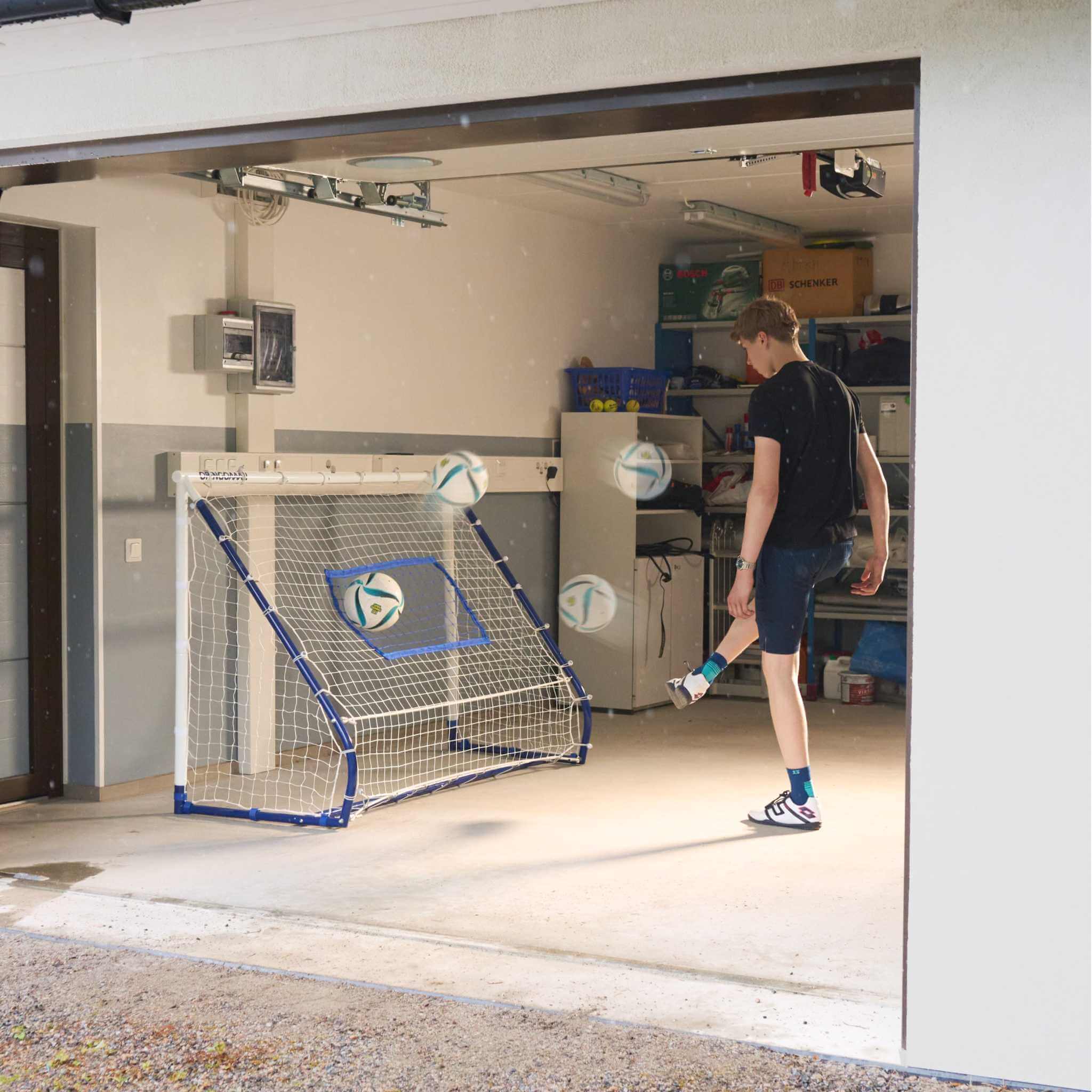
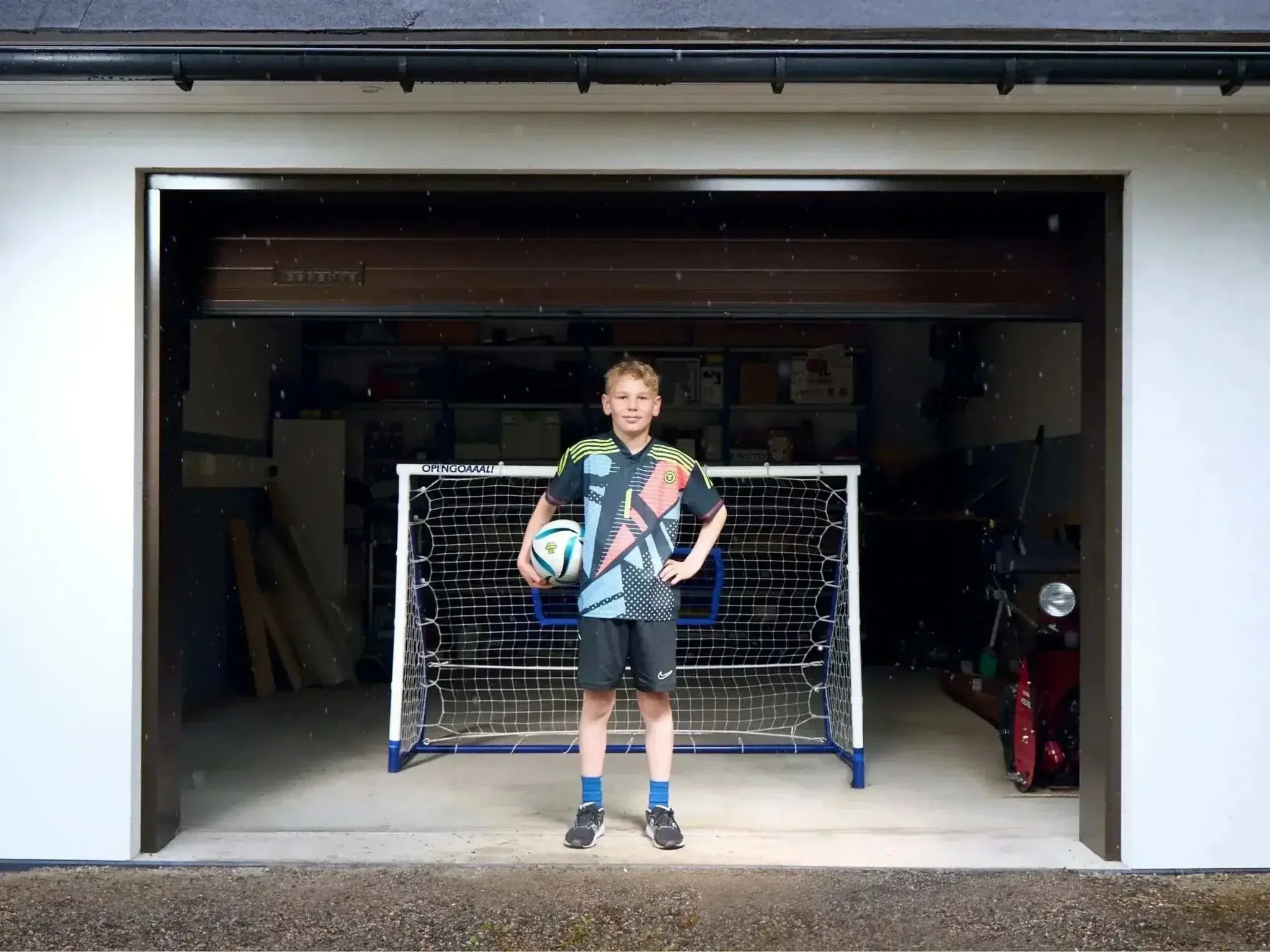
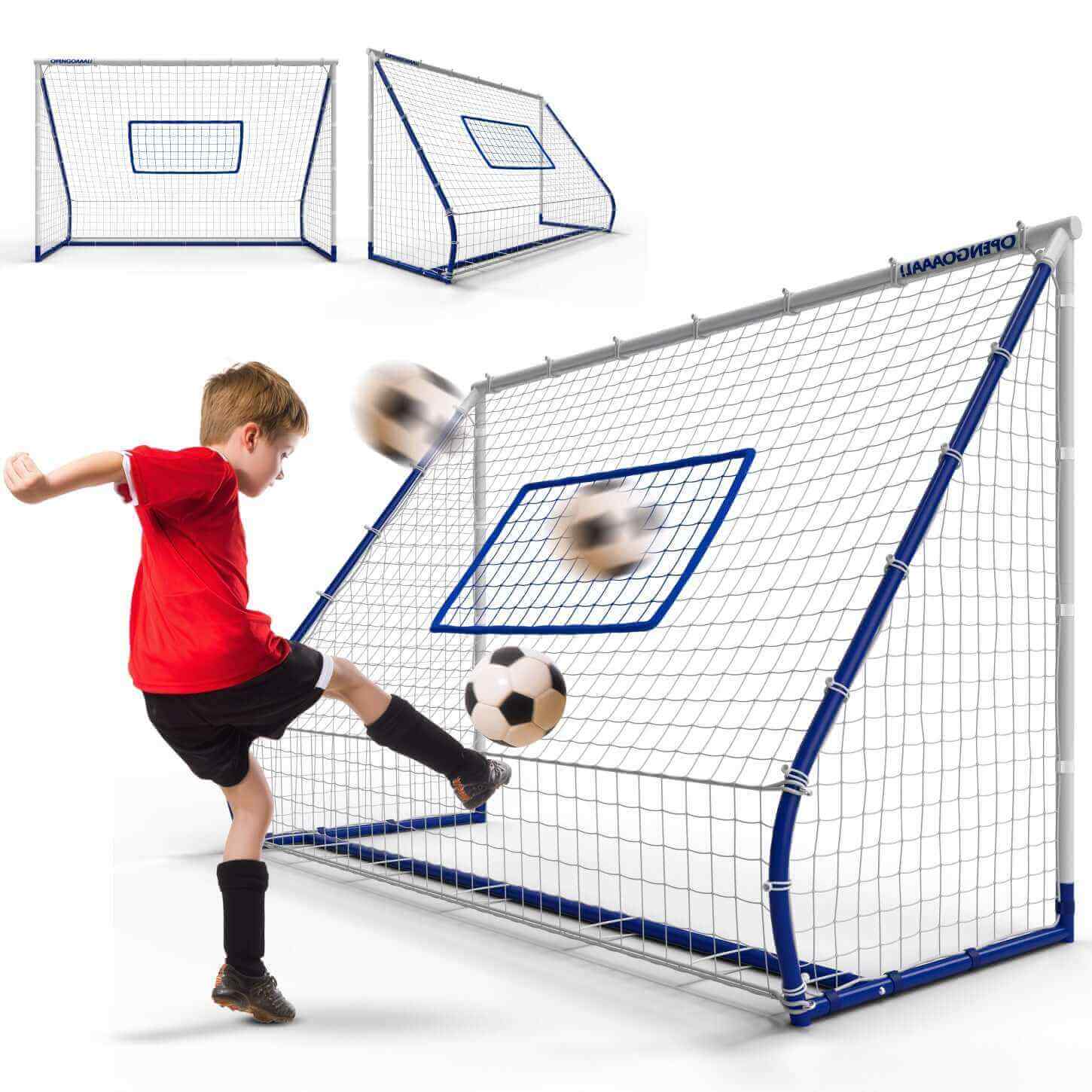
Block 4 gets the most time, and it's also where backyard sessions tend to fall apart, because half the shots miss and the next ten minutes go to fetching balls from the neighbor's flower bed. That's the problem the Open Goaaal® 3-in-1 Soccer Goal Trainer was built for: a goal, a rebounder and a backstop in one frame. The Standard size has a 9 x 5 ft goal inside a backstop 10 feet tall and up to 21 feet wide, and the Junior an 8 x 4.5 ft goal with an 8-foot backstop. It goes on natural grass, and the first build takes two people about an hour and a half (there's a build video on our site).
Should kids practice headers like Ronaldo?
Only once they're old enough under youth rules. US Youth Soccer's policy on players and playing rules (Rule 305, Dec. 2025) says players 10 and under may not head the ball in matches or practice heading in an organized team setting. Players 11 and 12 may head in matches, with coaches keeping each player to no more than 25 headers a week. From 13, heading is allowed in matches and practice. State associations are encouraged, not required, to adopt the rule, so check your own league.
4. Recovery and nutrition: what does he say about looking after his body?
He talks about it as part of the job. Accepting a FIFA award in 2022, Ronaldo said that if you treat your body well, "when you need your body it's going to give it back" (FIFA, Jan. 2022). Brazil's Ronaldo, the original one, told FIFA that "there are very few players who take such care of their bodies" (FIFA, Sept. 2019).
We found no official source for his actual diet or rest routine, so we're not printing a meal plan. For a young player, the basics are better documented. The CDC recommends 9 to 12 hours of sleep a day for kids aged 6 to 12, and 8 to 10 hours for teens aged 13 to 17 (CDC, May 2024). For food, our guide on what to eat before a soccer game covers game day, and our soccer conditioning drills cover running work that suits young players.
5. Mental training and discipline: what keeps him going?
In his own words, sacrifice and enjoyment. Ronaldo told FIFA in 2022: "Without sacrifice you can't achieve anything." In the same interview he said he had played since he was five or six and that "even in training, I'm still enjoying it." Brazil's Ronaldo put it more sharply in the FIFA tribute: "I trained because I was made to. He trains because he loves to."
For a parent, the enjoyment part is the useful one. A kid who likes the session will come back to it tomorrow, and the Lisbon stories are really about a boy who kept coming back. Two practical ways to keep that going: let your child pick one block each session, and keep a free-kick tally on the fridge so there's always a number to beat next week.
FAQs
How does Cristiano Ronaldo train for soccer fitness?
Official sources describe habits more than a program: extra solo sessions from age 12, weights on his feet or ankles while practicing skills, and lots of shooting and free kicks. We couldn't find his current gym routine in any official source.
What does Ronaldo eat to stay in shape?
He hasn't published a diet in any official source we could find. He has told FIFA that treating your body well pays off when you need it.
What exercises can a kid do for speed and agility, Ronaldo style?
Fast dribbling through cones, step-overs on both sides and short bursts after a fake. Keep the ball involved, since that's what his documented training had in common.
How many goals has Ronaldo scored for Portugal?
More than 140 in more than 225 matches, according to FIFA's March 2026 profile, which lists him as the men's international record holder for both goals and caps.
This article is general information, not medical advice, diagnosis or treatment. For a persistent or worsening symptom, or any concern about your health, speak to a qualified healthcare professional.
Where should you start this week?
Pick two evenings, run the five blocks, and put the tally on the fridge. What stands out in Ronaldo's story is how often he came back to practice, and that's the part a backyard can copy. For block 4, our corner targets give the shooting something specific to aim at, and more session ideas are in our backyard soccer training guide.