
The best soccer warm-up drills keep a ball at every player's feet from the first minute, start easy and finish at game speed. Pick three of the ten below, one for each block, and run them for about 10 minutes.
Ten minutes lines up with the guidance. Colorado State University's adult fitness program recommends a minimum of 5 to 10 minutes of light warm-up (Colorado State University, May 2018), and U.S. Soccer's Play-Practice-Play model (U.S. Soccer, February 2018) opens every session with small-sided games played mainly for fun. Below are the ten drills, the ages each one suits, and a simple way to stack them into one routine.
Which soccer warm-ups work for which age levels?
The younger the team, the more the warm-up should look like a game. U.S. Soccer caps the game format at 4v4 for U7 and U8, 7v7 for U9 and U10, 9v9 for U11 and U12, and 11v11 from U13 (U.S. Soccer game formats), and the drills below climb the same way, from tag-style games for the little ones to passing patterns for older teams.
| # | Drill | Best ages | Space | What players practice |
|---|---|---|---|---|
| 1 | Passing warm-up | All | Pairs, 10 yards apart | Passing and first touch |
| 2 | Sharks and minnows | U6 to U10 | 25 x 20 yards | Dribbling with defenders around |
| 3 | Soccer tic-tac-toe | U8 to U12 | Grid 15 yards out | Quick choices in a relay |
| 4 | Circle rondo | U10 and up | Circle about 12 yards across | Keeping the ball as a group |
| 5 | Figure 8 dribbling | U7 and up | Two cones 5 yards apart | Close control with both feet |
| 6 | Zig zag dribbling | U8 and up | 20-yard cone line | Cutting and turning with the ball |
| 7 | Catch me if you can | U6 to U10 | 10 x 10 yard square | Dribbling fast, stopping on a call |
| 8 | Clean your room | U5 to U8 | 15 x 15 yards | Shielding and winning the ball back |
| 9 | Fill the bucket | U6 to U10 | Half a small-sided field | Dribbling, then stopping the ball dead |
| 10 | Line passing combination | U11 and up | Along a sideline | Wall passes and timed runs |
If your club's age groups just reshuffled, that's expected. Starting with the 2026-27 season, US Youth Soccer, AYSO and US Club Soccer form age groups on an August 1 to July 31 cycle meant to line players up with their school-grade peers (US Youth Soccer, June 2025), so check which row your team now sits in.
1. Passing warm-up
Pair players up with one ball, about 10 yards apart, and put a two-yard cone gate halfway between them. They pass through the gate on two touches: one to set the ball, one to send it back. After a minute, drop a cone a few yards to each player's side. Before every receive, the player jogs out to touch it and comes back to meet the pass.

Every player touches the ball every few seconds, and setup takes a minute. With U8 and younger, cut the gap to 6 yards or most passes won't arrive.
2. Sharks and minnows
Mark a box about 25 by 20 yards. The minnows each have a ball and line up on one end line; two sharks without a ball wait in the middle. On "go," the minnows dribble for the far end while the sharks try to knock balls out of the box. Lose your ball and you're a shark on the next crossing. Last minnow left wins.

Expect six-year-olds to ask for it every single practice. Our sharks and minnows guide has versions for bigger rosters.
3. Soccer tic-tac-toe
Lay a three-by-three grid of cones or hoops about 15 yards from two starting cones and form two relay lines. The first three runners in each line hold a pinnie in their team's color. One at a time they sprint out, drop it in an empty square, run back and high-five the next player. If all six pinnies are down and nobody has three in a row, the fourth runner goes out empty-handed and moves one of their own.

Players have to choose a square while they're breathing hard and their teammates are yelling advice, which is half the fun. For U10 and up, make every runner dribble a ball out and back. Our soccer tic-tac-toe post has more setups.
4. Circle rondo
Six to eight players stand around a circle roughly 12 yards across, two defenders inside. The outside players move the ball across and around the circle; the defenders hunt it. A bad pass or a heavy touch sends the player who made it into the middle, and the defender who won the ball takes their spot.

Coaches lean on it before games because nobody stands still and everyone is on the ball. Touch limits and bigger versions are in our rondo guide.
5. Figure 8 dribbling
Two cones, about 5 yards apart. Each player dribbles a figure 8 around them for 45 seconds and then hands the ball to a partner. Around the left cone they use the outside of the left foot, around the right cone the outside of the right. Second turn, switch to the inside of the opposite foot.

Players turn up to practice in ones and twos, so this is a handy first drill: one pair of cones keeps two kids busy while you wait for the rest.
6. Zig zag dribbling
Set six cones in a zig zag, each about 4 yards from the last, so the course runs around 20 yards. Players dribble around every cone, cutting with the inside of the foot going one way and pulling the ball with the sole going the other. At the end they leave the ball and jog back down the outside.

Older players can finish each run with a shot at a goal. With U8, have them count cones out loud, otherwise someone always skips number four.
7. Catch me if you can
Mark a 10 by 10 yard square. Two players with a ball each start at opposite corners. On "go," both dribble around the outside of the square trying to catch the other. "Stop" means freeze the ball under the sole. "Turn" means reverse direction. Give each pair 45 seconds and rotate.

The coach's calls are what make it work, since players have to listen while they chase.
8. Clean your room
This one is for U5 to U8. Mark a 15 by 15 yard room and give everyone a ball except the cleaner. Players dribble around inside until the cleaner is let loose to win balls and boot them out. Whoever loses a ball chases it down, dribbles back in and carries on. The room is clean when every ball is out, or after 90 seconds, whichever comes first.

A parent makes a good cleaner (ideally one happy to be a little slow on purpose).
9. Fill the bucket
Two teams of three. Each team has a small cone square in the middle of the field, the bucket, plus three balls at each end. On the whistle, one player dribbles a ball into the bucket, stops it dead inside the square, then runs to tag a teammate at the far end, who brings the next one. First team with all six balls sitting still in its bucket wins.

A ball that rolls out doesn't count, so the stop has to be a real one.
10. Line passing combination warm-up
Four players stand along the sideline, roughly 10 yards apart. A passes to B, who lays it back first time. A then plays it forward to C while B runs past to take C's return. The same pattern repeats as the group moves down the field, each player passing, setting and running in turn. Swap ends and come back on the other foot.

Save this one for U11 and up. The patterns look like the wall passes teams use in 9v9 and 11v11, which makes it a good final block before kickoff.
How do you turn these drills into a 10-minute warm-up?
Split the 10 minutes into three blocks, getting players moving, loosening up and then playing fast. Colorado State describes a warm-up that is light to moderate in intensity and can use dynamic movements, which on a soccer field means dribbling first and something at game speed last.
| Minutes | Block | Drills from the list |
|---|---|---|
| 0 to 3 | Get moving | Figure 8 dribbling, catch me if you can, or clean your room |
| 3 to 6 | Loosen up | Dynamic movements over 15 yards (high knees, skips, side shuffles, backpedal), or the passing warm-up |
| 6 to 10 | Play fast | Sharks and minnows, circle rondo, or the line passing combination |
Keep the same three drills for three or four weeks. A routine the kids already know starts on time, even while you're still writing the lineup.
What does a high school pregame warm-up look like?
Give it about 20 minutes, split into four chunks. Jogging and dynamic movements across the width of the field come first, then passing in pairs, then a possession grid like the circle rondo, then finishing with the keepers. Wrap up 5 to 10 minutes before kickoff, which leaves time for water and the coin toss without anyone standing around long enough to go cold.
Can my kid warm up alone in the backyard?
Yes, using the same three blocks. Two minutes of toe taps, two minutes of figure 8s around a pair of cones, three minutes of dynamic movements across the yard, then three minutes passing against a rebounder with both feet.
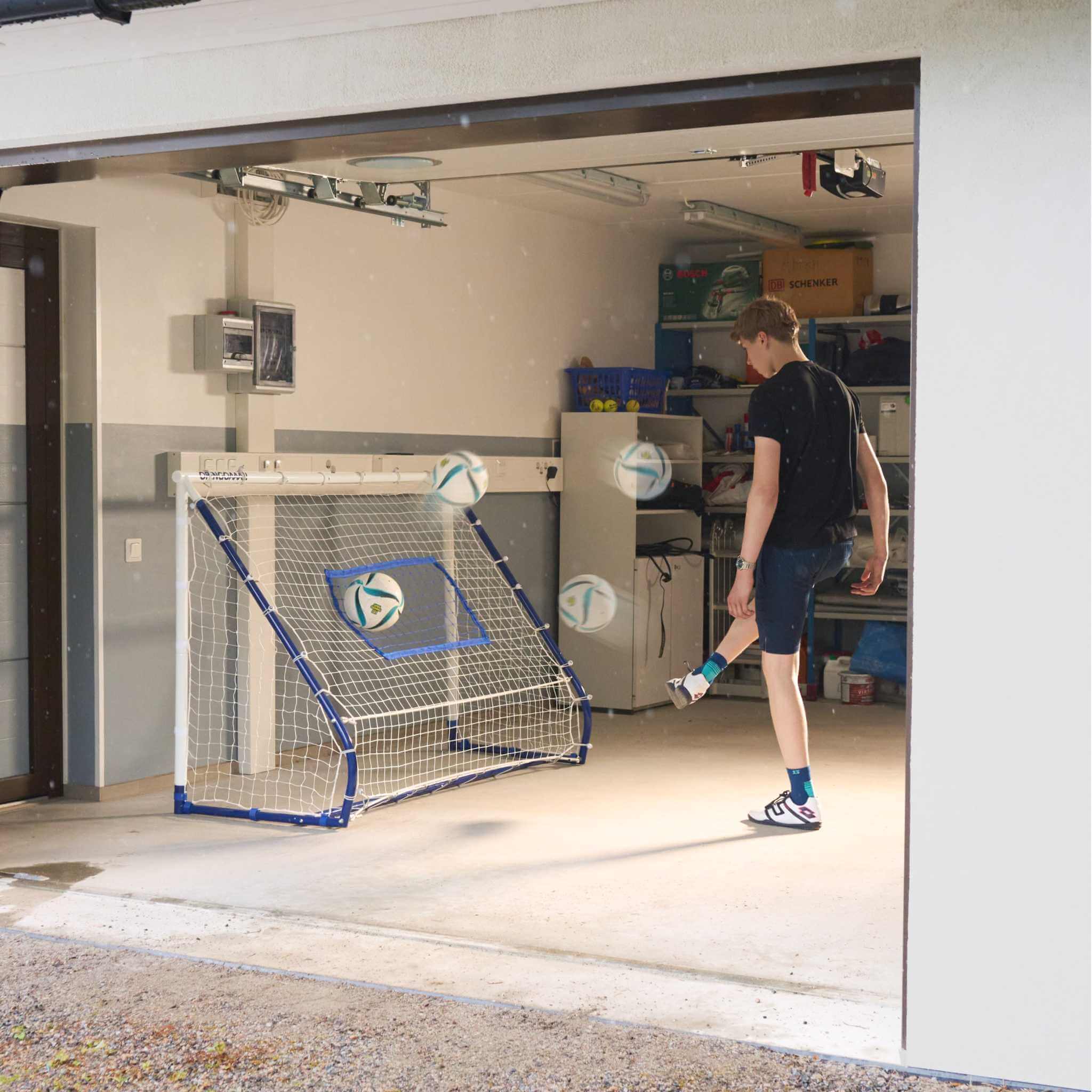
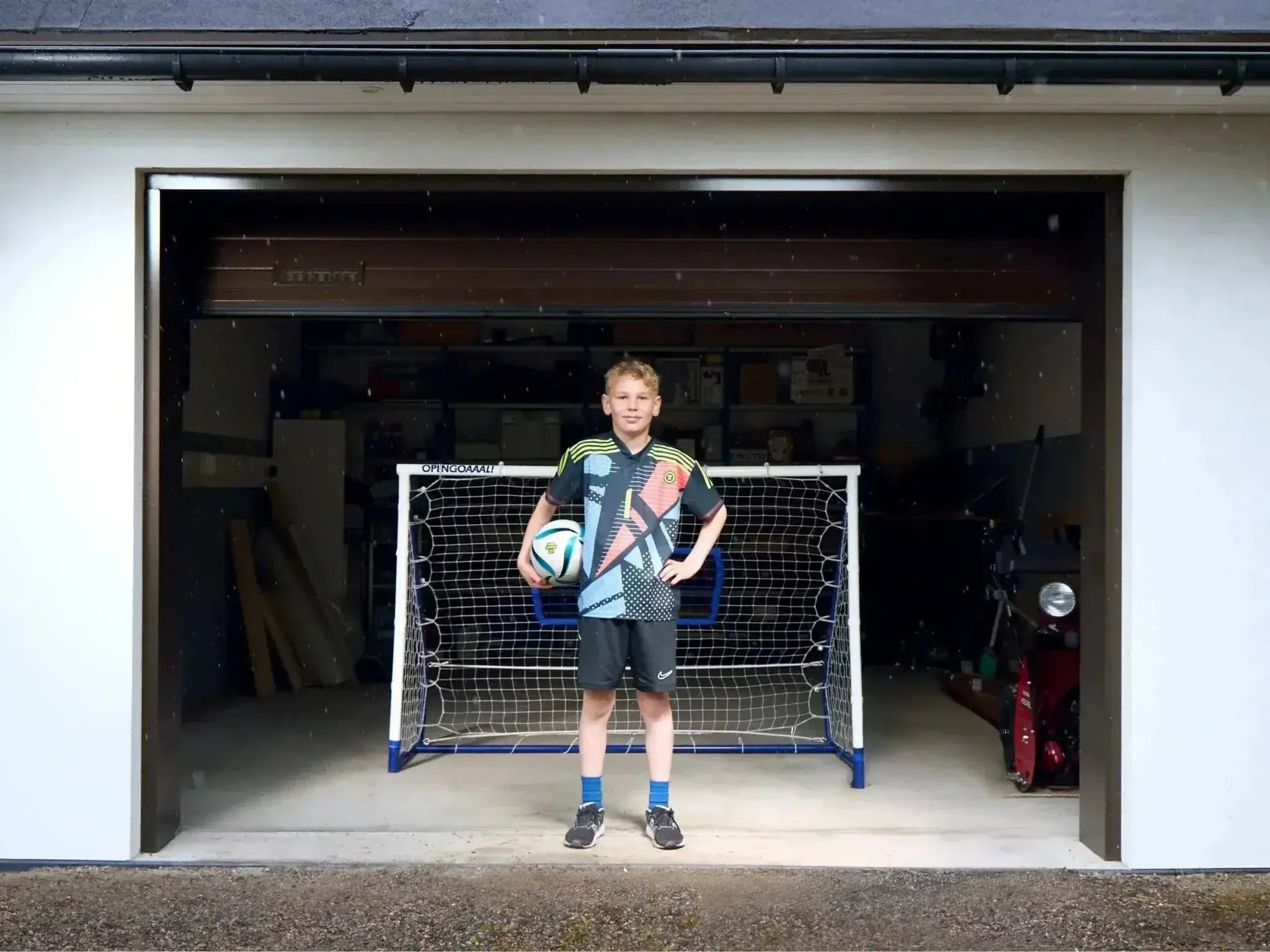
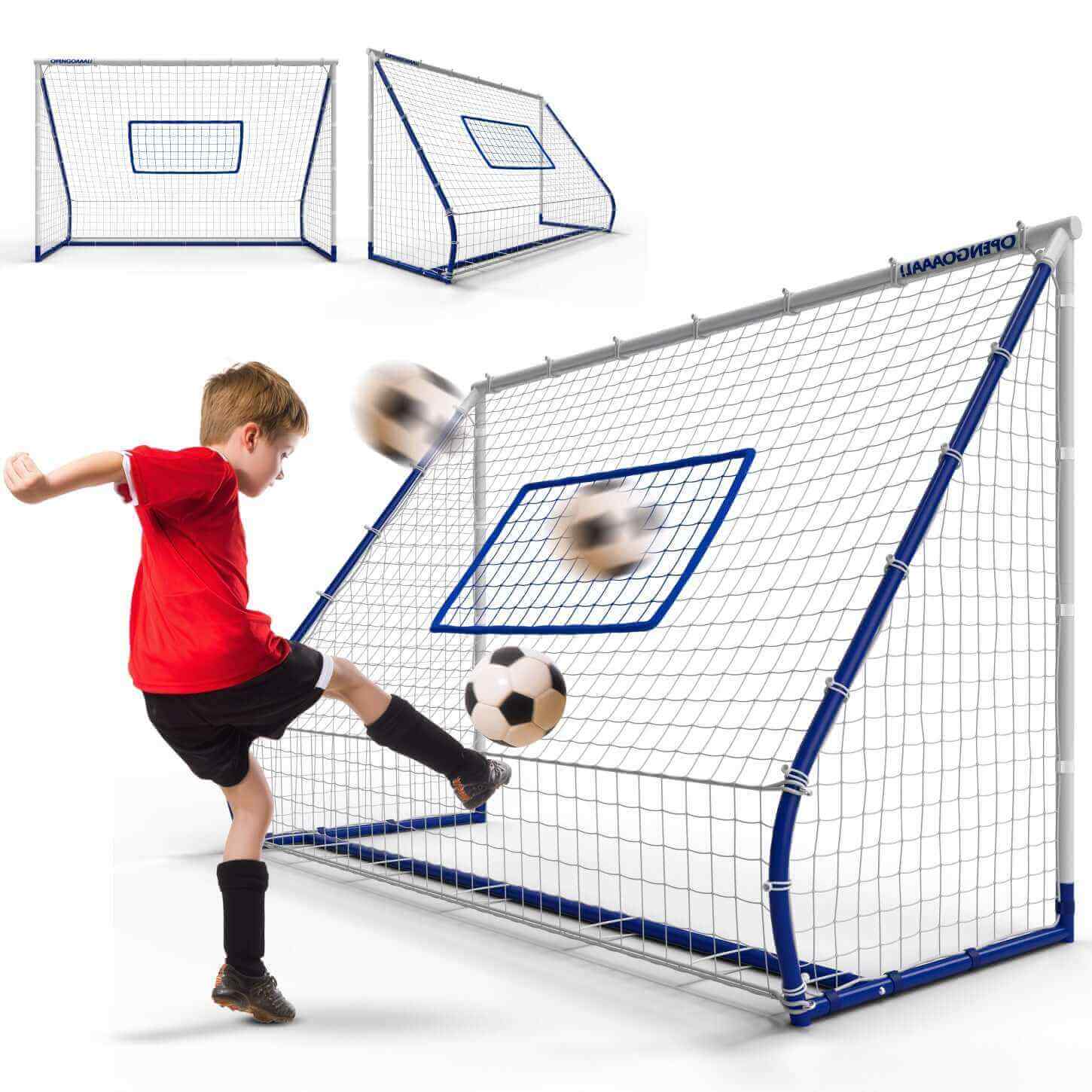
That last block is where solo warm-ups fall apart, because every miss is a walk to the fence. The Open Goaaal® 3-in-1 Soccer Goal Trainer is a goal, rebounder and backstop in one frame, so the ball comes back. On the Standard size the inner goal is 9 x 5 feet and the backstop stands 10 feet tall and up to 21 feet wide. Plan the first build for a weekend: it takes about 1.5 hours with two people, and our build video walks through each step. To keep the routine from going stale, roll our soccer training dice to pick the next move.
Should kids stretch before soccer?
Save the long holds for afterward. Colorado State puts a 10 to 30 second stretch of the major muscle groups in the cool-down, once the session is over. Five easy minutes after practice, while you hand out the weekend schedule, covers it.
FAQ
How long should a soccer warm-up be?
About 10 minutes for practice and for younger teams. High school teams usually take around 20 minutes before a game and finish 5 to 10 minutes ahead of kickoff.
What is the best warm-up for U6 soccer?
Sharks and minnows or clean your room. Both keep every child dribbling instead of waiting in a line, and our U6 soccer drills have more games pitched at that age.
Should a soccer warm-up use a ball?
Where you can, yes. Dribbling and passing get players moving and on the ball at the same time, which matters when practice is only an hour.
What if we only have five minutes before the game?
Skip the movement block. Run the passing warm-up for two minutes, then a circle rondo until the referee calls the captains.
This article is general information, not medical advice, diagnosis or treatment. For a persistent or worsening symptom, or any concern about your health, speak to a qualified healthcare professional.
Where to go from here
Choose one drill per block for your age group, write the three names on a card, and use that card for the next month. When the warm-up runs itself, move on to our soccer conditioning drills for the harder running work, and our guide to what to eat before a soccer game for the part that happens at the kitchen table.