
The most useful soccer conditioning drills copy the stop-start running of a real game, and most of the ten below use a ball. Spread them over a four-week preseason and keep the first two weeks inside your state's heat-acclimatization rules.
Why are conditioning workouts important for soccer?
Soccer asks players to keep running for a long time with almost no planned breaks. Under the Laws of the Game, a full match is two equal halves of 45 minutes (IFAB Laws of the Game, Law 7). Whatever length your league plays, the running comes in the same pattern: a short sprint, a sharp turn, a jog back into position, then another burst. Conditioning is the part of the week where players rehearse that pattern on purpose, ideally with a ball at their feet.
Players under 12 rarely need a separate fitness block. The federal Physical Activity Guidelines say youth ages 6 through 17 need at least 60 minutes of moderate-to-vigorous activity each day (U.S. Department of Health and Human Services, updated November 2025), and practice plus backyard play goes a long way toward that. This list is written for high school and older club players getting ready for August tryouts.
What should you check before the first session?
The heat rules come first, because an August preseason means training in summer heat. The National Athletic Trainers' Association's consensus guidelines define the first 14 consecutive days of preseason as the heat-acclimatization period, with no more than one practice a day on days 1 to 5 (NATA, August 2012). State associations write their own versions and some are stricter, so read your state's handbook or ask the school's athletic trainer before you put dates on a calendar.
Water is the other half of the prep. KidsHealth advises that kids drink water before physical activity and every 15 to 20 minutes throughout (KidsHealth, reviewed April 2026), which works out to a water break between every drill below rather than one stop halfway. Open each session with our 10-minute soccer warm-up.
10 soccer conditioning drills
1. 4v4 touch the line
Mark a field about 35 by 25 yards with a small goal at each end and play 4v4 with one extra rule. When your team gives the ball away, all four of you sprint back and touch your own end line before you're allowed to defend. Play three-minute games with two minutes off.

Every turnover becomes a short, hard run, and the whole team pays for a careless pass. It pairs well with our soccer transition drills.
2. 3v3 man-marking
A 30 by 20 yard area, small goals, no keepers. Before kickoff, each player is matched with one opponent and may only defend that player for the whole game. Games last 90 seconds; teams rest while the next two play.
There's nowhere to hide. If your opponent scores, everyone on the sideline knows who was supposed to be with them, so players keep tracking runs even when they're tired.
3. Pain shuttles
Line up five cones, 5 yards apart. Starting at the first cone, run to the second and back, then the third and back, then the fourth, then the fifth. That's 100 yards per rep. Do three reps with about a minute between them, rest two minutes, and repeat the set.

The name is fair warning. To change it up, backpedal the return legs or dribble a ball the whole way.
4. On-ball off-ball running
Set a 12-yard square with one cone in the middle. Dribble from the center out to a corner, around it and back. Leave the ball in the middle, sprint to the opposite corner and back without it, collect the ball and head for the next corner. Work for 40 seconds, rest for 80.

It switches between running with the ball and running without it every few seconds, which is roughly what a winger's afternoon looks like.
5. ABC 150s
Three runs of 150 yards each. Run A is a shuttle to cones at 5, 10, 15, 20 and 25 yards, back to the start each time. Run B is three out-and-backs to the 25-yard cone. Run C is one trip to a cone 75 yards away and back. Rest about 90 seconds between letters.

Send players in groups of three or four so one group recovers while the next one runs, and the session keeps moving without anyone timing rest by hand.
6. 12-minute run
On a track, run as far as you can in 12 minutes and write down the distance. Do it once in week 2 as a baseline and again late in week 4.
Ignore anyone else's number. The comparison that's useful is the player against their own week 2 result.
7. Step jumps
Stand beside a low cone. Jump sideways over it, land on both feet, jump back. Keep going for 30 seconds, rest 30, and do four to six sets.
Keep the cone low and stop the set as soon as landings get loud or sloppy. It's a short drill that fits at the end of a ball session.
8. Alternating box sprints
Treat the outline of the field as six segments: the two end lines, plus each sideline split at the halfway line. On lap one, sprint one segment and jog the other five. Lap two, sprint two and jog four, and so on up to lap five. Jog the whole of lap six. Then rest five minutes.

This one is long. Save it for week 4 and run it once.
9. Dribble patterns
Each pair sets two cone gates, 2 to 3 yards wide and 10 yards apart. The working player dribbles through the near gate, on through the far gate, turns the ball and comes back the same way, as fast as control allows. Work 30 to 45 seconds while the partner rests, then swap. Three or four rounds each.
Because the ball never leaves the player's feet, it doubles as dribbling practice at speed, and it's an easy way to ease into week 1.
10. 1-mile repeats
On a track, run a mile, rest five minutes, run another mile, rest again, then finish with a half mile. The goal is an even pace, with each mile close to the time of the one before.
This is the most track-heavy drill on the list and the least like a game, so once a week in week 3 is plenty.
How do you fit the 10 drills into a 4-week preseason?
| Week | Sessions | Drills | Notes |
|---|---|---|---|
| 1 | 4 to 5, one a day | Dribble patterns, on-ball off-ball running, 3v3 man-marking | Inside the 14-day heat window. Water between every drill. |
| 2 | 5 | Same drills, plus the 12-minute run as a baseline | Still in the heat window. Follow your state's limits. |
| 3 | 4 to 5 | 4v4 touch the line, pain shuttles, ABC 150s, 1-mile repeats (once) | Harder reps, longer rest. |
| 4 | 4 | Alternating box sprints, step jumps, 12-minute run retest | Make the last 2 days light before tryouts. |
Move the start point to fit the player. Someone coming off a summer of club tournaments can begin at week 2, while a player who spent July on the couch should run week 1 twice. If you want short acceleration work in week 4, a few of our soccer ladder drills slot in after the warm-up.
Can you do soccer conditioning at home?
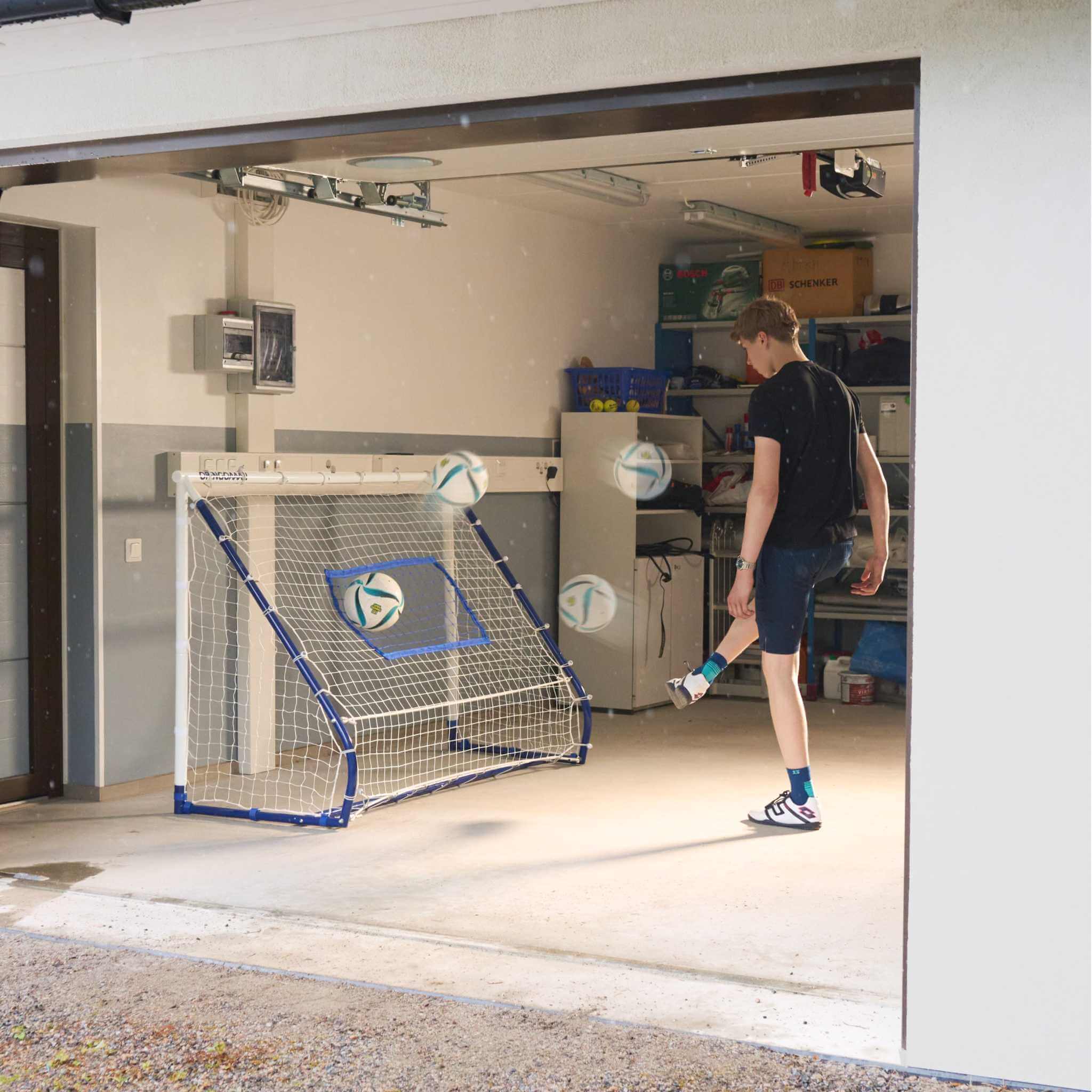
Most of it, yes. Dribble patterns, on-ball off-ball running, pain shuttles and step jumps all fit in a backyard with a handful of cones. Anything with shooting is harder, since every miss rolls toward the fence or into the neighbor's yard.
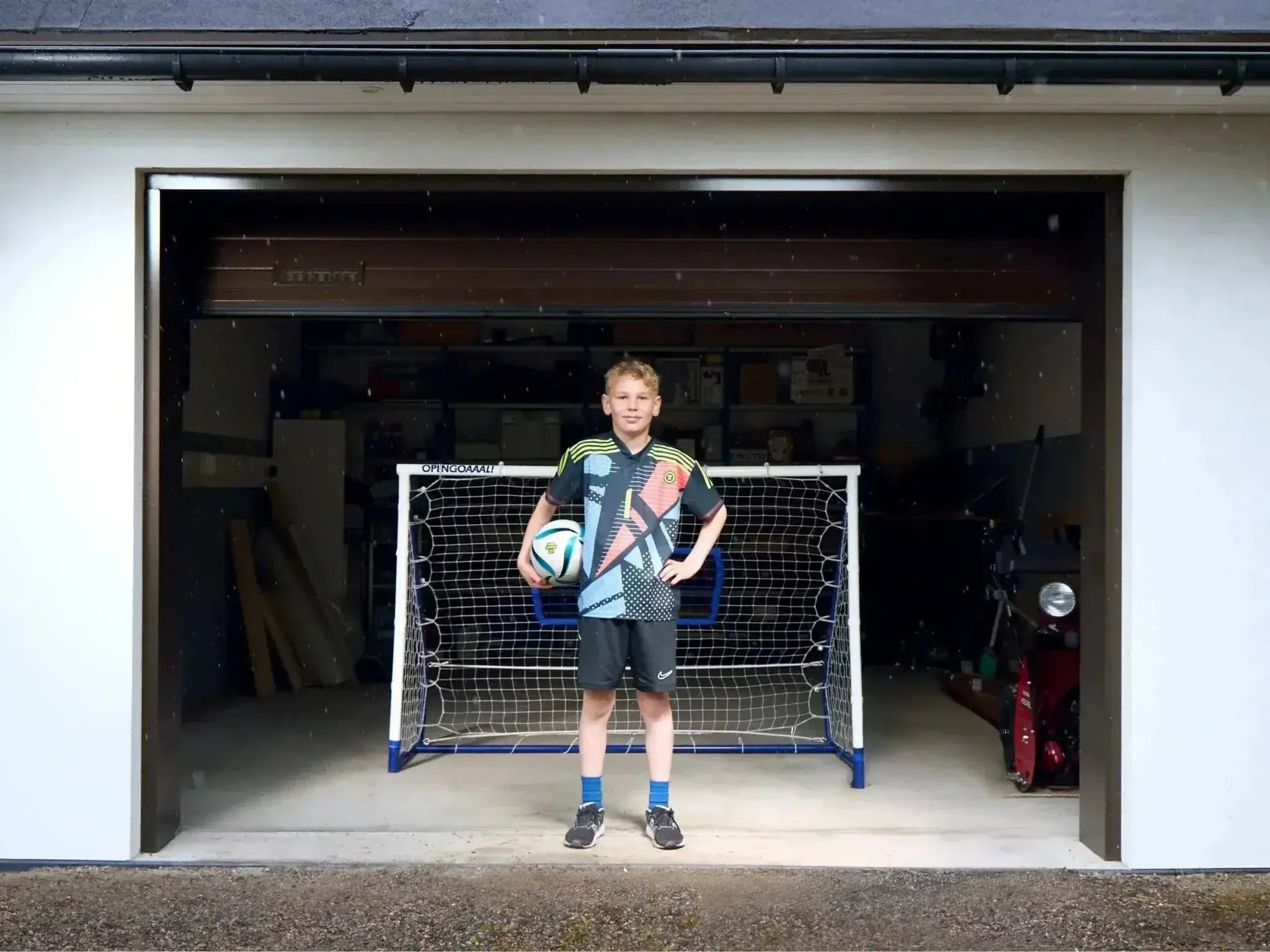
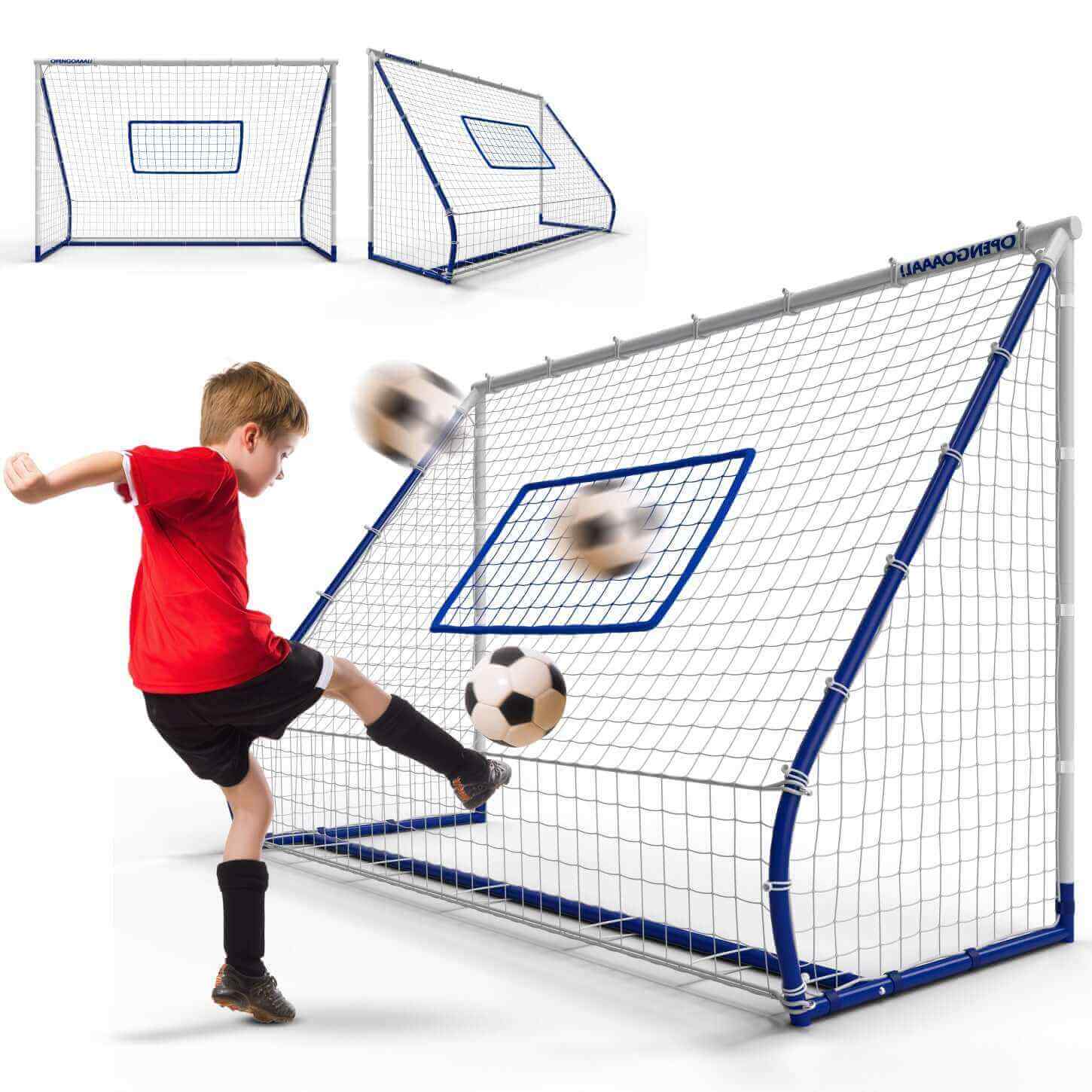
That's the problem the Open Goaaal® 3-in-1 Soccer Goal Trainer was built around. It combines a goal, a rebounder and a backstop, and on the Standard size the backstop is 10 feet tall and up to 21 feet wide, so the ball comes back and a 40-second round stays 40 seconds of work. The poles are steel and it carries a 1-year warranty. Get the first setup done before week 1: it takes about 1.5 hours with two people, and our build video covers each step. For something specific to aim at, add our precision shooting targets.
What if the plan isn't working?
Legs still heavy after a rest day. Repeat the previous week instead of moving on. Slipping a week in August costs nothing that matters.
Too hot to train. Move the session to early morning or evening and follow your state association's heat policy. If a player feels unwell, stop and bring in the athletic trainer or a parent.
The player is under 12. Skip the track work entirely. Games such as rondos, 3v3 and plenty of backyard play keep younger kids running without anyone calling it fitness.
FAQ
How many weeks before tryouts should I start conditioning?
Four weeks gives you the 14-day heat window plus two weeks of harder work. Starting in July is fine as long as those early sessions stay light.
Should soccer conditioning be done with the ball?
Where you can, yes. Four of the ten drills here are built around a ball, pain shuttles work with one too, and the small-sided games keep it in play the whole time.
How many days a week should a high school player condition?
Four to five sessions a week in this plan, with at least one full rest day. In the first five days of preseason the NATA guidelines allow one practice a day at most.
What should a player eat on conditioning days?
The same timing rules as game day apply: KidsHealth suggests a meal 3 to 4 hours before activity with plenty of carbs, some protein and little fat, a lighter snack when there's less time, and water throughout. Our guide to what to eat before a soccer game has the details.
This article is general information, not medical advice, diagnosis or treatment. For a persistent or worsening symptom, or any concern about your health, speak to a qualified healthcare professional.
Where to start this week
Look up your state association's heat rules today, count back four weeks from tryouts and write week 1 on the calendar. If season dates aren't set yet, our post on when soccer season starts lays out the usual calendar, and our soccer goals are there if the backyard is going to carry some of the load.