
A give-and-go is a two-pass move: you pass to a teammate, run past your defender, and get the ball straight back. The six drills below build it in order, from a small 2v1 square to full games where the move earns bonus points, plus a version a parent and child can run at home.
What is a give-and-go in soccer?
It's a 2v1 trick for getting behind one defender. Coaches also call it a one-two or a wall pass, because the teammate acts like a wall the ball bounces off.
The player on the ball dribbles at a defender to draw them in. Just before the defender can tackle, the dribbler passes to a teammate off to the side and immediately sprints past the defender's shoulder. The teammate returns the ball first time into the space behind. The defender has to choose between following the runner and closing down the passer, and can't do both.
Most failed one-twos come down to one of these three details.
- Commit the defender first. Pass too early and the defender simply drops off and covers the run.
- Go the moment you pass. The run starts with the pass, not after you watch it arrive.
- Play the return into space. The wall player passes to where the runner is going, usually with one touch.
Kids usually understand it after one demonstration and still mistime it for weeks, which is why the drills below build it in stages.
6 give-and-go soccer drills, from easy to game speed
The first two isolate the pass and the run. Drills 3 to 5 add defenders and goals. Drill 6 is a pattern to repeat once players know the move. Grid sizes are our suggestions for players around U9 to U12.
1. 2v1 square
Set-up
Six players, one ball, and a square about 10 by 10 yards. On two opposite sides stand two targets; on the other two sides stand two "bounce" players. The last two players start inside the square.
How it runs
A target passes into one of the two middle players, who becomes the attacker; the other middle player defends. The attacker's job is to get the ball to the target on the opposite side, and the only way through is a give-and-go with either bounce player. Each completed one-two that reaches the far target is a point. If the defender wins it, the two middle players swap roles. Rotate everyone to a new position every three minutes.
What it trains
Reading one defender, picking which bounce player to use, and telling them where you want the ball back. It's the move in its smallest form. If the attacker keeps trying to dribble through instead, run a few rounds of our 1v1 soccer drills first and come back to it.
2. Dribble and support triangle

Set-up
Eight players split into two groups of four, two balls, and two cones about 5 yards apart in the middle of a grid. Each group forms a triangle of three players, with the fourth waiting behind a cone.
How it runs
The first player dribbles at the middle player of their triangle, passes and runs, then gets the ball back and dribbles on to the next corner. Both groups run the pattern at once, which means players have to keep their heads up as the two triangles cross. Swap positions after each lap.
What it trains
Dribbling under control, then releasing the ball without breaking stride. Eye contact with the next player matters more than speed here. It also works as a warm-up for the drills that follow.
3. Conditioned game
Set-up
Twelve players, one ball, and a field about 50 by 30 yards with a 10-yard end zone at each end. That leaves a 30 by 30 yard middle. Put one target player in each end zone, and five attackers against five defenders in the middle.
How it runs
A target starts it by passing to an attacker. The attackers try to work the ball through the middle and into the target in the far end zone, and every completed pass to that target is a point. If the defenders win it, they become the attacking team and aim for the opposite target. Restart balls that go out with a throw-in or a kick-in. Limit touches once the group is comfortable.
What it trains
The give-and-go in traffic. With five players a side there are more passing options and less space, so players have to spot when a one-two is on and when a different pass is better. Older players can practice disguising which way the return pass will go.
4. Beat the offside line
Set-up
Two even teams, two goals with keepers, cones, and a field size that matches the format your players play. Mark an offside line with cones near each end.
How it runs
Attackers can only cross the line in front of the goal they attack by completing a give-and-go. Defenders can't drop behind it until that happens. A goal after a one-two scores a bonus point. Switch ends after about 15 minutes, and add a one- or two-touch limit to make it harder.
What it trains
Timing the run so the receiver doesn't stray offside. Under IFAB Law 11, a player is in an offside position when any part of the head, body or feet is in the opponents' half and nearer to their goal line than both the ball and the second-last opponent. Offside is judged at the moment a teammate plays the ball, so what counts is where the runner is when the wall player returns it. Level with the second-last defender is fine; a stride beyond is offside. The run has to be timed with the return, not started so early that the runner is already past the defense. Note that U.S. Soccer's small-sided standards have no offside before U9, so keep this drill for U9 and up.
5. 3v3 small-sided game
Set-up
Six players, one ball, two small goals with keepers (or mini goals without), and a field about 20 by 15 yards.
How it runs
Normal 3v3, a point per goal. If the goal came straight after a give-and-go, it's worth two.
What it trains
Spotting the moment for a one-two in a real game, without being told when. In 3v3 every player is always within one or two passes of the ball, so there are lots of chances to try it. Watch for players who complete the first pass and then stop. That's the most common reason the return pass goes nowhere.
6. Give-and-go passing pattern

Set-up
Six players in two teams of three, two balls, and a square about 10 by 10 yards. Each team has one target on each of two opposite sides and one player in the middle.
How it runs
A target passes to their middle player, who sets it back first time. The target then moves in, collects the return, and passes to their team's target on the far side. The player who made the first pass now becomes the middle player, and the middle player takes their place on the outside. Both teams run it at once for three minutes; the team with the most completed patterns wins. Add a one-touch rule for older players.
What it trains
Pure repetition of the pass, the run and the return. Once the move holds up in games, this pattern is a quick way to keep it sharp, and it slots into the same part of practice as a rondo.
How can you practice a give-and-go at home?
With two people, it's easy: a parent stands still as the wall, the player dribbles at a cone (the "defender"), passes, runs past it and takes the return. Swap sides so both feet get the pass and the return.
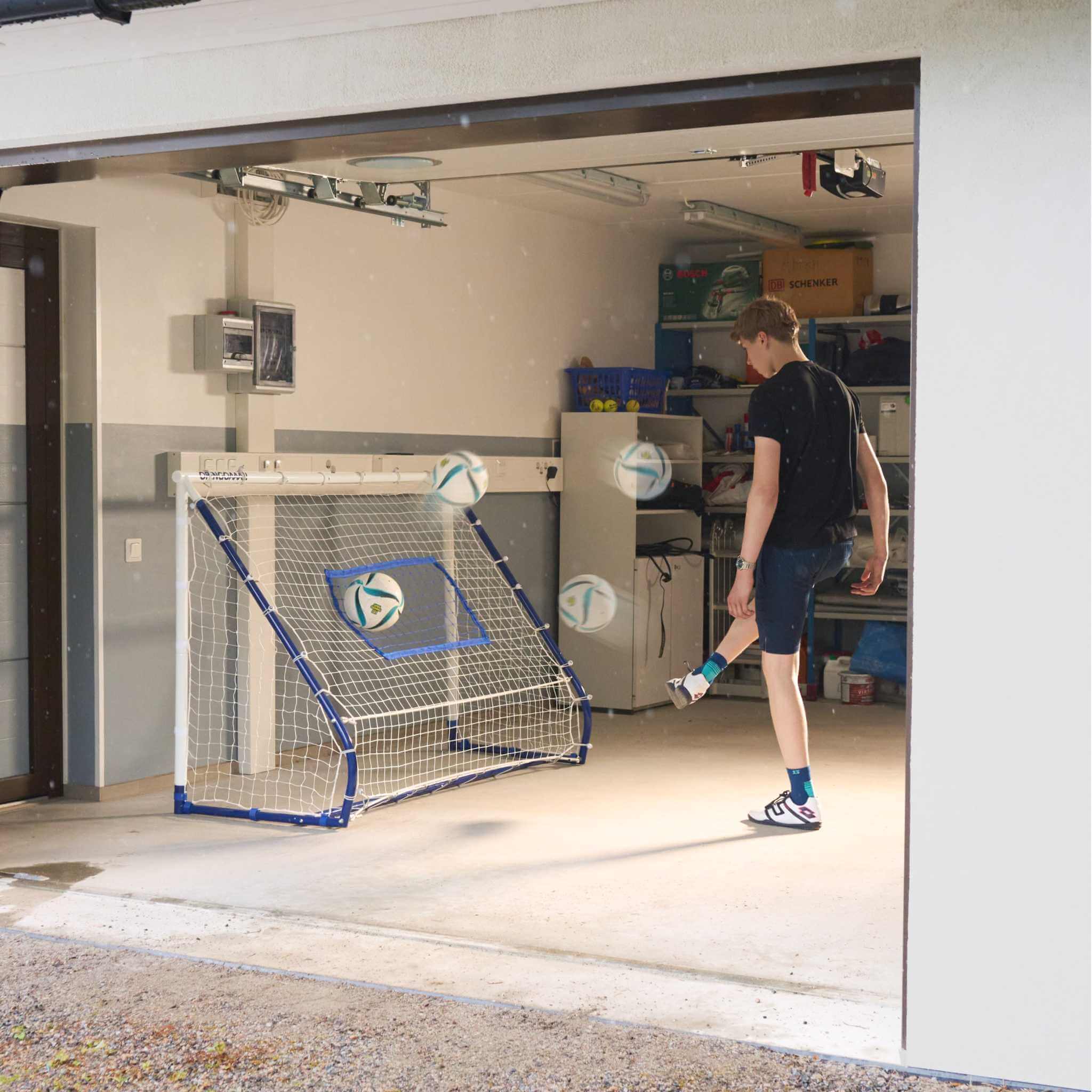
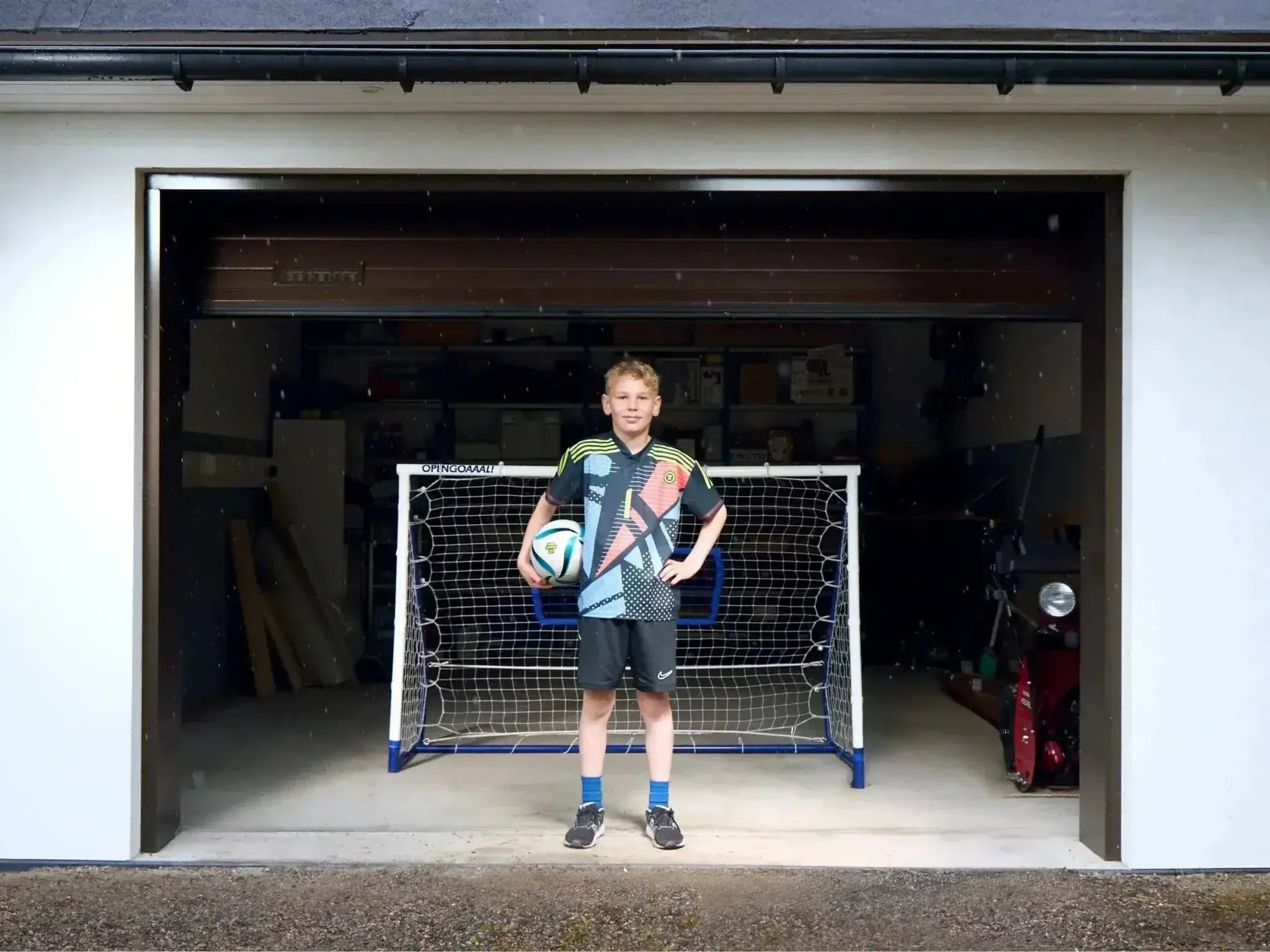
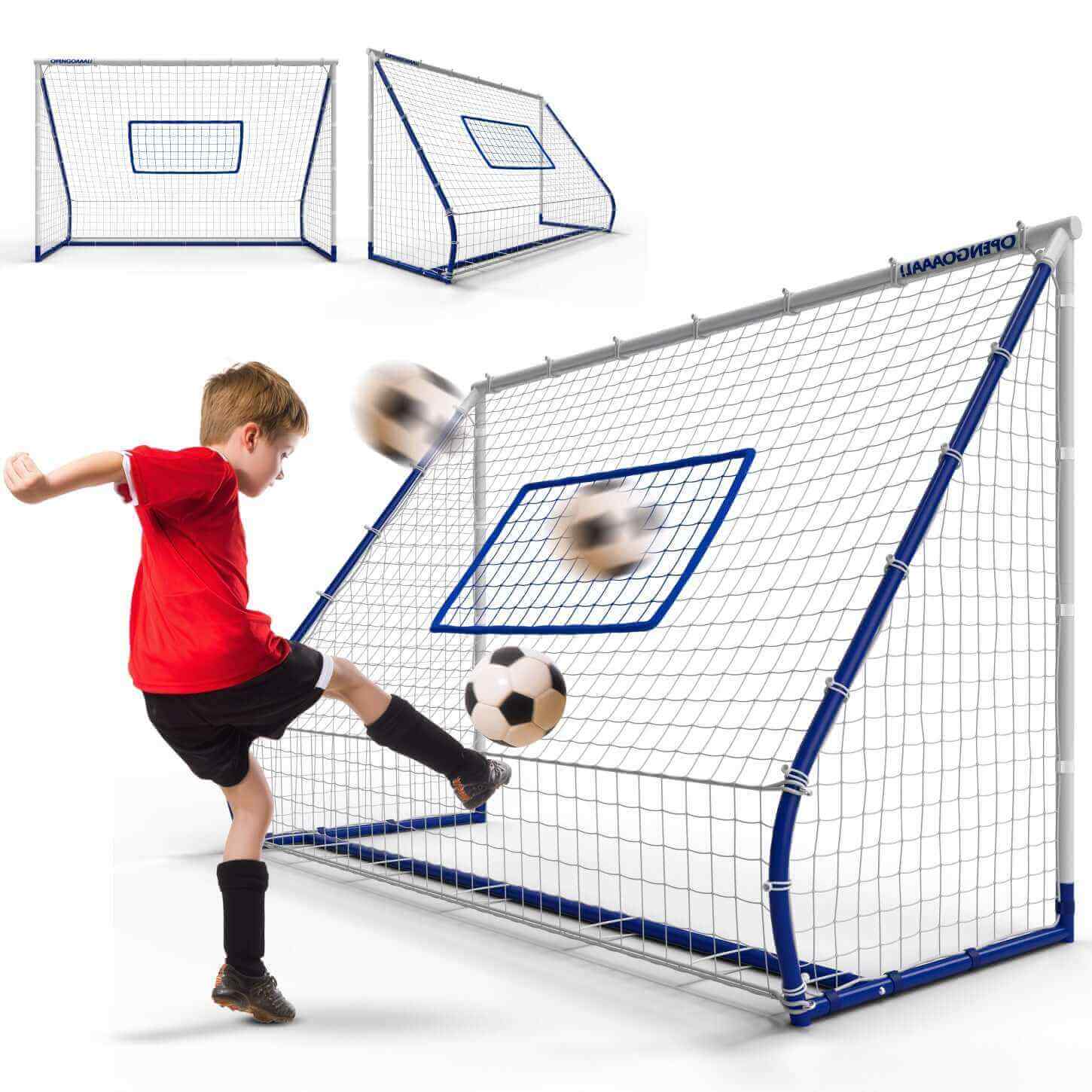
Alone, a player needs something that sends the ball back. The Open Goaaal® 3-in-1 Soccer Goal Trainer combines a goal, a rebounder and a backstop, so a firm pass into the rebounding net comes back as a return ball, and a finish that misses stays in the yard. Set a cone as the defender a few yards in front, play the "give" into the net, run around the cone and shoot. The Standard has a 9 x 5 ft inner goal with a backstop 10 ft tall and up to 21 ft wide, and the width can be set narrower for smaller yards. First setup takes two people and about 1.5 hours; the build video is on our Standard and Large build page.
Ten reps from each side, then switch the starting foot. Our article on five ways to use a soccer rebounder has more routines like this.
Give-and-go drills FAQs
What is the difference between a give-and-go and a one-two?
Nothing. Give-and-go, one-two and wall pass are three names for the same move.
What age can kids learn the give-and-go?
As soon as they can pass to a teammate on purpose. U.S. Soccer's game formats put U7 and U8 in 4v4, which leaves plenty of 2v1s to try it in. Drills 1, 2 and 5 work at that age; save drill 4 for when offside comes in.
How many players do you need for a give-and-go drill?
Two is enough for the home version. The team drills above use six to twelve.
Why does the give-and-go fail in games?
Usually one of three things: the pass is played before the defender commits, the passer stops to watch, or the return goes to feet instead of into space.
Final thoughts
Run the drills in order. The square and the triangle teach the timing, the games make players choose when to use it, and the pattern keeps it sharp. If a drill breaks down, go back a step rather than adding pressure. For the passing and possession work around it, see our possession drills and passing drills, and our attacking drills put the one-two into numbers games near goal.