
The best soccer socks for a youth player cover the shin guards, match the team color and fit the foot without bunching in the cleat. Most kids need two kinds: a long team sock for games and a grip sock underneath or on its own for practice.
Rather than rank brands, this guide walks through the seven types of soccer sock you'll see in stores, what each one is for, and what the rules say about them. Then come the three things to check on any pair: material, length and size.
What do the rules say about soccer socks?
Socks are required, and they have to cover the shin guards. The IFAB Laws of the Game, Law 4 lists socks as compulsory equipment and says shinguards must be covered by them. It also says any tape or material worn on the outside of a sock has to be the same color as the part of the sock it covers.
US high school adds a few rules of its own. According to the NFHS 2024-25 rules comparison, both socks must be a similar main color, tape on a sock must be a similar color to that part of the sock, and the home team wears dark jerseys and socks while visitors wear white jerseys and solid white socks. For club and rec soccer, your league's uniform list has the final say, so check with the coach before buying a different shade.
1. Over-the-calf team socks
This is the standard game sock: long, ribbed at the top, in your team's color, pulled up over the shin guard to just below the knee. If your club sends a uniform list, this is the sock on it.
Buy two pairs so one is always clean on game day. A good team sock keeps its stretch at the top, so it stays up over the guard through a whole game without tape.
2. Cushioned performance socks
These are team-length socks with extra padding at the heel, toe and sometimes the ball of the foot. Some add a tighter band around the arch so the sock doesn't twist.
Players who like a snug cleat often prefer less cushion, since padding takes up room inside the shoe. Try them on with the cleats, not on their own.
3. Anti-slip grip socks
Grip socks have rubbery pads on the sole that hold the foot against the inside of the cleat. Plenty of players wear them on game day too, either cut down or under a sleeve.
Most grip socks are crew or calf length. That's fine for practice, but on its own a short sock won't cover a shin guard for a game.
4. Dual-grip socks
A dual-grip sock has pads on the inside of the sock as well as the outside. The inner pads hold the foot in the sock and the outer pads hold the sock in the cleat. What you get is fewer layers sliding against each other.
We sell LUX grip soccer socks on this store. LUX is a sister brand of Open Goaaal®; both are owned by eBrands. The socks use LUX's Dual Grip pads on the inside and outside, and come in calf and knee lengths in a range of team colors.
5. Leg sleeves with grip socks
Lots of older players wear a short grip sock on the foot and a footless sleeve from the ankle to the knee. The sleeve covers the shin guard; the grip sock does the job inside the cleat.
This is where the color rules matter. Under IFAB Law 4 and the NFHS rules above, anything worn over the sock has to match it. Buy the sleeve in your team's sock color, and if the grip sock shows above the cleat, match that too or cover it.
6. Lightweight training crew socks
A thin crew-length sock for practices, futsal or turf sessions when shin guards aren't needed. Buying a multipack means one clean pair per practice day.
Skip them for games. They won't reach over a guard, so they don't meet the uniform rules above.
7. Youth-sized socks
An adult one-size sock on a small foot leaves a heel pocket halfway up the ankle and a toe seam under the arch. Look for socks sized by shoe size, not by "youth" or "adult" alone.
As an example of how sizing is listed, our LUX multipacks come in a Junior size for roughly kids' shoe sizes 3 to 6 and an Adult one size for roughly men's 7 to 12. Most brands print a similar chart. Go by the shoe size, and size down if your kid is between two.
What should you look for in the best soccer socks?
Material, length and fit, in that order. Here's how to check each one in the store or on a product page.
Material
Read the label. Most game and grip socks are a synthetic blend, mostly polyester or nylon, with a few percent of spandex or elastane for stretch. Cotton-rich socks feel soft and some kids prefer them, especially for training. Whatever the blend, check that the top band is firm and the pads, if any, are bonded flat with no raised edges.
Length
For games, the sock (or sleeve) has to cover the shin guard, which in practice means over the calf to just below the knee. Any length works for practice. Our shin guard guide explains how long guards should be, which decides how long the sock needs to be.
Sizing
Put the sock on with the cleat. The heel of the sock should sit on the heel, not above it, and the toe shouldn't fold. If the cleat feels tight with a cushioned sock, try a thinner one before buying bigger cleats. Our guides to turf soccer shoes and how soccer cleats differ from other cleats cover the shoe side.

FAQs
Why do some soccer players wear their socks low?
Mostly preference. Some find a long sock tight around the calf or like the look. In official games the socks still have to cover the shin guards, so "low" usually means a sleeve or a sock rolled to just over a short guard.
Why do you need soccer socks?
Because the rules require them. IFAB Law 4 lists socks as compulsory and says they must cover the shin guards. They also hold the guards in place and show which team a player is on.
Do you wear two pairs of socks for soccer?
Some players do: a grip sock on the foot and a team sock or sleeve over it. If you double up, check that the cleat still fits and that the outer layer matches the team color.
Are grip socks allowed in games?
Yes, as long as the shin guards are covered and anything visible matches the team sock color. That's why many players wear a grip sock under a cut team sock or a sleeve.
Final thoughts
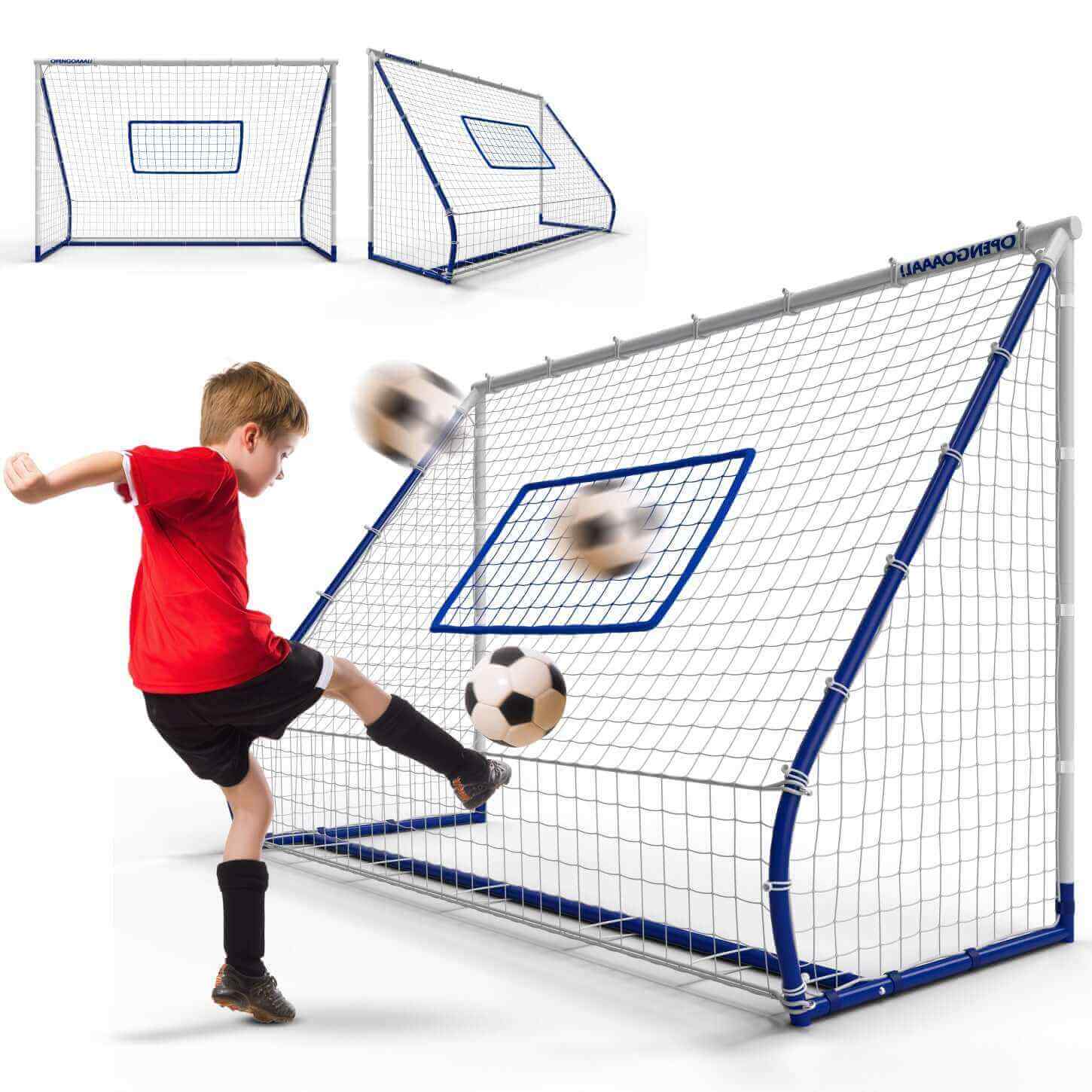
Buy the team sock your club asks for, add a grip sock for practice, and check the color rules before mixing the two. Keep a spare pair in the bag; our soccer backpack guide has more on what goes in a game-day bag. Socks are a small part of the kit; the bigger part is getting touches on a ball, and our guide to the best soccer training equipment covers what helps at home. For a backyard where the ball comes back after every shot, there's the 3-in-1 Soccer Goal Trainer, a goal, rebounder and backstop in one.