
Buy a size 3 for players in U8 and younger, a size 4 from U9 through U12, and a size 5 from U14 up. U13 depends on your league. Those sizes come from the US Youth Soccer playing rules (December 2025 edition).
What trips parents up in 2026-27 is the age group. It is decided by birth date against a cutoff, the cutoff just moved, and a kid who played U10 last spring is not automatically U11 this fall. Sort that out first and the ball is easy. If your child is brand new to the game, our guide on how old kids have to be to play soccer covers registration.
What are the soccer ball sizes for each age?
There are three sizes used in US youth games: 3, 4 and 5. Sizes 1 and 2 exist in stores but don't appear in the game rules. Which of the three your kid needs follows from their age group, and the way age groups are built has changed this season.
US Youth Soccer, AYSO and US Club Soccer are moving to an age-group cycle that runs from August 1 to July 31, starting with each organization's 2026-27 season, so that players line up with their classmates in school (US Youth Soccer, June 10, 2025). The December 2025 policy still describes the old basis, with players grouped by their age on the last day of December. Older charts you find online use that calendar-year basis.
We're not printing a birth-date chart, because the announcement doesn't publish one. Use U.S. Soccer's age group calculator instead. You enter a date of birth, and the page itself says to confirm the result with your club or league. Then check your league's 2026-27 chart before you spend anything.
Why do soccer balls come in different sizes?
Because the rules set one ball for each age group, so every game in that group is played with the same size and weight. The US Youth Soccer policy lists size, circumference and weight side by side with game length, which scales up too, from four 6-minute quarters for 6U to two 45-minute halves at 17U through 19U.
The ball grows in two steps. Kids play with the smallest game ball through U8, move to a mid-size ball for four seasons, then finish on the full-size ball the adult game uses. U.S. Soccer's game formats page follows the same bands for team size: 4v4 at most for U7 and U8, 7v7 for U9 and U10, 9v9 for U11 and U12, and 11v11 from U13.
Why does the right size matter at home?
Your player spends Saturday with one ball, and the backyard ball should be that one. A kid who practices all week with a size 5 and then plays U11 with a size 4 is practicing with a ball that never shows up on game day. Match the size first. Brand and price are a second decision.
It also tells you when to buy. Since the size only changes twice (going into U9, and somewhere around U13), most seasons last year's ball still fits. The two years to budget for a new one are the year a player turns into a U9 and the year they reach 13U.
Soccer ball size chart by age group
Ball sizes, circumferences and weights below are from the US Youth Soccer policy. The format column is U.S. Soccer's maximum for each band. Leagues can play smaller formats inside it.
| Age group | Ball | Circumference | Weight | Max game format |
|---|---|---|---|---|
| U8 and younger | Size 3 | 23 to 24 in | 11 to 12 oz | 4v4 (U7 and U8) |
| U9 and U10 | Size 4 | 25 to 26 in | 11 to 13 oz | 7v7 |
| U11 and U12 | Size 4 | 25 to 26 in | 11 to 13 oz | 9v9 |
| U13 | Size 5 in the USYS table; size 4 or a lighter 5 under U.S. Soccer's 2023 advice | 27 to 28 in (size 5) | 14 to 16 oz (size 5) | 11v11 |
| U14 to U19 | Size 5 | 27 to 28 in | 14 to 16 oz | 11v11 |
Size 5 soccer ball: U14 and up (U13 in some leagues)
This is the full-size ball from high school to the pros. The IFAB Laws of the Game, Law 2 set it at 27 to 28 inches around (68 to 70 cm), 14 to 16 ounces at the start of a match, and 8.5 to 15.6 psi at sea level.
U13 is the one year where the national bodies disagree. US Youth Soccer's table still lists a size 5 for 13U. U.S. Soccer changed its recommendation from fall 2023 to a size 4 or a lighter size 5, and Cal North, a US Youth Soccer state association, told its members in an August 29, 2023 memo that it backed the switch by fall 2024. Ask the coach before you buy. If the answer is size 4, the U12 ball gets one more year.
High school has its own rule on top. The NFHS 2024-25 soccer guide says games use three or more balls of similar quality carrying the NFHS logo, supplied by the home team and pumped to the maker's spec. For practice at home any size 5 does the job, and our size 5 soccer ball is built for this age band.
Size 4 soccer ball: U9 to U12
This is the ball your kid keeps for four seasons. US Youth Soccer puts 10U, 11U and 12U on a size 4 at 25 to 26 inches and 11 to 13 ounces, so a 9-year-old and a 12-year-old use the same size even though one plays 7v7 and the other 9v9. Rec and travel teams don't differ here; travel coaches just tend to want every kid to bring their own ball. A good size 4 bought at U9 usually wears out before it gets outgrown. Our U12 soccer drills are written for this size.

Size 3 soccer ball: U8 and younger
The smallest ball in any US Youth Soccer game. Both the 6U and 8U groups use a size 3 at 23 to 24 inches and 11 to 12 ounces. Those games are short and small: four 12-minute quarters for 8U, with no more than five players a side and four strongly recommended.
Buying in spring? Check whether your U8 player moves up to U9 in the fall. If so, a new size 3 gets a few months of use and a size 4 is the better buy. Our U6 soccer drills and drills for 8 year olds both use a size 3.
Size 2 soccer ball: a skills ball
You won't need one for a league. The size 2 isn't listed in the US Youth Soccer game table at any age. Families buy it as a second ball for juggling and close control, or for a toddler who wants to copy an older sibling. Sizes vary a little by maker, so read the label. If juggling is the plan, our guide to juggling a soccer ball walks through it.
Size 1 soccer ball: the mini
The mini ball is a keepsake or toy size, also absent from the game rules. It fits on a shelf and in a backpack. As a first ball for a toddler it's fine; for a 5-year-old heading to a 6U team, skip it and buy the size 3 they'll actually play with.
Should the backyard ball match the league ball?
Yes, in almost every case. Some older players like a smaller ball for footwork as an extra challenge, which is reasonable. A house with a U8 and a U12 needs one ball in each size, so the younger one isn't wrestling a size 4.
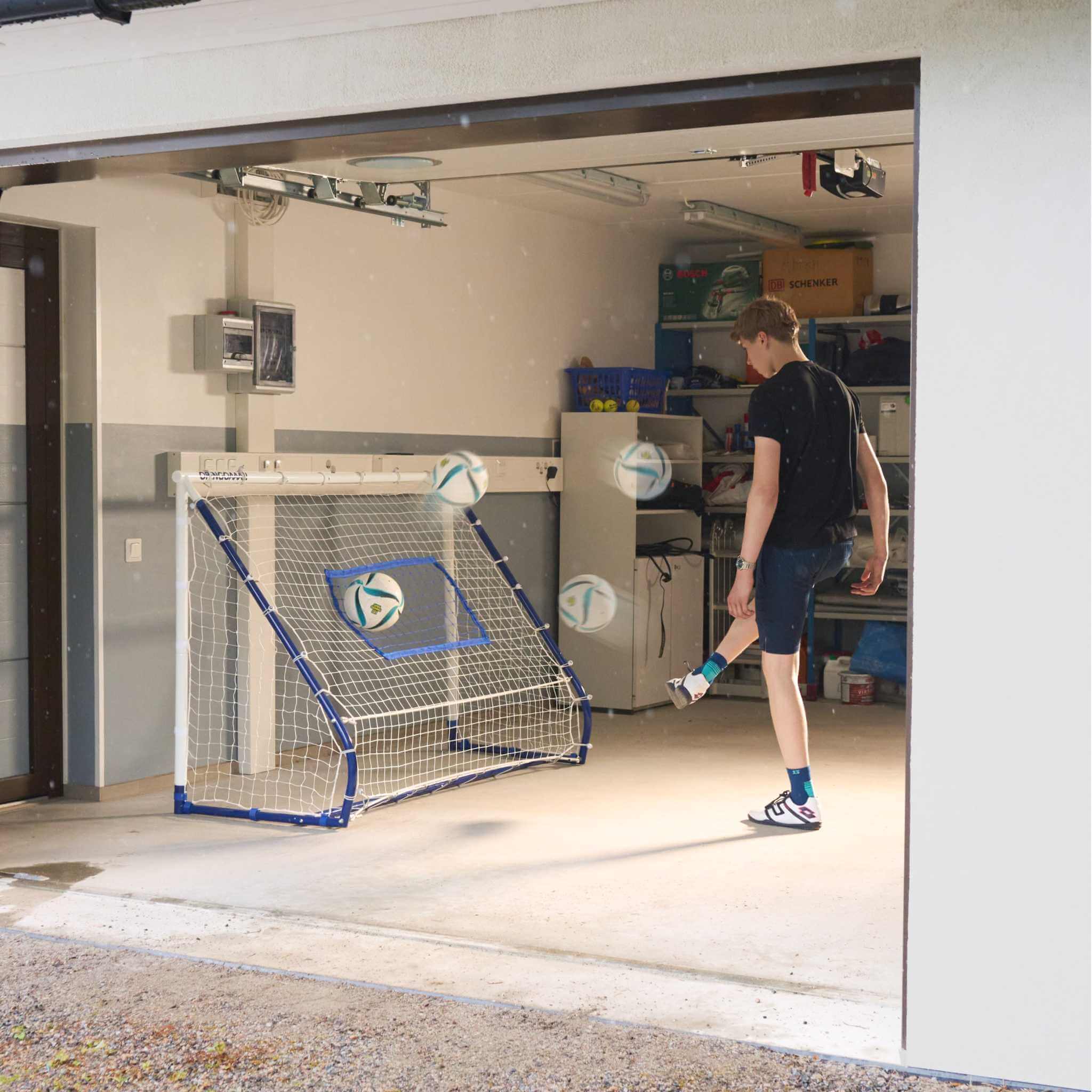
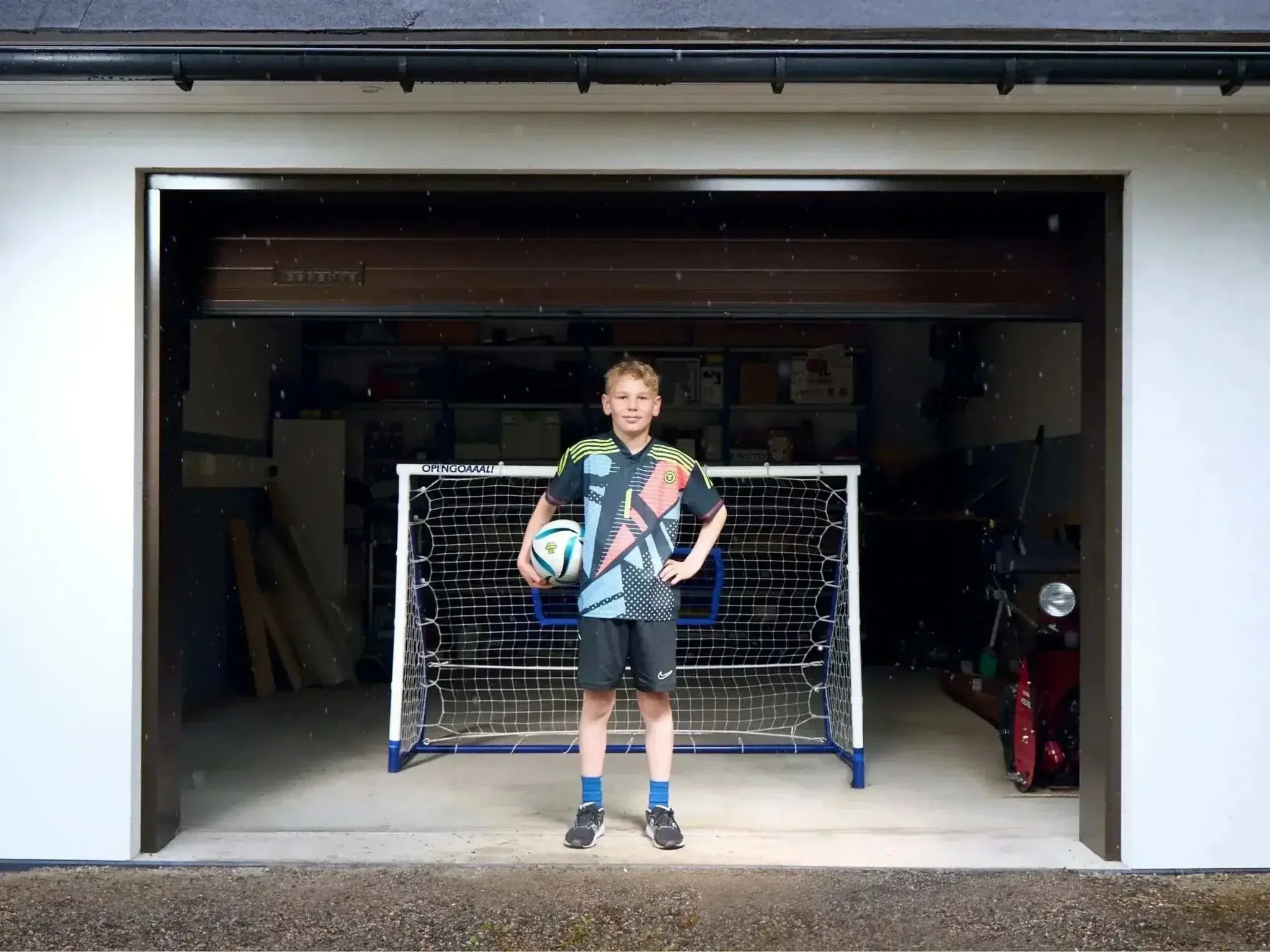
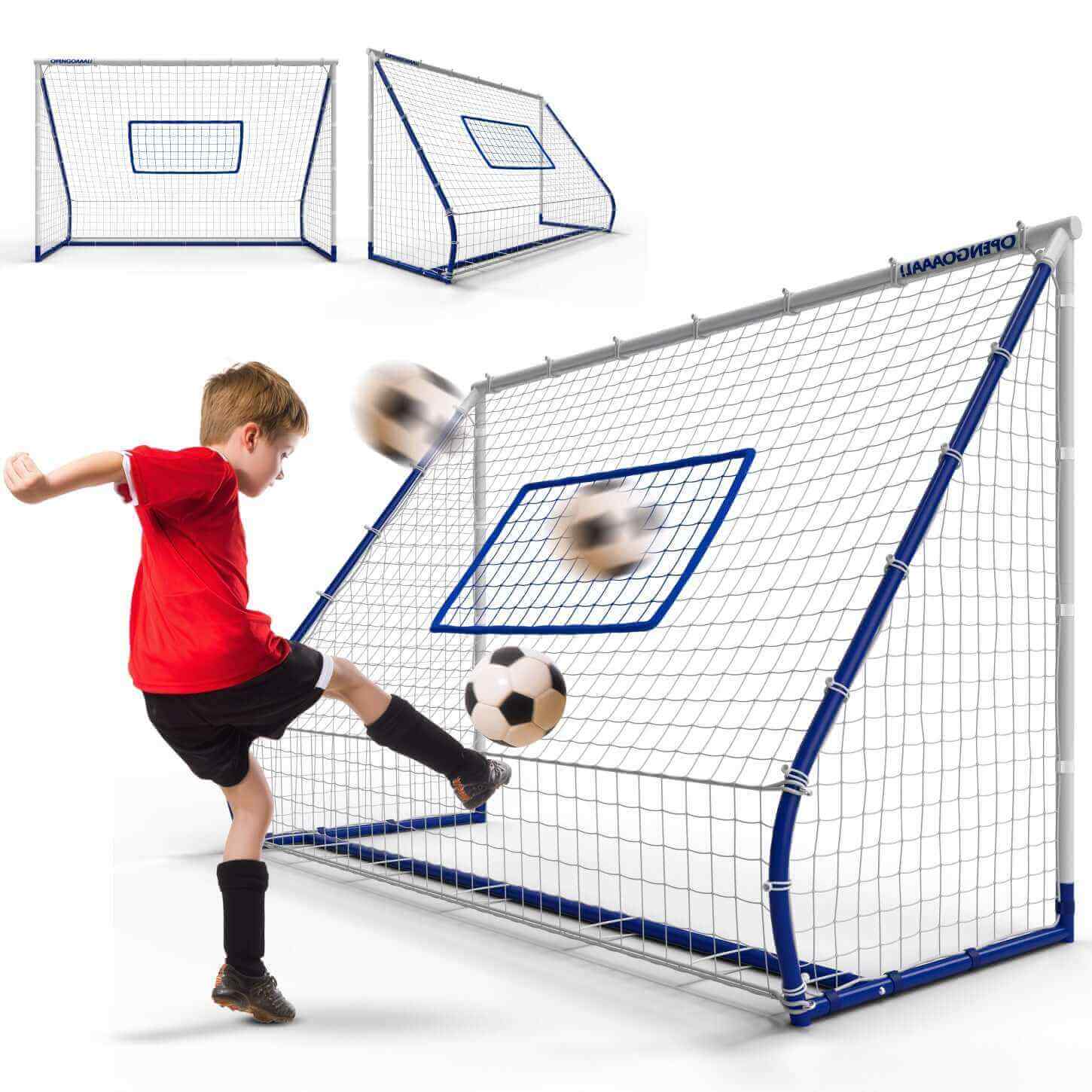
The ball is half the setup; the other half is somewhere to kick it that doesn't end with a ball in the street. The Open Goaaal® 3-in-1 Soccer Goal Trainer is a goal, a rebounder and a backstop in one frame, so most missed shots come back to the player and practice keeps going. The Junior has an 8 x 4.5 ft inner goal and a backstop 8 ft tall; the Standard has a 9 x 5 ft inner goal and a 10 ft backstop. Both stand on natural grass.
Pressure matters too. A soft ball feels dead off the foot. Pump it to the number printed by the valve and check it every couple of weeks (a cheap gauge does the job).
Frequently asked questions
What size soccer ball for an 8 year old?
A size 3 if they play U8, a size 4 if they've moved up to U9 or U10. Under the new August 1 cycle, your league's 2026-27 chart decides which group an 8-year-old lands in.
What size soccer ball for a 10 year old?
A size 4. A 10-year-old ends up in U10 or U11 depending on their birthday, and US Youth Soccer uses a size 4 for both.
What size soccer ball for a 5 year old?
A size 3. US Youth Soccer uses a size 3 for its youngest group, 6U, so that's the ball a 5-year-old will see at practice and games.
What size soccer ball for a 9 year old?
A size 4. A 9-year-old plays U9 or U10, and both use a size 4.
What PSI should a youth soccer ball be?
Whatever is printed on the ball. The IFAB range of 8.5 to 15.6 psi is for the full-size ball; for sizes 3 and 4, follow the maker's number.
Final thoughts
Check the age group on your league's 2026-27 chart (the cycle now starts August 1), then buy for that group: size 3 through U8, size 4 from U9 to U12, size 5 from U14, and ask the coach at U13. Picking a goal too? Our goal sizes by age guide uses the same age groups, and the rundown of ball sizes 1 to 5 goes deeper on specs. The soccer ball collection is sorted by size.