
A striker's main job is to score; a center forward's job is to lead the line, which means scoring but also holding the ball up, linking with midfield and pressing. In everyday use the two names overlap, and most teams' No. 9 is asked to do a bit of both.
There's no rulebook definition of either one. The Laws of the Game don't define them, so these are coaching terms, and coaches use them a little differently. Below is how they're most commonly understood, a side-by-side table, and how U.S. youth teams use a "9" once they reach 9v9 and 11v11.
What is a striker in soccer?
A striker is the forward whose first job is putting the ball in the net. They play highest up the field, live on the shoulder of the last defender and spend most of the game making runs into the penalty area: across the near post, in behind the back line, or into the space a teammate's run has opened.
Strikers are judged on goals. Their touches tend to be short: control and shoot, or shoot first time. The best ones are good at arriving in the box at the right moment and finishing with either foot or the head, often from a single touch.
U.S. fans got a clear example at the 2026 World Cup. U.S. Soccer described Folarin Balogun as "a true striker through and through" (June 23, 2026), after a group game in which he scored with a one-touch finish from a cross.
What is a center forward in soccer?
A center forward is the central attacker who leads the line and connects the attack. They still score, but a bigger share of their work happens with their back to goal: receiving long balls and passes into feet, shielding the ball from a center back, laying it off to midfielders and wingers, and then getting into the box for the finish.

Center forwards also set the team's press. When the other team has the ball at the back, the center forward decides when to close down the center backs and which way to force them. A good one makes the whole front line look organized.
Some teams use a "false 9," a center forward who drops deep into midfield to pull a center back out of position. That's a center forward at the far end of the scale from a pure striker.
What do center forwards and strikers have in common?
More than the debate suggests. Both play centrally and high, both are measured partly on goals, and both need the same core skills:
- finishing with both feet, and with the head at the ages where heading is allowed
- a clean first touch under pressure, often with a defender on their back
- off-the-ball movement to lose a marker for a split second
- timing runs so they stay onside
- pressing defenders when the other team has the ball
That's why the same player can be called a striker in one article and a center forward in the next. It's often the same position seen from a slightly different angle.
What is the difference between a center forward and a striker?
The difference is emphasis. A striker leans toward finishing and runs in behind; a center forward leans toward linking play and holding the ball up. Here's how that usually plays out.
| Striker | Center forward | |
|---|---|---|
| Main job | Score goals | Lead the line, link play, score |
| Typical position | On the last defender's shoulder, in and around the box | Central, often a few yards deeper, moving between the lines |
| Facing | Mostly toward goal | Often back to goal |
| Touches | Few, quick, mostly in the box | More, spread across the attacking third |
| Key strengths | Finishing, timing of runs, pace in behind | Hold-up play, passing, strength, stamina, pressing |
| Measured by | Goals | Goals plus assists, chances created, how the team attacks |
| Common setup | Paired with a second striker, or alone with runners around them | Alone up front with wingers and attacking midfielders |
The setup line is where it shows most. At the 2026 World Cup, U.S. Soccer noted that Balogun could play alone up top, as he did against Paraguay, or alongside a second striker, as against Australia. When Mauricio Pochettino started Ricardo Pepi next to him, the pair pressed from the start. Playing alone pushes a forward toward the center forward job. Playing in a pair lets one of them be the pure finisher.
What does a center forward do in a game?
A center forward gives the team a focal point. When the defense is under pressure, they're the outlet for a long ball, and their job is to win it or keep it long enough for teammates to get up the field. In possession, they drop in to receive between the lines, lay passes off and spin to attack the box when the ball goes wide.
Without the ball, they're the first defender. Many coaches ask the center forward to block the pass into the defensive midfielder and steer the other team's build-up toward one side. That's a lot of running, which is why stamina is near the top of most coaches' list for this role.
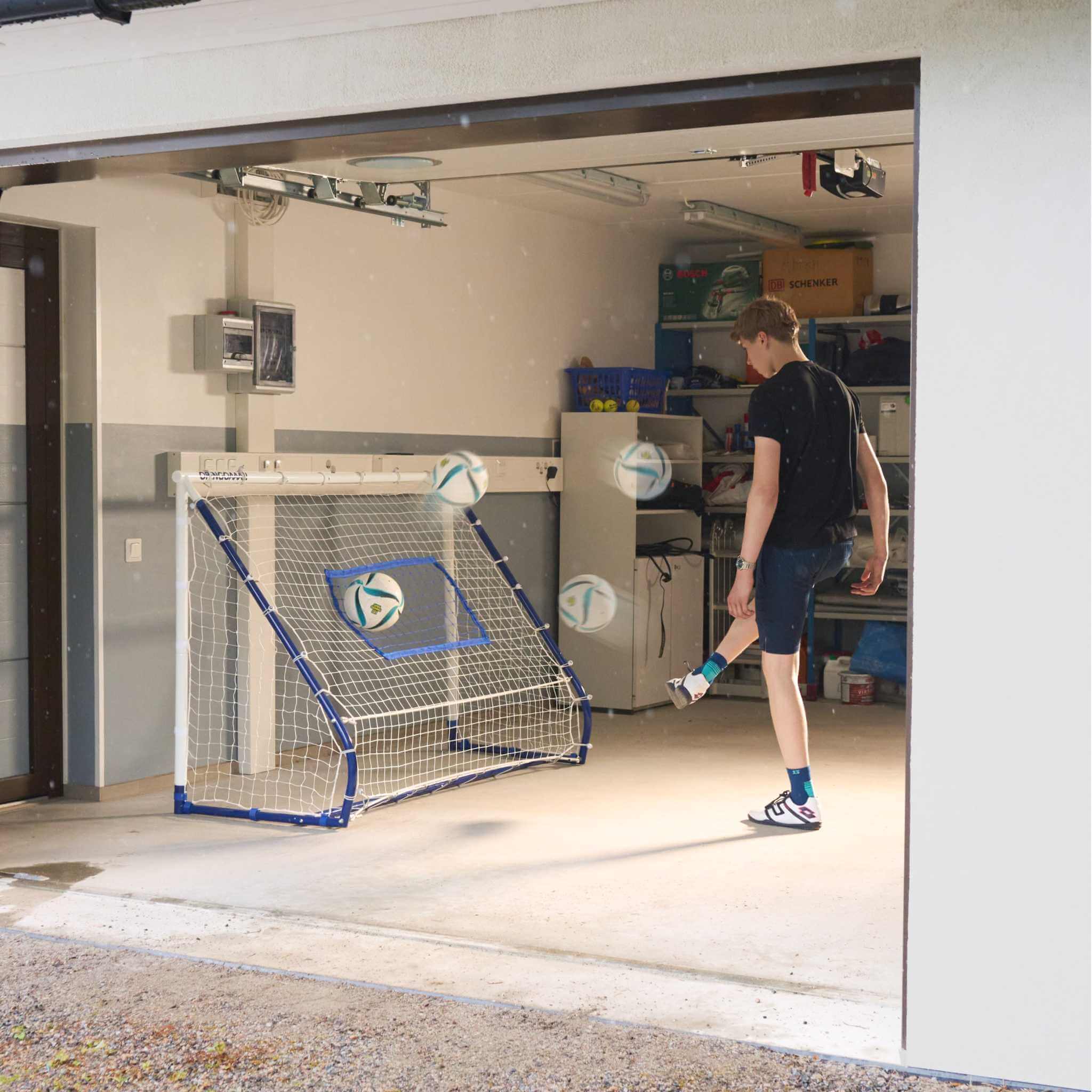
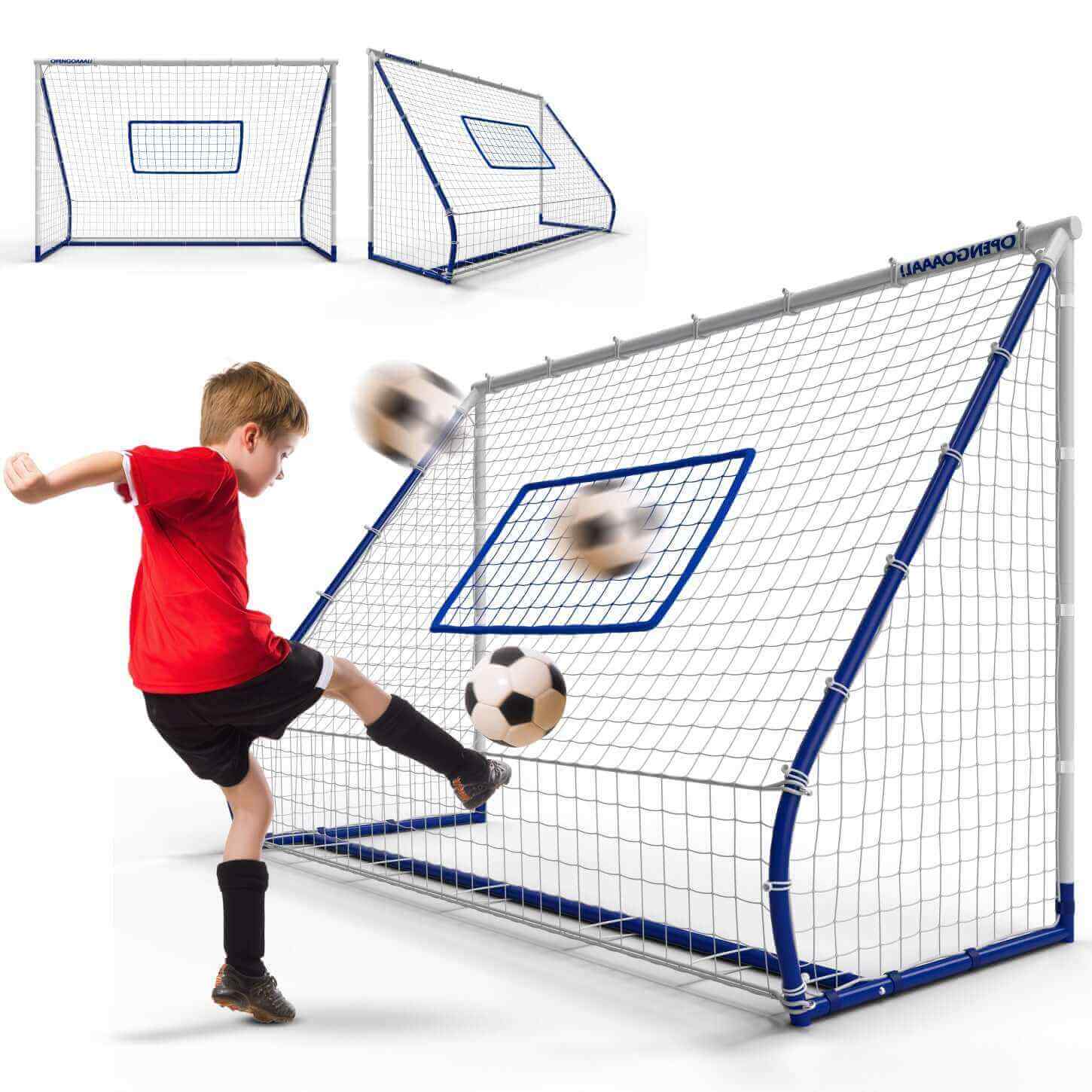
If you're working on this at home, the hold-up part is easy to practice with a parent or teammate playing passes into feet: receive, protect the ball with your body, lay it back, then spin and finish. A Standard 3-in-1 goal, with a 9 x 5 ft inner goal and a backstop up to 21 ft wide, keeps those finishes and misses in the yard.
What does a striker do in a game?
A striker's game is about the penalty area. They make repeated runs to lose their marker: a dart to the near post, a curve in behind the last defender, a check away and back to make space for a cutback. Most of their best work happens in the last second before the ball arrives.
Strikers still press and still help the team, but coaches judge them mainly on whether they're in the right place when chances come. A striker who finishes well but rarely touches the ball outside the box can be exactly what the team needs. For finishing practice suited to younger players, try our kids' shooting drills and soccer attacking drills.
How do U.S. youth teams use the "9"?
The "9" comes from the old shirt-numbering tradition, where the central forward wore No. 9 (the story behind famous soccer player numbers goes deeper). In U.S. youth soccer, the role only really takes shape once teams play bigger formats. U.S. Soccer's game formats cap U9 and U10 at 7v7, U11 and U12 at 9v9, and start 11v11 at U13.
- 7v7 (U9 to U10): usually one central forward. Players are best served rotating through it rather than owning it.
- 9v9 (U11 to U12): one or two forwards. A lone forward here does both jobs: hold the ball up for midfield runners and get in the box.
- 11v11 (U13 and up): the striker vs center forward split starts to mean something, depending on whether the team plays one forward or two. Where the 9 fits in each shape is laid out in soccer formations for 11v11.
Heading is part of the job at the older ages only. US Youth Soccer's policy on players and playing rules (December 2025) bars players 10 and under from heading in matches, so younger forwards finish with their feet. For more on rotating kids through positions, see our guide to youth soccer positions.
Center forward vs striker FAQ
Who are some famous center forwards in soccer?
For U.S. fans, Folarin Balogun led the line for the USMNT at the 2026 World Cup, sometimes alone and sometimes with Ricardo Pepi beside him. Across the game, any team's No. 9 is usually its center forward, so the easiest way to spot one is to watch who the long balls go to.
Is center forward the hardest position in soccer?
It's one of the most demanding, because the player has to score, hold the ball up and press, often while being marked by two center backs. Whether it's the hardest is a matter of taste; goalkeepers and center backs would argue their case.
What qualities should a center forward have?
Finishing, a strong first touch with their back to goal, the strength to shield the ball, the stamina to press for a full game and the awareness to know when to drop in and when to run in behind.
Is a striker the same as a No. 9?
Usually, yes. "No. 9" is shorthand for the main central forward. Whether that player is more of a striker or more of a center forward depends on the team's system and the coach's instructions.
Final thoughts on center forward vs striker
Think of it as a sliding scale. At one end is the pure finisher who lives in the box; at the other is the link player who drops off and brings others in. Most 9s sit somewhere in the middle, and in youth soccer the best thing a young forward can do is learn both halves of the job. For the other end of the field, read our guide to the sweeper in soccer.
Finishing takes a lot of repetitions, and the Open Goaaal® 3-in-1 Soccer Goal Trainer combines a goal, rebounder and backstop so the ball comes back and the next shot is ready.