The best soccer drills for 10 year olds are short, use one ball per player and put a decision into as many repetitions as they can. Below are eight you can run in a backyard with a size 4 ball, a handful of cones and either a wall or a rebound net, plus three 30-minute session plans that leave room for rest days.
Ten is also where match formats split. Under U.S. Soccer's Player Development Initiatives (February 2017), players register by birth year, the U9 and U10 age groups play 7v7 with a goalkeeper, the U11 and U12 groups play 9v9, and all four use a size 4 ball. A 10 year old can land in either group depending on the birth year, so every drill here works for both. The common thread is small space, few players and the ball in play as much as possible.
How long should a 10 year old practice soccer at home?
Thirty minutes is a workable backyard session, and three sessions a week leaves four days clear. That sits inside the rest-day guidance from both sources we checked. U.S. Soccer's best-practice standards for the 7v7 and 9v9 age groups say players should have at least two rest days a week during the season. The American Academy of Pediatrics' 2024 clinical report, as summarized by AAP News, tells pediatricians to encourage at least one to two days off a week from competition and sport-specific training.
If your child already trains with a team, count those sessions first and trim the backyard plan to fit. The plans further down are built so you can drop a drill without breaking the session.
What do you need for these drills?
One size 4 ball, six to eight cones (water bottles or shoes work), a flat wall or a rebound net, and a goal for the finishing drills. Three of the eight drills need a second person, and any parent or sibling will do. Check the ground for holes and keep the area clear of windows and the street before you start.
| Drill | Players | Needs a surface that returns the ball? | Space |
|---|---|---|---|
| 1. Two-touch wall passing | 1 | Yes | 10 ft from the surface |
| 2. Cone gates | 1 | No | 20 ft x 15 ft |
| 3. Turn on the rebound | 1 | Yes | 10 ft from the surface, 8 ft wide |
| 4. Corner targets | 1 | Helpful, not required | Shots from 12, 18 and 24 ft |
| 5. Call-the-foot returns | 2 | Yes | 8 ft from the surface |
| 6. Give-and-go with the net | 1 or 2 | Yes | 15 ft x 10 ft |
| 7. 1v1 to goal | 2 | Helpful, not required | 30 ft x 15 ft |
| 8. Three-and-out game | 2 or 3 | Helpful, not required | 30 ft x 20 ft |
Drill 1: Two-touch wall passing
Two-touch wall passing is a solo drill where you pass to a wall or rebound net, control the return with one touch and pass again with the second. Stand 10 feet from the surface. Pass with the inside of your right foot, control with your left, pass back with your left. Run four 30-second rounds, count the clean returns, and swap which foot starts each round.
To make it harder, move back 3 feet or play the return first time. No wall or net? Pass back and forth with a parent from the same 10 feet.
Drill 2: Cone gates
Cone gates is a dribbling drill where you move through small gates and pick the next open one with your head up. Set six gates, each 3 feet wide, inside a 20 by 15 foot area. Dribble through any gate, then pick a different one next, never the same gate twice in a row. Run 45-second rounds, and use your weaker foot only in round three.
For a version with a decision in it, have a parent call a gate color at random. This drill needs no wall, which makes it a good opener for any session.
Drill 3: Turn on the rebound
Turn on the rebound is a solo first-touch drill: pass to the surface, receive the return and take it across your body to an open cone. Stand 10 feet away with one cone 4 feet to your left and one 4 feet to your right. Pass, let the ball come back, and take your first touch toward whichever cone you picked before the pass. Alternate sides for 10 reps, then pick your side only after the ball leaves the surface.
Once that feels comfortable, add a second touch that finishes at goal. This is one of the drills where a returning ball matters most, because every rep starts with the ball already coming back to you.
Drill 4: Corner targets
Corner targets is a finishing drill where you score points for hitting a marked corner of the goal. Place a cone or bucket about a foot inside each post. Mark shooting lines at 12, 18 and 24 feet. Take three shots at each corner from each line, give yourself a point for every target hit and try to beat your own total next session.
A miss that goes wide is the usual reason this drill stalls, because someone has to go and get the ball. Put a rebound net or backstop behind the goal and the shots keep coming. Without one, set a second ball at each line and collect them in batches.
Drill 5: Call-the-foot returns
Call-the-foot returns is a two-player drill where a parent calls "left" or "right" as the ball comes back and the player returns it first time with that foot. Stand the player 8 feet from the surface with the parent beside them, a step behind. The call should come late, once the ball is already on its way. Run 20 returns, then swap roles and let your child make the calls.
The point is the late decision. A wall works here, and so does a rebound net.
Drill 6: Give-and-go with the net
Give-and-go with the net is a drill where the rebound surface plays the part of a teammate, so you can rehearse a wall pass alone. Put a cone 8 feet in front of the surface as a "defender." Dribble at the cone, pass to the surface so the return lands past it, take the ball on the far side and finish at goal. Run six reps from each side.
When a parent is available, replace the cone with a defender moving at half speed. See our 1v1 drills guide for more ways to practice beating a defender.
Drill 7: 1v1 to goal with a parent
1v1 to goal is a two-player drill where a parent plays the ball in and the player controls it and attacks the goal while the parent defends. Use a 30 by 15 foot area with the goal at one end. The parent starts 20 feet out, passes in, and defends at half speed for three rounds, then at three-quarter speed for three more. Swap roles so your child gets to defend too.
Keep the first rounds slow on purpose. The aim is for the attacker to see the defender's body shape, not to win the ball. A backstop behind the goal keeps the finishing kicks in your yard.
Drill 8: Three-and-out game
Three-and-out is a small game where each attack gets three touches to score, which keeps the decisions quick, the way a small-sided match does. With two or three players on a 30 by 20 foot area, one player attacks at a time while the others defend. Count three touches maximum, including the first, then shoot. Play five attacks each and keep a running score.
With three players, the player not attacking is the goalkeeper. This is the drill where the younger sibling or a neighbor can join in.
Can you build a 30-minute session from these?
Yes. Each plan below fills 30 minutes, opens with Cone gates as a warm-up (see our warm-up drills for alternatives) and ends with a drill that involves a decision. Run one plan per session, three sessions a week at most.
| Block | Session A (solo) | Session B (with a parent) | Session C (with friends) |
|---|---|---|---|
| Warm-up | Drill 2, 5 min | Drill 2, 5 min | Drill 2, 5 min |
| Block 2 | Drill 1, 6 min | Drill 5, 6 min | Drill 3, 5 min |
| Block 3 | Drill 3, 6 min | Drill 6, 6 min | Drill 8, 10 min |
| Block 4 | Drill 4, 8 min | Drill 7, 8 min | Drill 7, 10 min |
| Finisher | Drill 6, 5 min | Drill 1, 5 min | None |
For more drill ideas by age, our guides to drills for 8 year olds and U12 drills sit either side of this one, and the Youth Soccer Training Program lists drills by age.
Which drills need a rebounder, and what does a 3-in-1 add?
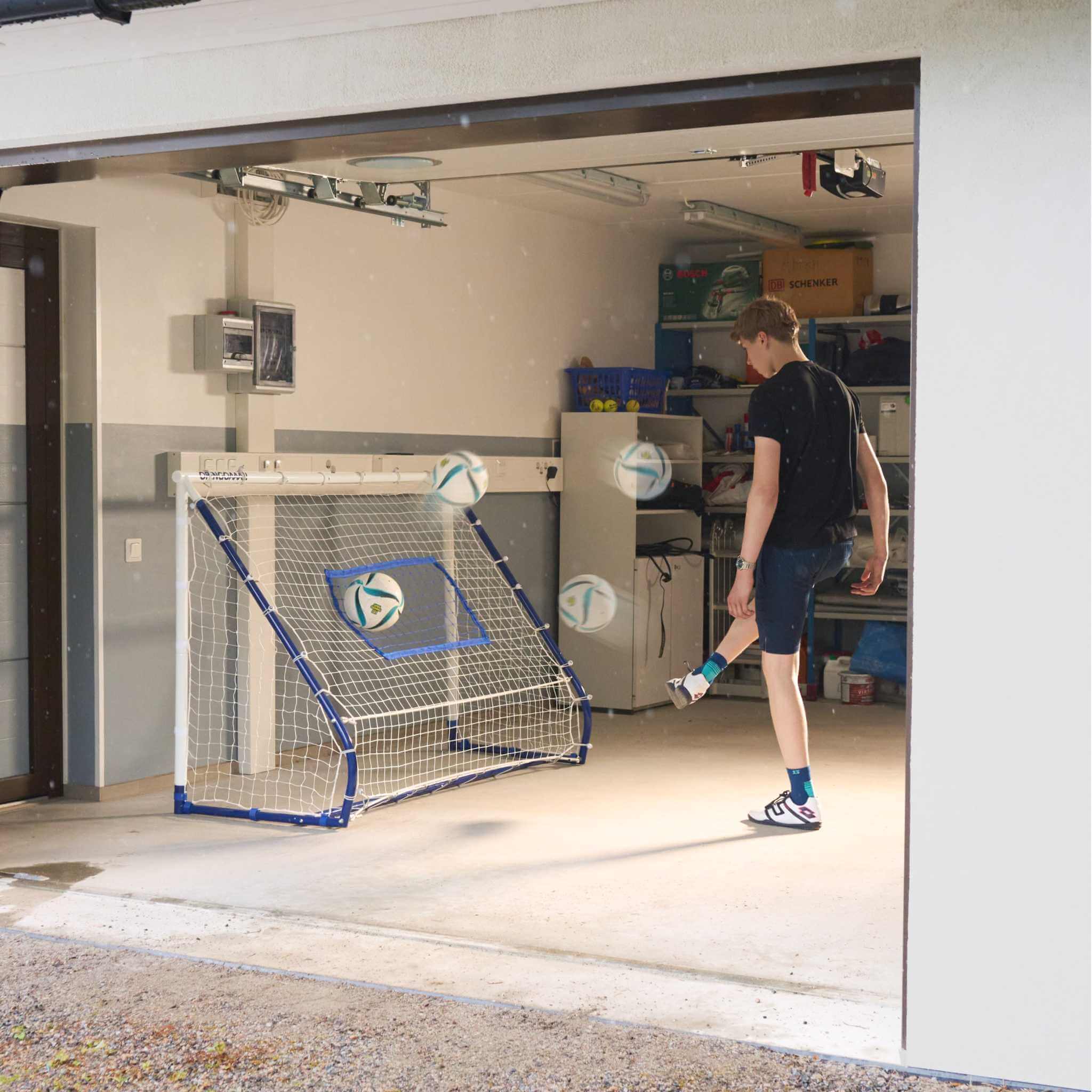
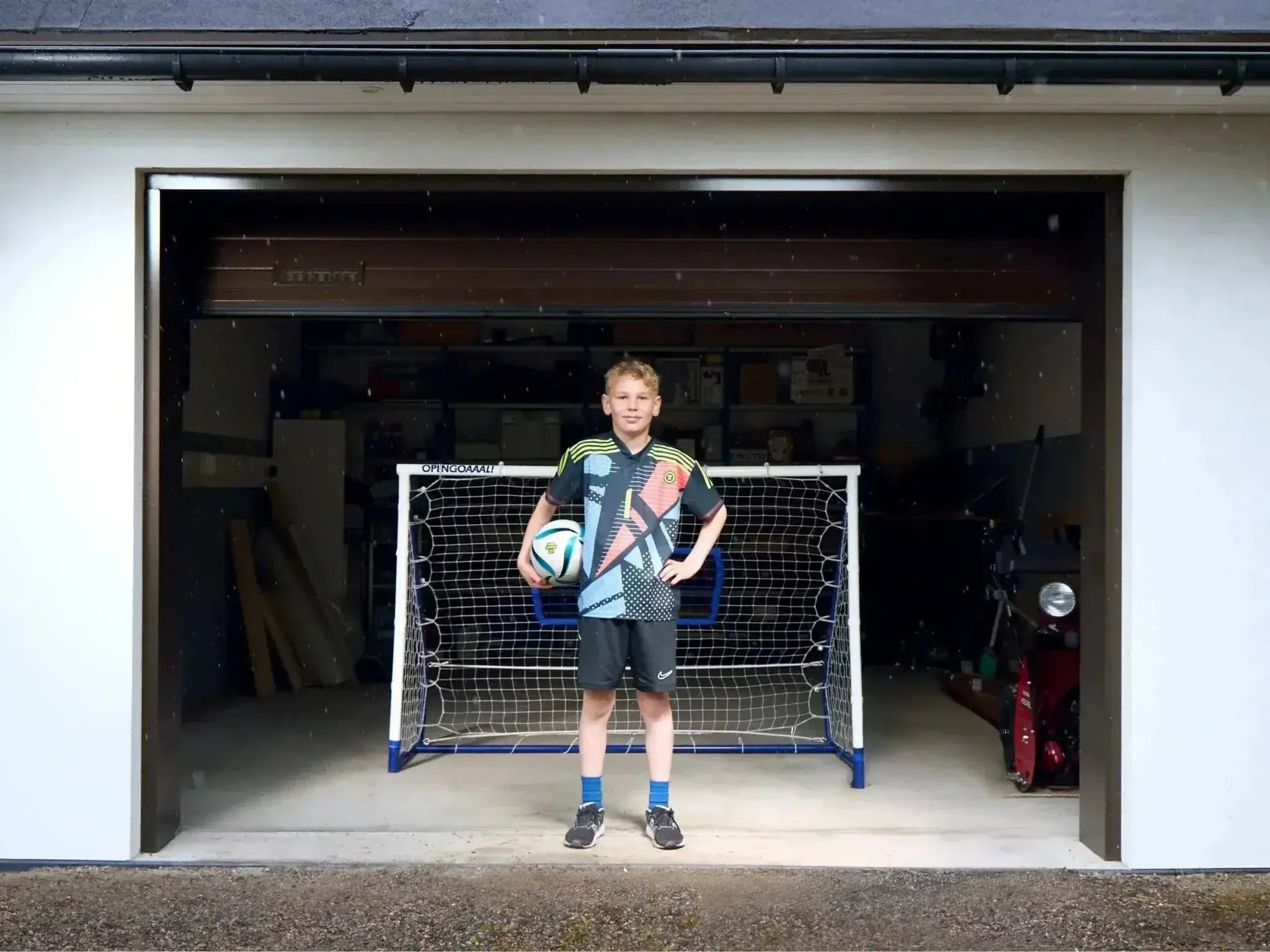
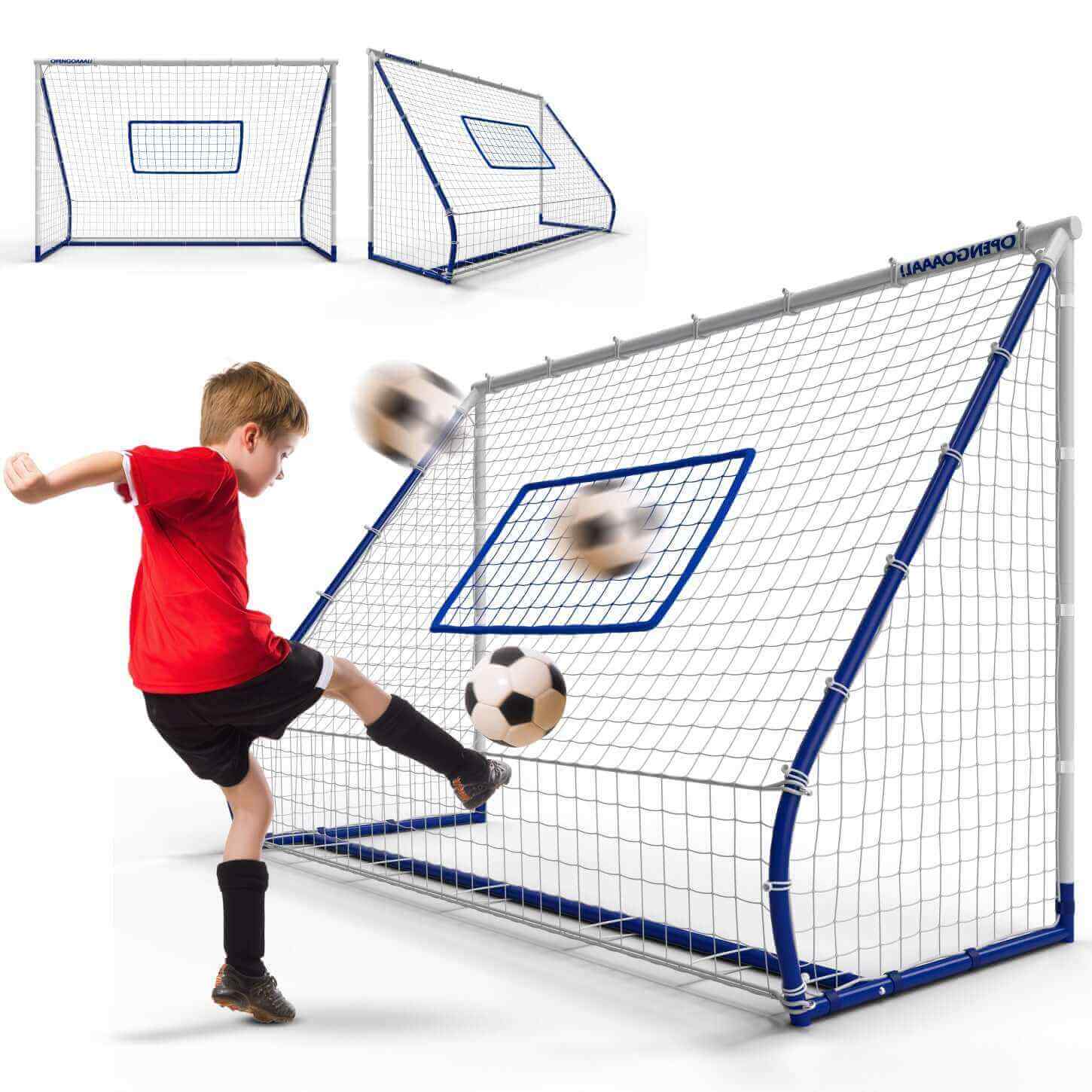
Four of the eight drills (1, 3, 5 and 6) need something that returns the ball, and three more (4, 7 and 8) are easier to run with one. With a clean wall you can cover the first group. A rebound net gives you more room to miss, and a backstop keeps stray finishes in the yard. That is the job of the Open Goaaal® 3-in-1 Soccer Goal Trainer: a goal, a rebounder and a backstop in one frame, so shots that hit the net come back to you and you spend less of the session fetching the ball.
For ages 8 to 12 our product FAQ lists the Large or the Standard, and recommends the largest size your yard can hold. Each product page lists the grass space that size needs, so measure before you pick. Here is how the two goal mouths compare with the match goals your child may play on.
| Goal | Goal mouth | Rebound net height |
|---|---|---|
| U.S. Soccer U10 match goal, maximum | 18.5 ft x 6.5 ft (12 ft x 6.5 ft recommended) | Not applicable |
| Open Goaaal Standard | 9 ft x 5 ft | 10 ft |
| Open Goaaal Large | 16 ft x 7 ft | 10 ft |
The match-goal figures come from the same U.S. Soccer 2017 document. A practice goal does not have to match a match goal, and a smaller mouth asks for more placement while a larger one forgives more misses. Pick by yard first.
Two practical points before you order anything. Both sizes install on real grass with soil, not on turf, concrete or gravel. And our product page says most customers finish the first build in one to two hours with two people, so plan for two adults and a free afternoon. The setup page has the instruction manuals, and every goal comes with a one-year warranty.
Questions parents ask about backyard soccer for 10 year olds
What size soccer ball does a 10 year old use?
A size 4. U.S. Soccer's small-sided standards put the U9 through U12 age groups on a size 4 ball, so that is the ball to practice with.
Can a 10 year old practice soccer alone?
Yes. Drills 1 to 4 are built for one player, and drill 6 works solo with a cone standing in for the defender. For drills 5, 7 and 8 you need a second person.
Should a 10 year old practice heading?
None of these drills use it. U.S. Soccer's 7v7 standards do not allow deliberate heading in games for this age group, and the 9v9 standards extend the ban through U11, so there is no reason to add it to backyard practice. Ask your child's club about its own rule if they play at U12.
What if there is no wall or rebounder?
Drills 2, 4, 7 and 8 need no returning surface. For drills 1, 3, 5 and 6, a parent can pass the ball back from the same distance, or you can use a flat wall at a neighbor's house or a school with permission.
How much space do these drills need?
The table near the top lists the area for each drill, and the largest is 30 feet by 20 feet. Measure before you set up and keep the area clear of windows and the street.
How often should a 10 year old do these?
Three 30-minute sessions a week is the most we would plan, and fewer is fine. Count team practices first, and keep at least a couple of rest days, in line with the U.S. Soccer and AAP guidance above.
This article is general information, not medical advice, diagnosis or treatment. For a persistent or worsening symptom, or any concern about your health, speak to a qualified healthcare professional.
Pick two drills for tomorrow and run them for 10 minutes each. If you want the ball to come back while you do it, the full range of Open Goaaal soccer goals is one click away.
More from the Coach's Corner
Written by The Open Goaaal Editorial Team. Last updated 10.13.2026. Next review due 04.13.2027.